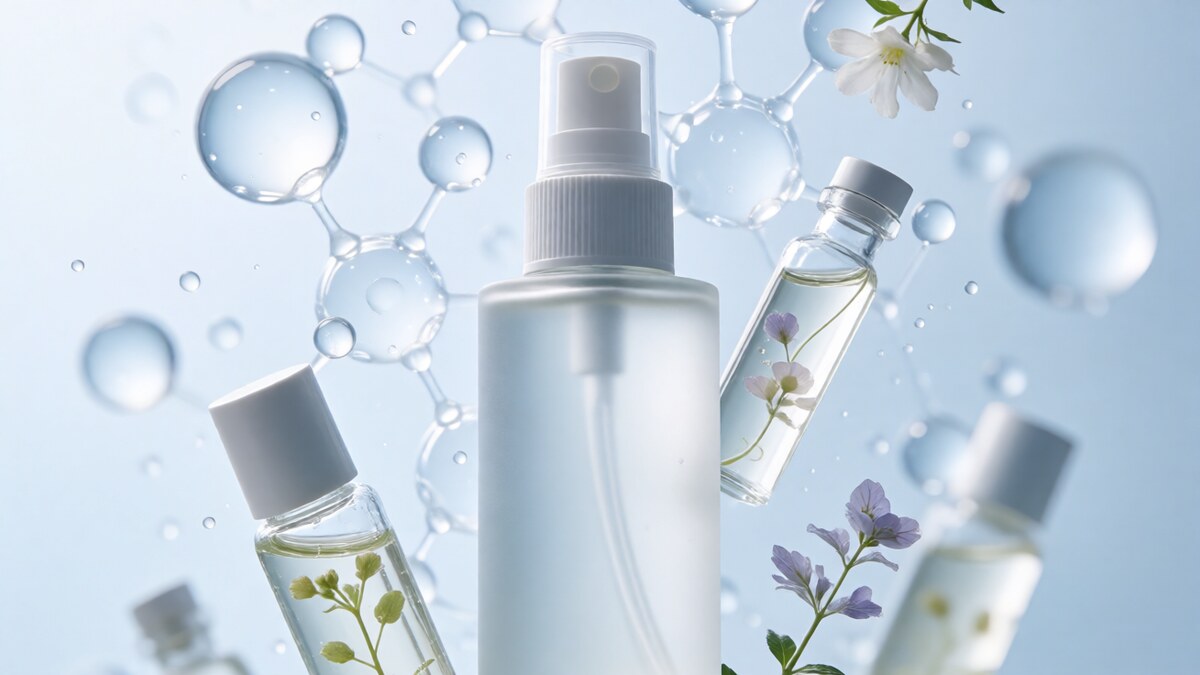
A face mist is the most underestimated brightening format in the skincare aisle. It is water-thin, absorbs in seconds, and can be reapplied over makeup — yet most formulators treat it as a hydrating afterthought rather than a genuine active-delivery system. This guide walks through a complete, bench-ready protocol for a brightening face mist, from phase design to pH control to clinical justification.
Why a Mist Is a Legitimate Brightening Format
The core challenge with any brightening active is getting it to the target layer in a stable, bioavailable form. A mist delivers a low-viscosity, high-water-content film directly onto the stratum corneum. Because there is almost no oil phase, penetration enhancers and humectants do the heavy lifting. The trade-off is real: water activity is high, so preservation and pH stability become critical. Get those right and a mist becomes an elegant, high-frequency delivery vehicle — particularly for humid Southeast Asian climates where heavy creams are often rejected by consumers.
Target Product Profile
- Format: translucent aqueous mist, spray atomiser
- pH: 5.0–5.8 (optimal for niacinamide stability and skin compatibility)
- Viscosity: < 10 cP (must pass a fine-mist nozzle without clogging)
- Key actives: niacinamide 3%, tranexamic acid 2%, panthenol 2%
- Preservation: phenoxyethanol + ethylhexylglycerin (broad spectrum)
Phase-by-Phase Formula (100 g)
Phase A — Water Phase
- Aqua — to 100%
- Glycerin — 4.0%
- Sodium PCA — 1.5%
- Disodium EDTA — 0.05%
- Niacinamide — 3.0%
- Tranexamic acid — 2.0%
Phase B — Humectant / Skin-Conditioning
- Panthenol (D-panthenol) — 2.0%
- Betaine — 1.0%
- Sodium hyaluronate (low MW) — 0.2%
Phase C — Soothing Botanicals
- Centella asiatica extract (madecassoside-standardised) — 1.0%
- Allantoin — 0.2%
Phase D — Preservation & Finish
- Phenoxyethanol (and) Ethylhexylglycerin — 1.0%
- Pentylene glycol — 2.0%
- pH adjuster (citric acid 10% soln) — q.s.
Step-by-Step Process
- Sanitise and hydrate. Clean the vessel, then charge the full water quantity at 25–30 °C. There is no oil phase, so no high-shear emulsification is required.
- Dissolve chelator and humectants. Add disodium EDTA, glycerin, sodium PCA and betaine under gentle propeller agitation (300–400 rpm) until fully clear.
- Dissolve the actives. Add niacinamide and tranexamic acid one at a time, ensuring complete dissolution before the next addition. Tranexamic acid is the slower-dissolving component — allow 10–15 minutes. Do not heat above 40 °C; excess heat accelerates niacinamide hydrolysis to nicotinic acid.
- Add the hyaluronate. Sprinkle low-MW sodium hyaluronate slowly onto the vortex to avoid fisheyes, then agitate 20–30 minutes until fully hydrated.
- Add botanicals and soothing agents. Charge Centella extract, panthenol and allantoin. Keep the batch below 35 °C to preserve madecassoside integrity.
- Adjust pH. Measure and titrate to 5.2–5.6 with citric acid solution. Verify with a calibrated electrode, not pH strips — precision matters here.
- Preserve. Add the phenoxyethanol/ethylhexylglycerin blend and pentylene glycol. Mix 15 minutes.
- QC and fill. Confirm clarity, pH, and viscosity. Filter through 1 µm and fill into an opaque atomiser.
Clinical Evidence for the Core Actives
Niacinamide. A landmark randomised, double-blind study (Hakozaki et al., British Journal of Dermatology, 2002) demonstrated that 5% niacinamide significantly reduced melanin transfer from melanocytes to keratinocytes, with visible skin-lightening effects versus vehicle. A more recent 2018 review in the Journal of Cosmetic and Laser Therapy confirmed that niacinamide inhibits melanosome transfer via a PAR-2-dependent mechanism and simultaneously strengthens the barrier by upregulating ceramide synthesis — an unusual dual benefit for a single active.
Tranexamic acid. Tranexamic acid works by interfering with plasminogen activation in keratinocytes, which in turn reduces tyrosinase activity and melanocyte stimulation. A 12-week split-face trial (Kanechorn Na Ayuthaya et al., Journal of the Medical Association of Thailand, 2012) reported significant reduction in melasma severity with topical tranexamic acid versus placebo. A 2021 meta-analysis in the Journal of Dermatological Treatment pooled multiple RCTs and concluded that topical tranexamic acid is effective and well tolerated for melasma, especially in combination with other brightening agents.
The combination argument. Niacinamide and tranexamic acid act on complementary pathways — melanosome transfer and plasminogen-mediated melanocyte stimulation respectively. Combining them in a single aqueous vehicle is chemically straightforward: both are water-soluble, both are stable at pH 5.0–5.8, and neither requires encapsulation. This makes the mist format a genuinely sensible pairing platform.
Stability and Quality Control
- Niacinamide: keep pH ≤ 6.0 and store below 40 °C to prevent hydrolysis to nicotinic acid, which causes transient flushing.
- Tranexamic acid: chemically robust in aqueous systems; no light sensitivity. Watch for crystallisation if the batch is chilled below 10 °C.
- Preservation efficacy: challenge-test the finished formula (ISO 11930) — a high-water, low-solids mist is a favourable environment for microbial growth.
- Accelerated stability: 12 weeks at 40 °C / 75% RH plus freeze-thaw cycles; monitor pH drift, colour and clarity.
- Packaging: opaque or frosted atomiser with a fine-spray nozzle; validate that the nozzle does not clog over 200 actuations.
Positioning and Use
Instruct the end user to mist 15–20 cm from the face, morning and evening, and pat — not rub — to distribute the film. Because there is no photosensitising active, the mist layers safely under sunscreen and can be reapplied during the day. For humid markets, position it as a lightweight, layerable brightening step that replaces a heavier essence without sacrificing active concentration.
References
- Hakozaki T, et al. “The effect of niacinamide on reducing cutaneous pigmentation and suppression of melanosome transfer.” British Journal of Dermatology. 2002;147(1):20–31.
- Kanechorn Na Ayuthaya P, et al. “Topical tranexamic acid vs. hydroquinone in the treatment of melasma.” Journal of the Medical Association of Thailand. 2012;95(3):391–395.
- Draelos ZD, et al. “Niacinamide: a B vitamin that improves aging facial skin appearance.” Dermatologic Surgery. 2005;31(s2):860–865.
- Bala HR, et al. “Topical tranexamic acid in the treatment of melasma: a systematic review and meta-analysis.” Journal of Dermatological Treatment. 2021;32(6):1–10.
- Wohlrab J, Kreft D. “Niacinamide — mechanisms of action and its topical use in dermatology.” Skin Pharmacology and Physiology. 2014;27(6):311–315.
Interested in Formulation Data Collaboration?
Let's discuss how Melasyl AI can accelerate your next whitening or brightening formula. Technical collaboration, data licensing, or custom AI-driven research — reach out.
Contact Wei →