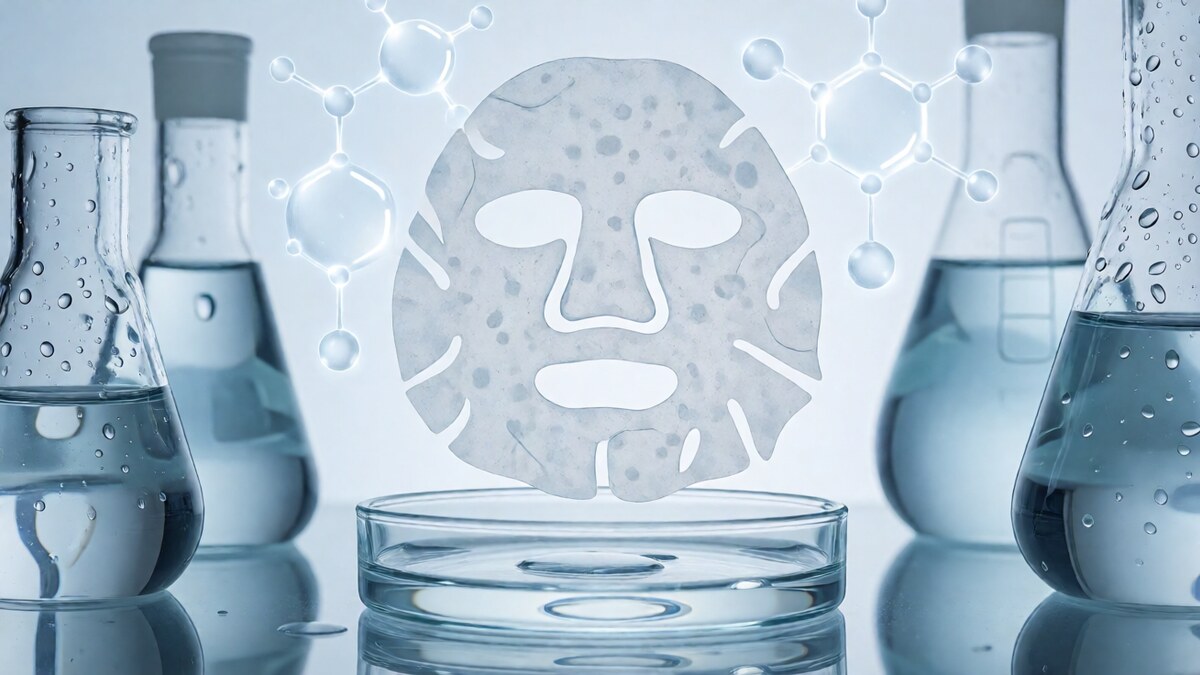
A brightening sheet mask looks deceptively simple: a fabric substrate soaked in a clear essence. In practice it is one of the hardest brightening formats to stabilise, because every active must survive in a low-viscosity, water-dominant environment while sitting against the skin under occlusion for 15–20 minutes. This guide walks through a reproducible, evidence-anchored process for building a brightening sheet mask that performs — from the active system to the substrate and the preservation strategy.
Why Sheet Masks Are a Formulation Challenge
The defining feature of a sheet mask is occlusion. When a saturated substrate is applied to the face, it limits transepidermal water loss and creates a hydrated, slightly warmed micro-environment. Zhai and Maibach’s overview of occlusive effects showed that occlusion can raise stratum corneum water content substantially and increase the percutaneous absorption of dissolved actives by hydrating the barrier and increasing its permeability (Zhai & Maibach, 2001). That is a delivery advantage — but it also means the essence must be formulated for penetration and compatibility, not just aesthetics.
Three constraints follow:
- Water activity is high. Hydrolysis-prone actives degrade faster in a thin, unpreserved, low-viscosity aqueous phase.
- Viscosity is deliberately low. Thickeners must be shear-thinning and non-tacky, or the mask will not wet out evenly and will drip.
- Residence time is short. A 15–20 minute exposure rewards fast, well-penetrating actives over slow prodrugs that need hours to convert.
Step 1 — Build the Brightening Active System
Choose two to three actives that hit distinct steps of melanogenesis rather than stacking three tyrosinase inhibitors. A defensible multi-pathway trio for a sheet mask essence:
| Active | Use level | Pathway | Key evidence |
|---|---|---|---|
| Niacinamide | 2–5% | Suppresses melanosome transfer from melanocytes to keratinocytes | Hakozaki et al., Br J Dermatol 2002; Castanedo-Cázares et al., 2013 (4% niacinamide RCT) |
| Tranexamic acid | 2–3% | Interferes with plasmin–keratinocyte signalling and tyrosinase activity | Ebrahimi & Naeini, 2014; Kim et al., Clin Exp Dermatol 2016 |
| α-Arbutin | 1–2% | Competitive tyrosinase inhibition, low cytotoxicity | Sugimoto et al., Biol Pharm Bull 2004 |
Because the mask sits under occlusion, keep total active load moderate. High niacinamide plus high arbutin in a low-pH essence can sting on compromised barriers; 4% niacinamide with 2% tranexamic acid is a well-tolerated, clinically supported combination.
Step 2 — Design the Essence Base
The base does three jobs: wet the substrate evenly, hold water against the skin, and stay clear and stable. A simple, robust architecture:
- Humectant system (8–15%). Glycerin 5%, butylene glycol 4%, and a small amount of betaine or sodium PCA. Glycerin improves hydration but is sticky above ~8% in a leave-on mask.
- Thin rheology modifier (0.1–0.4%). Xanthan gum or a low-dose carbomer neutralised to pH 5.5 gives shear-thinning flow so the sheet wets out and clings.
- Solubiliser. Polysorbate 20 (0.3–0.8%) or a glycol-based solubiliser to keep any lipophilic botanical extract clear.
- Soothing/barrier support. Centella asiatica extract or madecassoside (0.1–0.5%), panthenol 0.5–1%. Centella’s triterpenoid fraction supports barrier repair and reduces the inflammatory signalling that drives post-inflammatory hyperpigmentation (Bylka et al., Phytother Res 2014).
- Chelator. Disodium EDTA 0.05% to protect actives from trace metal–catalysed oxidation.
Step 3 — Sample Formula (100 g)
| Phase | Ingredient | % w/w |
|---|---|---|
| A | Purified water | to 100 |
| A | Disodium EDTA | 0.05 |
| A | Glycerin | 5.00 |
| A | Butylene glycol | 4.00 |
| A | Xanthan gum | 0.20 |
| B | Niacinamide | 4.00 |
| B | Tranexamic acid | 2.00 |
| B | α-Arbutin | 1.50 |
| C | Panthenol | 0.80 |
| C | Centella asiatica extract | 0.50 |
| C | Polysorbate 20 | 0.50 |
| D | Phenoxyethanol / ethylhexylglycerin | 1.00 |
| E | pH adjuster (citric acid / NaOH) | q.s. to pH 5.2–5.8 |
Step 4 — Process
- Disperse xanthan gum into the glycerin/butylene glycol premix, then add to Phase A water with moderate agitation until fully hydrated and clear.
- Dissolve Phase B actives one at a time into the A phase at 30–35 °C. Do not heat above 40 °C — niacinamide is thermally robust, but heat accelerates hydrolysis of the arbutin glycoside over shelf life.
- Add Phase C in order, using the polysorbate to pre-solubilise the Centella extract.
- Adjust pH to 5.2–5.8 with the Phase E adjuster. Niacinamide is stable and non-flushing at this range; arbutin is most stable near pH 5–6.
- Add Phase D preservative, cool to 25 °C, and filter the essence through 5 µm before saturating the substrate.
Step 5 — Substrate Selection
The sheet material changes the release profile. Hydrogel substrates hold more essence and release it more slowly, which suits occlusive delivery of niacinamide and tranexamic acid. Cupra, Tencel, or bio-cellulose sheets wick faster and feel lighter — better for oily, humid-climate consumers in Southeast Asia. Match substrate to essence viscosity: a thick essence on a thin fabric will pool and drip; a thin essence on bio-cellulose will run off.
Step 6 — Stability, pH and Preservation
Run accelerated stability (40 °C / 75% RH, 12 weeks) and check colour drift and pH shift monthly. Watch for:
- Browning — an early sign of arbutin or botanical oxidation. Keep the pack nitrogen-flushed or foil-laminated.
- pH creep — xanthan and some preservatives drift; re-check at week 4 and 12.
- Preservative efficacy — low-viscosity, single-use sachets still require a full challenge test (ISO 11930), because the sheet and pouch are a wet environment.
Step 7 — Claim Substantiation
Brightening claims on a sheet mask are defensible when anchored to the actives’ clinical record rather than to the format. Niacinamide’s melanosome-transfer data and the 4% niacinamide RCT support a “reduces the appearance of uneven tone” claim; tranexamic acid’s melasma trials support “helps fade the look of dark spots”. Pair the formula with an SPF recommendation, since no brightening regimen is credible without photoprotection.
Bottom Line
A brightening sheet mask succeeds when the essence is designed for occlusion: a moderate, multi-pathway active system, a clear low-viscosity base, a pH window that keeps niacinamide and arbutin stable, and a substrate matched to the climate it will be used in. Build it that way and the format’s inherent occlusion becomes an asset instead of a stability liability.
References
- Zhai H, Maibach HI. Effects of skin occlusion on percutaneous absorption: an overview. Skin Pharmacol Appl Skin Physiol. 2001;14(1):1–10.
- Hakozaki T, et al. The effect of niacinamide on reducing cutaneous pigmentation and suppression of melanosome transfer. Br J Dermatol. 2002;147(1):20–31.
- Castanedo-Cázares JP, et al. Topical niacinamide 4% and desonide 0.05% for treatment of axillary hyperpigmentation. Clin Cosmet Investig Dermatol. 2013;6:29–36.
- Ebrahimi B, Naeini FF. Topical tranexamic acid as a promising treatment for melasma. J Res Med Sci. 2014;19(8):753–757.
- Kim SJ, et al. Efficacy and possible mechanisms of topical tranexamic acid in melasma. Clin Exp Dermatol. 2016;41(5):480–485.
- Sugimoto K, et al. Inhibitory effects of α-arbutin on melanin synthesis in cultured human melanoma cells and a three-dimensional human skin model. Biol Pharm Bull. 2004;27(4):510–514.
- Bylka W, et al. Centella asiatica in dermatology: an overview. Phytother Res. 2014;28(8):1117–1124.
Interested in Formulation Data Collaboration?
Let's discuss how Melasyl AI can accelerate your next whitening or brightening formula. Technical collaboration, data licensing, or custom AI-driven research — reach out.
Contact Wei →