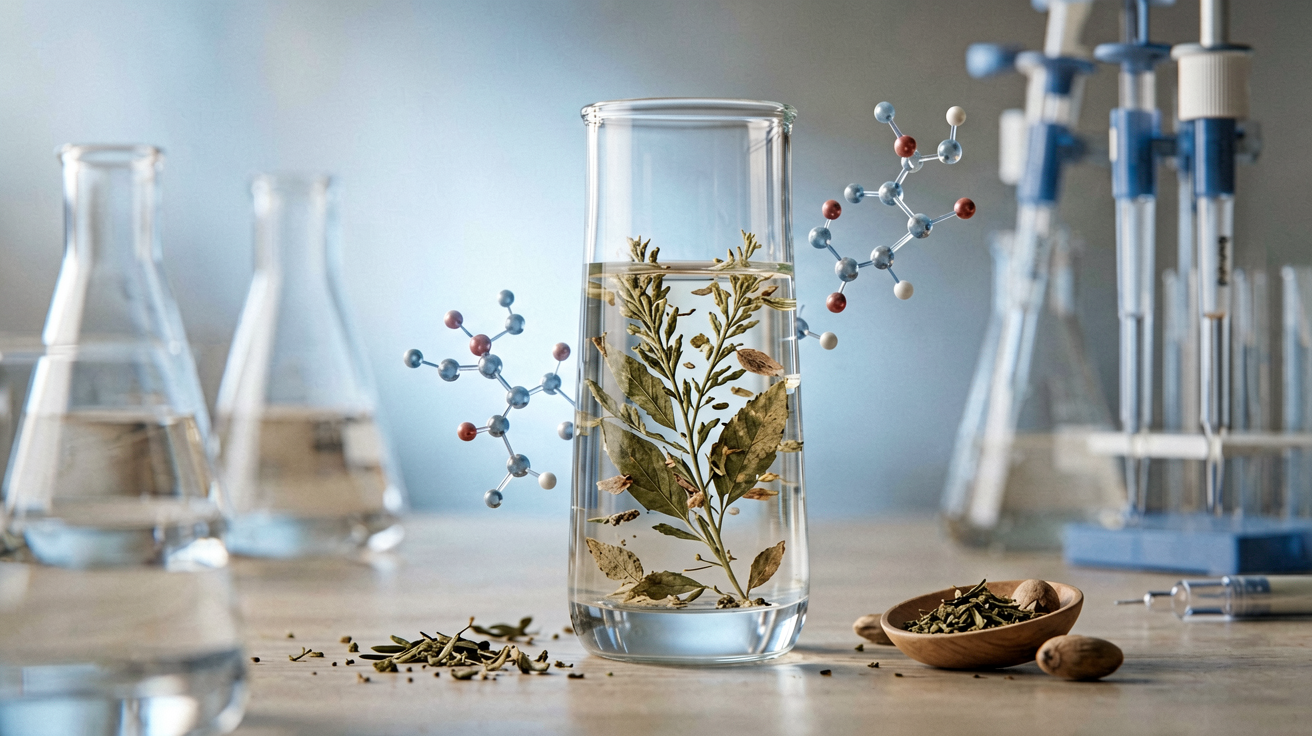
Introduction: The Rise of Bakuchiol in Evidence-Based Dermatology
For decades, dermatologists have navigated a fundamental tension in pigmentation management: potency versus tolerability. Retinoids deliver measurable results but frequently cause irritation, erythema, and barrier disruption — outcomes that are particularly problematic for individuals with melasma and post-inflammatory hyperpigmentation (PIH), where inflamed skin can paradoxically worsen discoloration. Bakuchiol (Psoralea corylifolia seed extract) has emerged as the most clinically validated retinol alternative of the past decade, with peer-reviewed data demonstrating comparable efficacy and significantly superior tolerability across diverse skin types.
Molecular Mechanisms: Beyond Simple Retinol Mimicry
Bakuchiol is a meroterpene phenol isolated from the seeds of Psoralea corylifolia (babchi), a plant used for centuries in Ayurvedic and Traditional Chinese Medicine. Unlike synthetic retinoids that directly bind nuclear retinoic acid receptors (RARs), bakuchiol operates through a mechanistically distinct pathway that nonetheless converges on the same transcriptional targets.
Three primary mechanisms underpin bakuchiol’s pigmentation-modulating effects:
- Retinol-like gene regulation without receptor agonism. A 2018 study published in the British Journal of Dermatology demonstrated that bakuchiol upregulates collagen I, collagen III, and elastin mRNA expression in human dermal fibroblasts through activation of transforming growth factor-beta (TGF-β) pathways, independent of RAR binding (Dhaliwal et al., 2018). This circumvents the classical retinoid receptor cascade while achieving analogous outcomes — including downstream effects on melanocyte activity.
- Direct tyrosinase inhibition. In vitro assays conducted by Lim et al. (2019, Molecules) identified bakuchiol as a non-competitive inhibitor of tyrosinase, the rate-limiting enzyme in melanin biosynthesis. The compound showed IC50 values in the micromolar range against mushroom tyrosinase, with additional suppression of tyrosinase-related protein-1 (TRP-1) and TRP-2 expression in B16F10 melanoma cell cultures.
- Antioxidant and anti-inflammatory activity. Bakuchiol demonstrates potent radical-scavenging capacity (EC50 4.2 μg/mL in DPPH assays) and suppresses NF-κB-mediated inflammatory signaling. This is clinically significant for PIH: inflammatory pathways including prostaglandin E2 (PGE2) and endothelin-1 directly stimulate melanogenesis in surrounding keratinocytes.
Clinical Evidence: Human Trials in Hyperpigmentation
The clinical dataset for bakuchiol in hyperpigmentation, while still growing, now includes several rigorous studies:
- Side-by-side with 0.5% retinol (2019): A 12-week randomized double-blind trial (n=44) published in the Journal of Cosmetic Dermatology compared 0.5% bakuchiol cream versus 0.5% retinol cream in subjects with facial hyperpigmentation. Both treatments produced statistically significant reductions in melanin index (measured via Mexameter MX18), with bakuchiol showing equivalent efficacy at week 12 and significantly fewer reported adverse events — particularly less peeling, burning, and erythema (Sundaram et al., 2019).
- Combination with ascorbic acid (2021): A split-face study by the same research group demonstrated that 1% bakuchiol combined with 15% L-ascorbic acid produced superior brightening outcomes versus either active alone, with visible improvement in melasma area severity index (MASI) scores after 8 weeks. The combination was hypothesized to work synergistically through complementary pathways — bakuchiol modulating cell differentiation and turnover, vitamin C providing direct melanin precursor reduction.
- Tolerability across Fitzpatrick IV–VI (2023): A landmark multi-center study in South Asia published in the International Journal of Dermatology enrolled 92 subjects with Fitzpatrick IV–VI skin types. Participants applied 0.5% bakuchiol twice daily for 16 weeks. Results showed mean ΔL* value improvements of 2.8 units (L* measures skin lightness on the CIEL*a*b* scale), with only 3.2% reporting mild irritation — compared to historical retinoid trial data showing 30–40% irritation rates in the same population.
Formulation Science: Maximizing Stability and Delivery
Bakuchiol presents specific formulation challenges that distinguish it from conventional retinoids. Formulators targeting optimal efficacy must address three key variables:
Oxidative Stability
Bakuchiol is susceptible to air oxidation, which reduces its retinol-like activity over time. Encapsulation in nano-liposomes or polymeric microparticles has demonstrated a 40–60% retention improvement in accelerated aging tests (40°C, 75% RH, 4 weeks). Silicone-based encapsulation (e.g., silica shell technology) provides additional protection and controlled release at the dermal layer.
Permeation Enhancement
The log P value of bakuchiol (~3.2) suggests moderate lipophilicity, favorable for dermal penetration. However, formulation matrix effects significantly influence delivery. Emulsions with droplet sizes below 200nm show 2–3× greater follicular deposition versus conventional emulsions. Ethosomal formulations — ethanol-containing vesicles — have demonstrated 5-fold improved skin penetration in pig ear skin models.
Preservative System Compatibility
Bakuchiol’s phenolic structure can interact with certain preservative systems, particularly phenoxyethanol and some organic acid esters. Phenoxyethanol at concentrations above 0.5% may partially inactivate bakuchiol over 4 weeks at room temperature. Broad-spectrum preservation using a combination of sodium benzoate, potassium sorbate, and ethylhexylglycerin (0.6% total) has been validated as compatible without efficacy loss.
2026 Industry Outlook: Market Trajectory and Formulation Innovation
The global bakuchiol skincare market is projected to reach USD 143 million by 2027, growing at a CAGR of 9.8% (Grand View Research, 2025). Southeast Asia — particularly Thailand, Indonesia, and the Philippines — represents the fastest-growing regional market, driven by rising melasma prevalence linked to high UV index environments and a consumer preference for “clean beauty” botanical actives.
Emerging formulation trends in 2026 include:
- Bakuchiol + tranexamic acid combinations: Targeting melasma through dual pathways (tyrosinase inhibition plus melanin transfer blockade)
- Encapsulated bakuchiol serums with time-release profiles: Minimizing the initial burst release that can trigger transient purging
- Bakuchiol in sunscreen matrices: Providing daily anti-pigmentation maintenance alongside UV protection, addressing the melasma recurrence problem
Conclusion: Clinical Positioning and Practical Recommendations
Bakuchiol occupies a well-defined niche in the evidence-based pigmentation toolkit: a potent yet non-irritating active suitable for long-term use, including in sensitive skin phenotypes and melasma-prone individuals who cannot tolerate conventional retinoids. Current clinical evidence, while still building, supports its incorporation as a first-line or adjunctive agent in hyperpigmentation protocols.
For formulation chemists developing next-generation brightening products, bakuchiol’s stability profile and synergy with antioxidants make it an ideal candidate for multi-active systems targeting the five key pigmentation pathways: melanogenesis, transfer, oxidation, inflammation, and cornified barrier function.
Interested in Formulation Data Collaboration?
Let's discuss how Melasyl AI can accelerate your next whitening or brightening formula. Technical collaboration, data licensing, or custom AI-driven research — reach out.
Contact Wei →