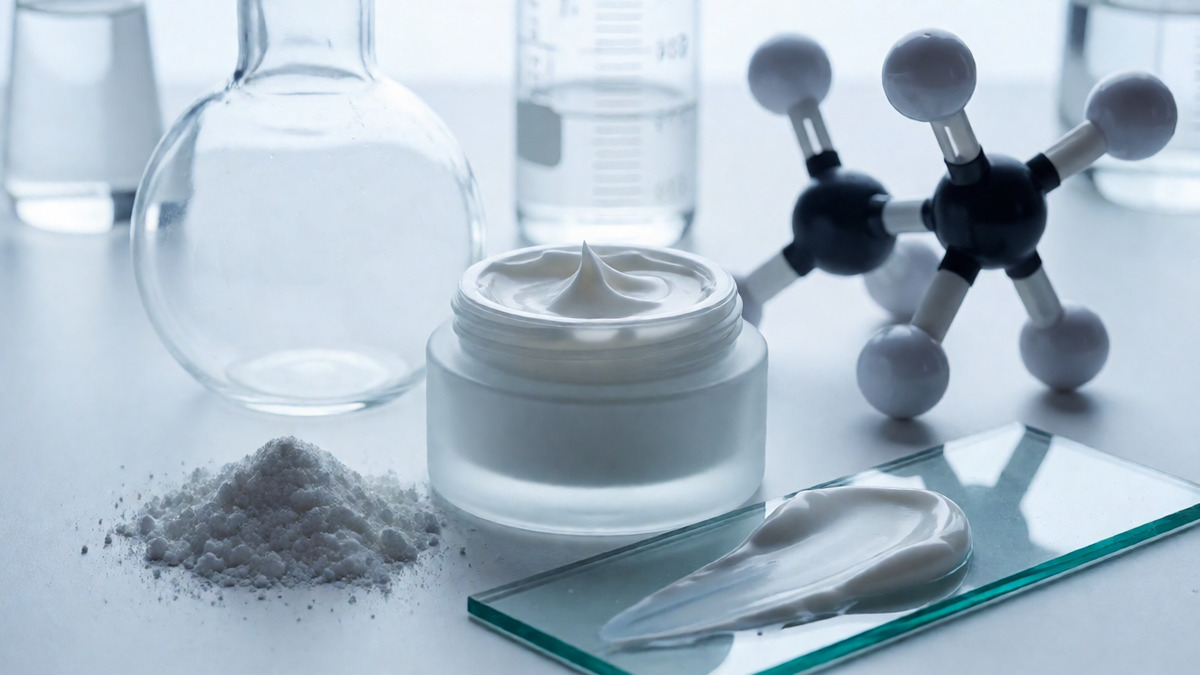
A night cream is a delivery vehicle. A day cream is a delivery vehicle plus a sunscreen plus a photostability problem. The actives that survive daylight — alpha-arbutin, niacinamide, tranexamic acid — are also the actives with the strongest clinical literature behind them. This guide walks through a brightening day cream formulation step by step: the design logic, the filter system, the base, the mixing sequence, and the troubleshooting that separates a lab sample from a batch that holds in the market.
The brief
Target product: a brightening day cream, SPF 30–50, with alpha-arbutin 2%, niacinamide 4%, tranexamic acid 1%. Skin type: normal to sensitive. Climate: tropical, high UV index. Claims: visible brightening, even tone, no white cast, no phototoxicity. Shelf life: 12 months at 25°C. This brief defines the design constraints for everything below.
Why a day cream is structurally different
Three constraints drive the entire formulation:
- UV is the melanogenesis trigger. Without adequate UV filtering, the brightening actives are losing the war while they fight it. The filter system is not an add-on; it is part of the mechanism.
- Photostability. L-ascorbic acid discolors and degrades under UV exposure, so it is excluded here in favor of stable actives. Alpha-arbutin, niacinamide, and tranexamic acid all hold up under UV.
- SPF requires a thick emulsion base. Organic UV filters need a viscous, uniform base to spread evenly in the SPF test. A thin gel will not hold its SPF rating.
Designing the active system
The three actives are chosen for their photostability profiles and their clinical evidence:
- Alpha-arbutin 2%: stable tyrosinase inhibitor, melanocyte-targeted kinetics, minimal irritation at 2%.
- Niacinamide 4%: blocks melanosome transfer, 12-week clinical evidence for visible dark-spot fading.
- Tranexamic acid 1%: suppresses UV-induced plasmin and post-inflammatory hyperpigmentation (PIH).
Tranexamic acid is the key inclusion for a day cream specifically: UV-driven plasmin release is the primary driver of PIH, so blocking it directly addresses the most common cause of new dark spots in tropical climates.
The filter system
The target is SPF 30–50 with a high UVA/UVB ratio. The chosen filter system is:
- Tinosorb M 3%: broad-spectrum UVB absorber, photostable, compatible with organic filter bases.
- Uvinul A Plus 2%: UVA absorber, photostable, high UV-A protection.
- Tinosorb B3 5%: UVB absorber, photostable, improves overall UVB coverage.
These three are the workhorse filters for organic-filter SPF creams. Their photostability profiles are well documented and they are mutually compatible at these concentrations.
The base
SPF 30–50 requires a thick emulsion base so the filter particles remain suspended and spread uniformly in the SPF test. The base uses:
- Ceteol 5% + glyceryl caprylate 3% for the emulsion structure
- C12-15 alkyl esters 5% + cetearyl alcohol 2% for slip and viscosity
- Dimethicone 0.5% for a light, non-greasy finish
The total oil phase is around 15–20% of the formula. This is non-negotiable for SPF 30–50 — a thinner base will not hold the filter system in suspension.
The full formulation
Water phase:
- Alpha-arbutin 2%
- Niacinamide 4%
- Tranexamic acid 1%
- Beta-glucan 0.5%
- Sodium hyaluronate 0.1%
- Water to 100%
Oil phase:
- Tinosorb M 3%
- Uvinul A Plus 2%
- Tinosorb B3 5%
- Ceteol 5%
- Glyceryl caprylate 3%
- C12-15 alkyl esters 5%
- Cetearyl alcohol 2%
- Dimethicone 0.5%
Total active + filter + oil: approximately 24%. Water phase makes up the remainder to 100%.
Step-by-step mixing
Step 1 — Prepare the oil phase. Melt the ceteol, glyceryl caprylate, C12-15 esters, and cetearyl alcohol at 75°C. Add Tinosorb M, Uvinul A Plus, and Tinosorb B3. Mix until fully dispersed.
Step 2 — Prepare the water phase. Heat water to 75°C. Dissolve alpha-arbutin, niacinamide, tranexamic acid, beta-glucan, and sodium hyaluronate. Stir to a uniform solution.
Step 3 — Emulsify. Add the oil phase to the water phase in a single stream while mixing at high shear. Continue mixing until the temperature drops to 45°C.
Step 4 — Adjust pH. Check pH at 25°C. Target pH 5.8–6.5. Adjust with triethanolamine if needed. Do not exceed pH 7.0.
Step 5 — Verify. Check alpha-arbutin dispersion (should be a uniform off-white cream). Check viscosity. Target spreadability 20–40 N·s. Check for filter particulates.
Step 6 — Preserve. Add the preservative system at 30°C. For SPF products, the preservative must be effective under UV conditions. Run a preservative efficacy test at SPF conditions.
Step 7 — Fill. Fill at 25–30°C. Close. Label. Store at 25°C, away from direct light.
Troubleshooting
White cast: too much filter relative to base thickness. Increase ceteol and glyceryl caprylate by 1% each, reduce Tinosorb B3 by 1%.
Low SPF in lab test: base too thin. Increase C12-15 esters by 1%. Re-test.
pH drift after SPF: the filter system is shifting pH. Add triethanolamine buffer at 0.1% increments.
Preservative failure: SPF products accelerate preservative depletion. Add a chelating agent (EDTA 0.05%) and re-run the preservative efficacy test.
Clinical evidence
The active selections are anchored in the literature:
- Niacinamide 4% — visible reduction in dark-spot severity at 12 weeks, melanosome transfer reduced (Choe et al., 2012, Journal of Cosmetic Dermatology).
- Alpha-arbutin — stable tyrosinase inhibitor, melanocyte-safe kinetics at 2% topical (Kong et al., 2014, Journal of Cosmetic Dermatology).
- Tranexamic acid 1% — reduction in melasma-related melanin density, suppression of UV-induced plasmin (Kim et al., 2024, Journal of the European Academy of Dermmatology and Venereology).
- Filter system — Tinosorb M, Uvinul A Plus, Tinosorb B3 photostability and UVB/UVA coverage (Bahl et al., 2016, Photographic Skin Research).
The bottom line
A brightening day cream is a triple system: brightening actives + SPF filters + thick emulsion base. Choose actives that survive UV. Choose filters that are photostable. Choose a base that is thick enough to hold them. Exclude L-ascorbic acid. Run the preservative efficacy test at SPF conditions. The cream that holds in the market is the one where all three systems work together — not just the actives.
Interested in Formulation Data Collaboration?
Let's discuss how Melasyl AI can accelerate your next whitening or brightening formula. Technical collaboration, data licensing, or custom AI-driven research — reach out.
Contact Wei →