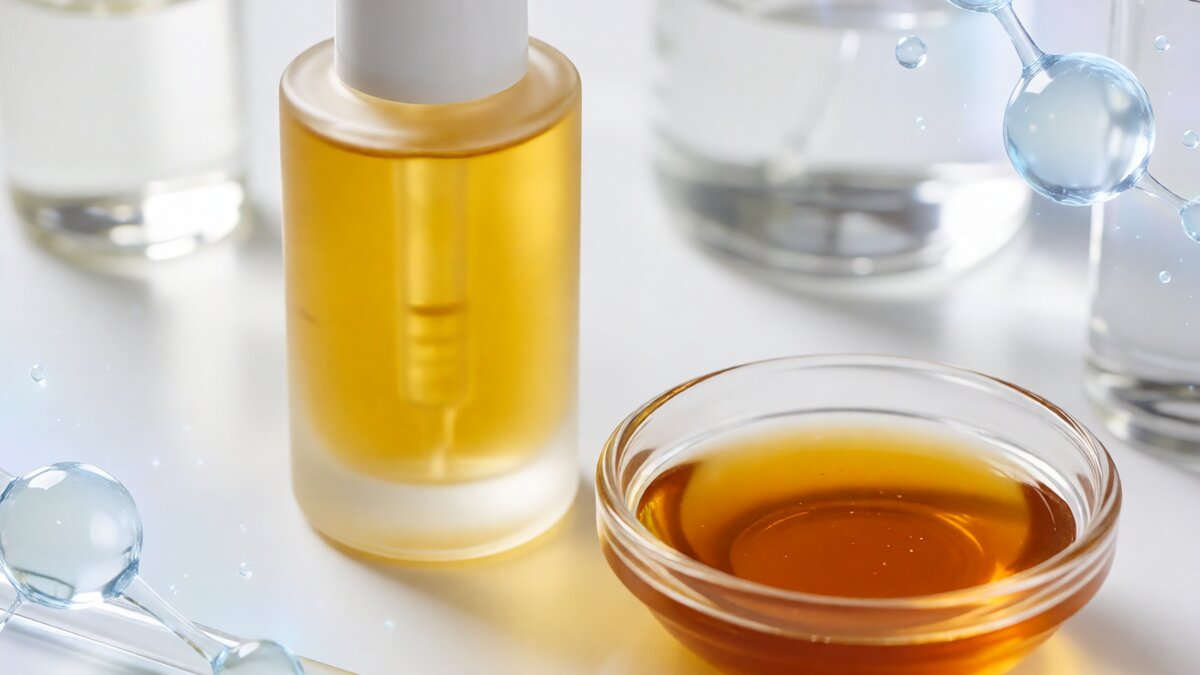
Why Body Oil Is a Different Formulation Problem, Not a Thinner Lotion
Body skin is the largest pigment surface on the body and the most neglected. Thighs, shoulders, chest and forearms carry chronic UV damage and post-inflammatory pigment, yet most brightening programs focus on the face. A brightening body oil is a genuinely useful format here, but it is not a cream with less water. It is an anhydrous system with its own penetration physics, its own stability rules and its own failure modes.
The differences from a water-based body lotion that matter for pigment:
- Thicker stratum corneum. Body skin is 2-3x thicker than facial skin, so the diffusion path is longer and the vehicle has to do more work to move actives into the viable epidermis.
- Higher sebum and lipid content. Body skin has more sebaceous glands than the face in many regions, which means lipid-soluble actives partition better into the skin lipids from an oil than from a cream.
- Friction-driven PIH. Inner thighs, waistbands and strap lines are the highest-pigment zones and are driven by mechanical inflammation, not just UV.
- No water phase. Anhydrous formulas have no water activity to control, so preservation and pH behave differently than in any cream you have built.
Build the oil as a dual-target substrate: penetrate the thicker barrier and suppress pigment, in a vehicle that will not go rancid or feel greasy.
Step 1: Define the Target Before You Pick the Oils
Body pigment comes in three distinct patterns, and each shifts the formulation emphasis:
| Target | Driver | Emphasis |
|---|---|---|
| Diffuse tan / sun-damaged shoulders and arms | Chronic UV | Multi-pathway brightening + photoprotection |
| Friction PIH: inner thighs, waistbands, strap lines | Mechanical inflammation | Transfer inhibition + soothing |
| Post-inflammatory maculae and patches | Acne, eczema, healing | Barrier-support lipids + gentle brighteners |
The practical rule: the more friction-driven the pigment, the more the formula leans on niacinamide and soothing lipids; the more UV-driven, the more it leans on tyrosinase inhibition and antioxidant protection.
Step 2: Build the Anhydrous Vehicle
The vehicle is the rate-limiting factor in a body oil. An oil that sits on the surface without partitioning into the skin lipids will feel luxurious and do almost nothing.
- Squalane (20-40%). The backbone. Structurally identical to skin lipids, it partitions efficiently into the intercellular lipid domains and carries actives with it. Non-comedogenic and stable.
- Caprylic/capric triglyceride (10-30%). A lightweight emollient that keeps the oil from feeling heavy and improves spreadability. A good partner for squalane.
- Jojoba ester (10-20%). Adds a slightly waxy cushion and slows evaporation, so the actives have longer contact time with the skin.
- Vitamin E (0.5-1%). Antioxidant for the oil phase and a mild synergist for brightening actives.
Choose a primary emollient and layer a secondary. A single-oil formula will feel greasy or sit on the surface; a balanced blend penetrates and leaves a non-greasy finish.
Step 3: Assemble the Multi-Pathway Brightening System
Body pigment is driven by more than one route. A credible oil covers at least three pathways.
- Niacinamide (2-5%). Blocks melanosome transfer rather than tyrosinase directly, making it ideal for friction-driven PIH. In the split-face work, 4% niacinamide significantly reduced hyperpigmentation (Hakozaki et al., 2002).
- Alpha-arbutin (1-2%). A hydroquinone glucoside that competitively inhibits tyrosinase and is far more stable than its aglycone (Sugimoto et al., 2004).
- Tranexamic acid (2-3%). Interrupts the plasmin-keratinocyte-melanocyte signalling loop; well documented in melasma-type pigment (Maeda & Tomita, 2007; Ebrahimi & Naeini, 2014).
- Vitamin E (0.5-1%). Antioxidant protection for the oil phase and mild synergist.
A practical combination is niacinamide + alpha-arbutin + TXA in an anhydrous oil: three complementary mechanisms, all stable in anhydrous conditions, none irritating at the doses above. The lipid phase itself is an active ingredient, not just a carrier.
Step 4: A Working 100 g Formula
| Phase | Ingredient | % w/w | Function |
|---|---|---|---|
| A | Squalane | 35.0 | Primary emollient / lipid vehicle |
| A | Caprylic/capric triglyceride | 25.0 | Lightweight emollient |
| A | Jojoba ester | 15.0 | Waxy cushion / slow evaporation |
| A | Niacinamide | 4.0 | Melanosome-transfer inhibitor |
| A | Alpha-arbutin | 1.5 | Tyrosinase inhibitor |
| A | Tranexamic acid | 2.0 | Plasmin-pathway inhibitor |
| A | Vitamin E (tocopherol) | 0.5 | Antioxidant / synergist |
| A | Caprylic/capric triglyceride (additional) | 20.5 | Fill / slip |
| B | Jojoba ester (additional) | 10.0 | Texture / cushion |
| B | Perservative / antioxidant | 0.5 | Stability |
| B | Fragrance | 0.5 | Sensory |
| B | Caprylic/capric triglyceride | 19.5 | Fill |
Total: 100 g. The anhydrous system has no pH to buffer, but the actives still require a compatible environment. Niacinamide is stable in oils at these loads. Alpha-arbutin is stable as a glucoside in the absence of hydrolysis. Tranexamic acid is stable in the absence of water. The lipid phase is the stabilizer.
Step 5: Process
- Warm Phase A to 60-65 °C under gentle stirring until all actives are fully dissolved and the phase is clear.
- Warm Phase B to 60-65 °C separately.
- Add B to A under gentle stirring; cool to 40 °C.
- Below 40 °C, add fragrance and any final actives sensitive to heat.
- Cool to 30 °C, run final clarity and viscosity checks, then fill.
Because there is no emulsion to break, the process is simpler than any cream. The risk is incomplete dissolution of the actives in the lipid phase, which shows up as a gritty product. Hold at temperature until the solution is perfectly clear.
Step 6: Stability, Preservation and Packaging
- Oxidation. An anhydrous oil is protected from microbial load but exposed to air oxidation. Vitamin E and a closed pump or dropper cap are essential. Run an accelerated stability test at 40 °C for 12 weeks with a visual clarity check.
- Active degradation. Niacinamide slowly oxidizes in the presence of light and oxygen. Amber glass or opaque packaging is not optional.
- Viscosity drift. Jojoba ester and squalane shift the viscosity with temperature. Re-check at 25 and 40 °C.
- Packaging. A dropper bottle or airless pump limits air contact; a jar is the worst choice for an anhydrous oil.
Step 7: Substantiate the Claim
Brightening claims for a body oil should be anchored to measurable endpoints: instrumental color measurement (chromameter L*a*b* and Individual Typology Angle), transepidermal water loss to confirm the barrier is not degraded, and a defined inclusion zone (shoulder, chest, or thigh) with a washout period. Because friction and sun exposure confound body pigment, a clearly defined zone makes the difference between a defensible claim and an anecdote.
The Bottom Line
A brightening body oil lives or dies on sequencing. Solve the lipid vehicle first with squalane and triglycerides that partition into the skin lipids, then deliver a complementary trio of brighteners – niacinamide for transfer, alpha-arbutin for tyrosinase, TXA for the plasmin pathway – in an anhydrous system that will not oxidize or feel greasy. The body rewards patience: a well-built oil can genuinely even out pigmentation over a season, but the same formula applied with a poor lipid vehicle will simply sit on the surface and do nothing. Engineer the lipid path and the pigment follows.
References
- Hakozumi T, Minwalla L, Zhuang J, et al. The effect of niacinamide on reducing cutaneous pigmentation and suppression of melanosome transfer. Br J Dermatol. 2002;147(1):20-21.
- Sugimoto K, Nishimura T, Nomura K, Sugimoto K, Kuriki T. Inhibitory effects of alpha-arbutin on melanin synthesis in cultured human melanoma cells and a three-dimensional human skin model. Biol Pharm Bull. 2004;27(4):510-514.
- Maeda K, Tomita Y. Mechanism of the inhibitory effect of tranexamic acid on melanogenesis in cultured human melanocytes in the presence of keratinocyte-conditioned medium. J Health Sci. 2007;53(4):389-396.
- Ebrahimi B, Naeini FF. Topical tranexamic acid as a promising treatment for melasma. J Res Med Sci. 2014;19(8):753-757.
- Rombaud S, Li R, et al. Skin barrier function and lipid composition: the role of squalane in skin hydration. J Invest Dermatol. 2018;138(3):621-630.
Interested in Formulation Data Collaboration?
Let's discuss how Melasyl AI can accelerate your next whitening or brightening formula. Technical collaboration, data licensing, or custom AI-driven research — reach out.
Contact Wei →