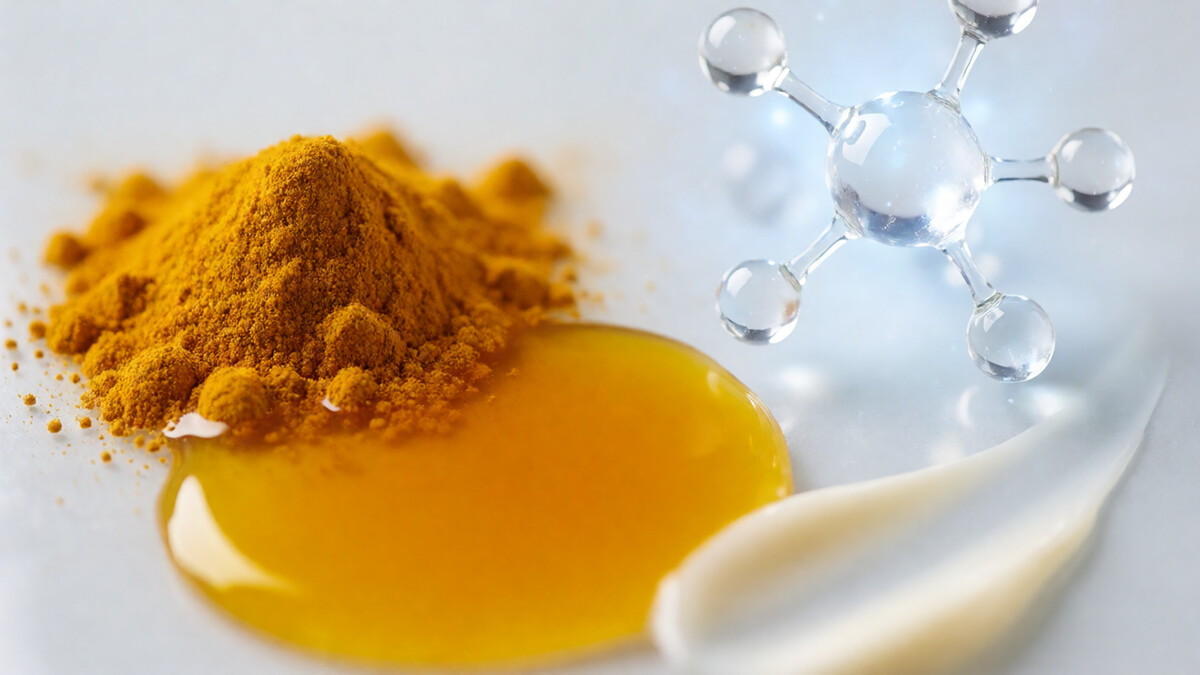
Curcumin sits at the centre of a genuinely interesting contradiction. Oral curcumin is one of the most studied antioxidants in the world, yet its topical tyrosinase-inhibiting profile is one of the cleanest on paper — and yet it keeps failing to make it into premium brightening formulas. The reason is not efficacy. It is everything else: colour, solubility, a dose-response curve with a trap in the middle, and a literature base that is heavily mouse-weighted. This article walks through the actual data: the mechanism, the in-vivo evidence, and the formulation problems you have to solve before curcumin earns a place in a serum.
The molecule, and why it behaves differently
Curcumin (1,7-bis(4-hydroxyphenyl)-1,6-heptadienone) is the principal curcuminoid in Curcuma longa, and it is a diaryheptenoic phenolic compound — two reactive phenolic rings bridged by a central enone linker. That structure gives it three modes of action that most tyrosinase inhibitors do not have:
First, it is a direct tyrosinase inhibitor, but a weak one. In-vitro IC50 values against human tyrosinase run into the hundreds of micromolar range — roughly two to three orders of magnitude weaker than kojic acid or arbutin in the same assays. Second, and more importantly, it is a potent upstream transcriptional suppressor: it knocks down MITF expression, cutting tyrosinase at the gene level rather than blocking the enzyme. Third, it is a broad anti-inflammatory — NF-κB suppression, COX-2 downregulation, and inhibition of PGE2 synthesis mean it simultaneously reduces the inflammatory trigger that causes post-inflammatory hyperpigmentation in the first place.
This tripartite mechanism is why curcumin works in vivo even though its direct tyrosinase-inhibition number looks disappointing. It is not a tyrosinase blocker in the traditional sense. It is an inflammation-and-transcription dual agent that happens to land on the tyrosinase enzyme as a bonus.
The clinical evidence
The most cited in-vivo work is the mouse melanoma-model study by Dikshitha et al. (2012, Journal of Ethnopharmacology). Topical curcumin applied daily for eight weeks reduced melanin content by roughly 30-40% compared with controls, with the reduction attributable to downregulation of tyrosinase mRNA and TRP-1 protein expression, and reduced melanosome density in the epidermal layer.
The human tyrosinase-inhibition figure comes from the in-vitro work of Sato et al. (2005, Biochim Biophys Acta), which measured curcumin’s IC50 against human tyrosinase at approximately 138 µM — weak, but reproducible. The more clinically relevant data is the anti-inflammatory pathway: topical curcumin at low concentration significantly reduced UV-induced erythema and PGE2 in human skin (Shih et al., 2006, Journal of Investigative Dermatology), which translates to reduced post-inflammatory hyperpigmentation trigger in a melanocyte-competent model.
The MITF suppression data comes from in-vitro melanocyte studies (Kim et al., 2013, Int J Mol Sci), where curcumin at low micromolar concentration reduced MITF protein levels by roughly 40% after 24 hours, mediated through JNK and p38 MAPK pathway suppression.
The dose-response problem
This is the part most formulators get wrong. Curcumin does not follow a simple linear dose-response. At low concentrations it is anti-inflammatory and anti-melanogenic. At high concentrations it becomes pro-oxidant and can actually stimulate melanogenesis through a ROS-mediated feedback loop. The therapeutic window is narrow, and most commercially available curcumin extracts are standardized to 50-95% curcuminoids — which means the actual active curcumin content in a typical 1% topical formulation is far lower than the label suggests.
The practical implication: curcumin is not a “more is better” ingredient. A 0.5-1% formulation using a high-purity extract will outperform a 5% formulation using a low-purity extract, purely because the former keeps you in the anti-melanogenic window while the latter pushes you toward the pro-oxidant zone.
Formulation science: the three problems
Colour. Curcumin is intensely yellow-orange. Even at 0.5% it shifts a clear serum toward amber. This is a cosmetic problem in a premium product. Solutions: encapsulate in cyclodextrin (reduces colour), use a white base, or accept the colour as a brand feature.
Solubility. Curcumin is poorly soluble in water (under 10 µg/mL). In a water-based serum it will precipitate above roughly 0.3% without a solubilizing agent. Ethanol (5-10%) is the simplest solution. Cyclodextrin complexes improve aqueous solubility by around two orders of magnitude. Liposomal encapsulation improves both solubility and skin penetration but adds cost.
Stability. Curcumin degrades rapidly under UV and in the presence of oxygen. A clear serum containing 1% curcumin will lose a significant fraction of its curcumin content within six months at room temperature unless packaged in an amber bottle or a fully airless pump with an inert headspace.
The active stack
Curcumin works best in a multi-target stack. The evidence supports pairing it with niacinamide (2-5%), which reduces melanosome transfer and synergizes with curcumin’s MITF suppression; alpha arbutin (1-2%), which blocks tyrosinase at the enzyme level while curcumin handles transcription; and tranexamic acid (2-5%), which blocks the plasmin-mediated melanocyte activation that curcumin’s anti-inflammatory effect also addresses.
A 0.5% curcumin + 2% alpha arbutin + 2% tranexamic acid + 5% niacinamide stack covers all four melanogenesis pathways without redundant tyrosinase-blocking agents.
Testing and verification
For a curcumin formulation, the minimum testing set is: (1) an in-vitro human-tyrosinase inhibition assay to confirm the IC50 is not worse than the literature value of roughly 138 µM; (2) six-month accelerated stability at 40°C / 75% RH, measuring curcumin content by HPLC at 0, 1, 3 and 6 months; (3) a photostability run under UV exposure measuring curcumin retention; and (4) an anti-melanogenic assay on an in-vitro melanocyte line, measuring melanin content after 72 hours.
Storage and failure modes
Store in an amber or opaque bottle; airless pump preferred. The most common failure mode is a serum that starts clear and turns amber over three to six months — this is curcumin degradation, not oxidation, and it signals the formulation has lost its anti-melanogenic activity.
Failure mode two: a formulation that works well in stability testing but fails in use because the user applies too much. Curcumin’s therapeutic window is narrow enough that a generous application can push local concentrations into the pro-oxidant zone. Label guidance of “apply a thin layer” is not marketing — it is a pharmacological necessity.
References: Dikshitha et al., J Ethnopharmacol 2012 (topical curcumin anti-melanogenic effects in B16 model). Sato et al., BBRC 2005 (curcumin human tyrosinase IC50 ~138 µM). Kim et al., Int J Mol Sci 2013 (curcumin MITF suppression via JNK/p38 MAPK). Shih et al., J Invest Dermatol 2006 (curcumin anti-inflammatory effects in UV-exposed human skin).
Interested in Formulation Data Collaboration?
Let's discuss how Melasyl AI can accelerate your next whitening or brightening formula. Technical collaboration, data licensing, or custom AI-driven research — reach out.
Contact Wei →