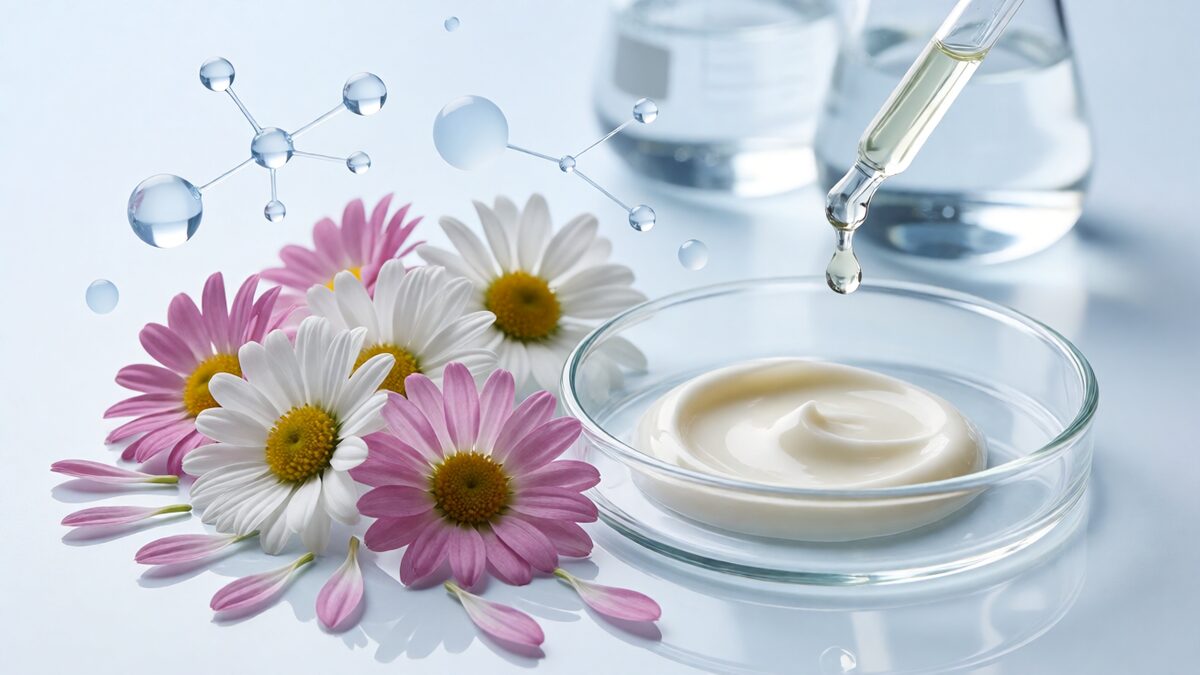
Daisy Flower Extract for Hyperpigmentation: Bellis perennis, the Endothelin-1 Pathway and 2026 Clinical Evidence
Hyperpigmentation remains one of the hardest targets in cosmetic dermatology. Melasma recurs, post-inflammatory hyperpigmentation (PIH) lingers for months, and solar lentigines resist all but the most aggressive actives. The reason is mechanistic: pigment is not a single switch but a relay of signals, and most brightening actives attack only one node of it — tyrosinase.
Daisy flower extract (Bellis perennis) is unusual because it intervenes at four separate points in the melanogenesis cascade. Even rarer among botanicals, it has been tested head-to-head against hydroquinone in a controlled clinical trial. This review examines the phytochemistry, the mechanistic evidence and the human data, then translates all of it into practical formulation guidance.
What Daisy Flower Extract Actually Is
Under INCI, the material is Bellis perennis (Daisy) Flower Extract, produced from the flower heads of the common (English) daisy, a member of the Asteraceae family. The standardized commercial fraction is widely known as Belides, whose active constituents are triterpene glycosides (saponins), polyphenols and polysaccharides.
The phytochemical profile is broad. A 2023 review in Molecules consolidated more than 310 individual components identified in B. perennis, including:
- Triterpenoid saponins — bellisosides A–F, perennisosides I–VII and bellissaponins, with polygalacic acid as the sapogenin.
- Flavonoids — apigenin, kaempferol, quercetin, isorhamnetin and their glycosides.
- Phenolic acids — caffeic, chlorogenic, ferulic and salicylic acids.
- Polyacetylenes — deca-4,6-diynoic acid and related C10 acetylenes.
This matters for expectation-setting: the depigmenting activity is attributed to the polyphenol/saponin fraction as a whole, not to a single purified molecule. Standardization therefore has to be by polyphenol content, and batch-to-batch consistency is a genuine formulation concern (Albien & Stark, 2023).
Mechanism: A Four-Stage Blockade of Melanogenesis
Daisy extract is often described as working “360 degrees” because it acts before, during and after pigment synthesis:
- 1. Signal suppression (pre-melanogenesis). UV-stressed keratinocytes release endothelin-1 (ET-1), the paracrine signal that drives melanocyte proliferation, dendrite formation and tyrosinase synthesis. Daisy extract reduces ET-1 release, cutting the pigment command at its source.
- 2. Receptor level. It reduces the binding capacity of α-MSH to melanocortin-1 receptors, lowering eumelanin production.
- 3. Enzymatic and transcriptional. It downregulates tyrosinase transcription (fewer enzyme molecules made) and also inhibits tyrosinase activity directly in a dose-dependent manner.
- 4. Melanosome transfer (post-melanogenesis). It interferes with the transfer of melanosomes from melanocytes into keratinocytes — the final step that determines how much pigment is actually visible at the surface.
On top of this, the aqueous extract is a competent antioxidant, scavenging DPPH radicals at 85.8% at 102.5 µg/mL (Kavalcıoğlu et al., summarised in Albien & Stark, 2023), which blunts the oxidative stress that upregulates MITF in the first place.
The Clinical Evidence
Head-to-head against hydroquinone (Costa et al., 2010)
The landmark study is a mono-blind, phase IV clinical trial published in Anais Brasileiros de Dermatologia. Fifty-six women aged 18–60, phototypes I–IV, with epidermal or mixed melasma, underwent a 60-day exclusive SPF35 run-in before randomisation:
- Group A: a cream combining Belides, Emblica and Licorice 7%, applied twice daily.
- Group B: hydroquinone 2% cream, applied nightly.
| Outcome (60 days) | Botanical complex (A) | Hydroquinone 2% (B) |
|---|---|---|
| Depigmentation, medical evaluation | 78.3% | 88.9% |
| Depigmentation, self-evaluation | 91.3% | 92.6% |
| Mild adverse events | 2 of 23 | 7 of 27 |
There was no statistically significant difference between the two groups in melasma improvement, while Group A recorded markedly fewer cutaneous adverse events. Visia imaging confirmed significant reductions in spot number (p = 0.001). A companion analysis of the same cohort using the MELASQoL scale found improvement across every quality-of-life domain, matching hydroquinone.
The honest caveat: this was a three-ingredient combination, so the effect cannot be attributed to B. perennis alone, and the design was mono-blind rather than double-blind. The tolerability advantage, however, is the signal formulators should read carefully.
Photoprotection and anti-inflammatory data (2021)
A 2021 study in the Journal of Photochemistry and Photobiology B tested daisy extract (BPE) on HaCaT human keratinocytes exposed to UVA. At 1%, BPE significantly recovered cell viability after UVA insult (p < 0.05) and reduced cleaved caspase-3, reactive oxygen species and IL-6, while increasing catalase activity (p < 0.01) — benchmarking favourably against Polypodium leucotomos extract. The implication: daisy does not merely suppress pigment, it buffers the UV-driven stress that triggers it in the first place. This evidence is in vitro only.
The arbutin comparison
A small pilot study in human volunteers reported Belides to be roughly twice as active as arbutin at equivalent polyphenol concentrations (SOFW Journal, 2005). The finding is frequently cited but preliminary — treat it as directional, not definitive.
Formulation Science
- Use level: 1–5%. Clinical brightening data cluster at 2% and above; below 0.5% the extract is essentially decorative.
- pH: 4–7. Water-soluble and stable in aqueous systems, without the oxidation headaches of L-ascorbic acid.
- Processing: heat-sensitive — add in the cooling phase below roughly 40°C to preserve polyphenols and saponins.
- Vehicle fit: serums, toners, gel creams and lightweight emulsions.
- Synergies: niacinamide (adds a second melanosome-transfer blockade), ascorbic acid, tranexamic acid (PIH), alpha-arbutin, licorice, emblica and — mandatorily — broad-spectrum SPF.
- Avoid: high ethanol loads, strongly alkaline systems (pH > 8) and prolonged exposure above 50°C.
- Safety: low irritancy and comedogenicity 0. The only real precaution is Asteraceae allergy (ragweed, chamomile, marigold) — recommend a patch test.
Where Daisy Fits in a 2026 Brightening Stack
Daisy extract is best positioned not as a hydroquinone replacement but as the signal-blocking layer of a multi-pathway regimen. Pair it with a tyrosinase inhibitor (alpha-arbutin, thiamidol, tranexamic acid) and a melanosome-transfer inhibitor (niacinamide), and it addresses the two nodes those actives miss. Its gentleness also makes it a logical maintenance active between hydroquinone cycles, with no ochronosis or rebound risk — particularly relevant for the sensitive-skin and melanin-rich consumers driving brightening demand across Southeast Asia.
FAQ
How quickly does it work? Visible radiance within about 14 days; significant spot reduction typically at 28–56 days, consistent with one skin-turnover cycle.
Can it be used during the day? Yes. It is photostable and does not photosensitise. It should still be paired with broad-spectrum sunscreen.
Is it better than hydroquinone? Not more potent, but in combination it performed comparably with fewer adverse events, and it carries none of the rebound or ochronosis risk.
Does it work as a single active? The strongest human evidence is for the botanical combination, not the isolated extract — a real limitation worth stating plainly.
References
- Costa A, Moisés TA, Cordero T, Alves CRT, Marmirori J. Association of emblica, licorice and belides as an alternative to hydroquinone in the clinical treatment of melasma. An Bras Dermatol. 2010;85(5):613–620. doi:10.1590/S0365-05962010000500003.
- Souza de Carvalho VM, Covre JL, Correia-Silva RD, et al. Bellis perennis extract mitigates UVA-induced keratinocyte damage: Photoprotective and immunomodulatory effects. J Photochem Photobiol B. 2021;221:112247. doi:10.1016/j.jphotobiol.2021.112247.
- Albien AL, Stark TD. (Bio)active Compounds in Daisy Flower (Bellis perennis). Molecules. 2023;28(23):7716. doi:10.3390/molecules28237716.
- Costa A, Pereira MO, Moisés TA, et al. Evaluation of quality of life improvement in melasma patients (MELASQoL) following a botanical combination based on Bellis perennis, Glycyrrhiza glabra and Phyllanthus emblica. Surg Cosmet Dermatol. 2011;3(3).
- Morikawa T, Li X, Nishida E, et al. Perennisosides I–VII, acylated triterpene saponins with antihyperlipidemic activities from the flowers of Bellis perennis. J Nat Prod. 2008;71(5):828–833.
- Belides (Bellis perennis extract) pilot human skin-lightening study. SOFW Journal. 2005;131:40–49.
Interested in Formulation Data Collaboration?
Let's discuss how Melasyl AI can accelerate your next whitening or brightening formula. Technical collaboration, data licensing, or custom AI-driven research — reach out.
Contact Wei →