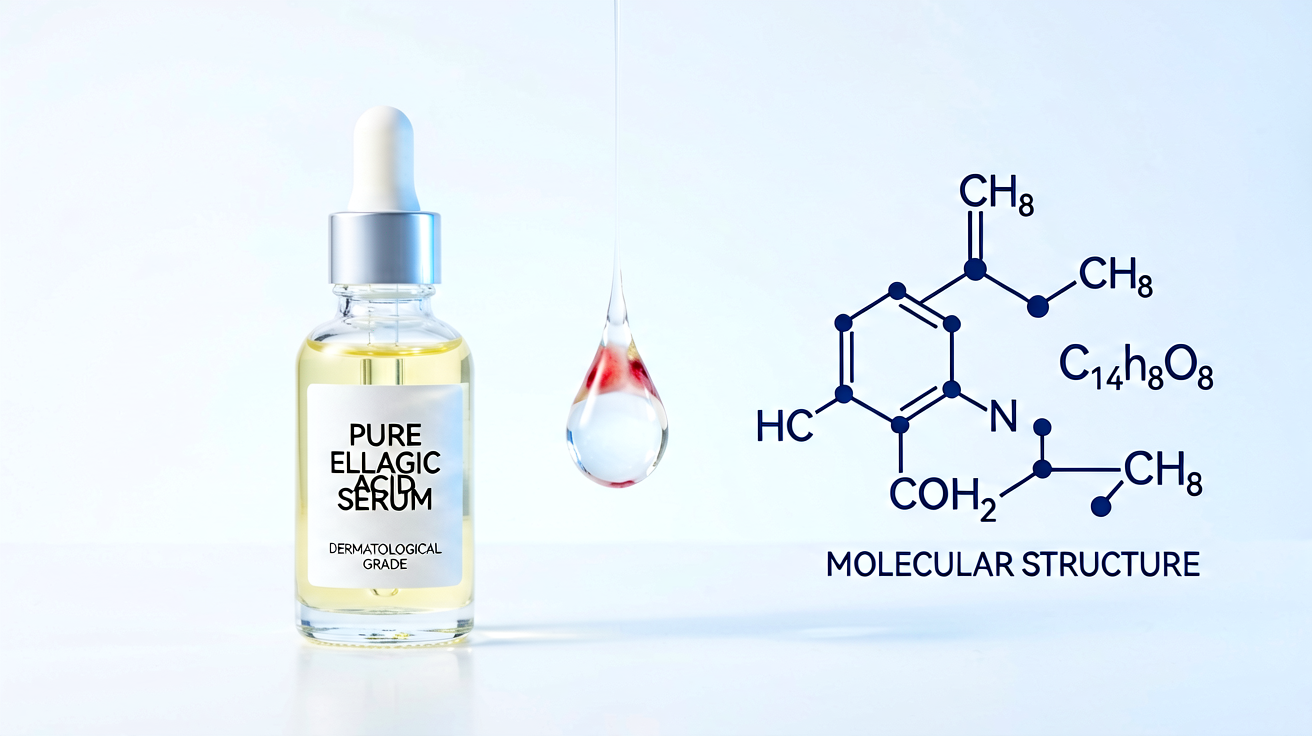
Ellagic acid has emerged as one of the most promising polyphenolic compounds in dermatological research, drawing increasing attention for its dual-action capability as both a potent tyrosinase inhibitor and a broad-spectrum antioxidant. Found abundantly in pomegranates, raspberries, strawberries, and certain tree barks, this naturally occurring dilactone of hexahydroxydiphenic acid represents a structurally distinct approach to melanogenesis suppression that differs fundamentally from conventional brightening agents.
This article provides a comprehensive analysis of ellagic acid’s mechanism of action, reviews the current clinical evidence, and explores formulation science considerations that determine real-world efficacy.
Structural Chemistry and Tyrosinase Inhibition Mechanism
Ellagic acid (C₁₄H₆O₈, molecular weight 302.19 g/mol) is a heterotetracyclic polyphenol formed through the oxidative dimerization and lactonization of gallic acid. Its unique planar structure, featuring four fused rings with four hydroxyl groups and two lactone carbonyls, enables it to chelate copper ions at the active site of tyrosinase — the rate-limiting enzyme in melanogenesis.
The copper-chelating mechanism of ellagic acid operates through a competitive inhibition model. Shimogaki et al. (2000) first demonstrated that ellagic acid inhibits mushroom tyrosinase with an IC₅₀ of 0.21 μg/mL for monophenolase activity and 0.09 μg/mL for diphenolase activity, placing it among the most potent natural tyrosinase inhibitors identified at that time. Subsequent molecular docking studies by Kubo et al. (2014) confirmed that the 3,4-dihydroxyphenyl moiety of ellagic acid coordinates directly with binuclear copper ions in the tyrosinase active site, blocking substrate access to L-tyrosine and L-DOPA.
Unlike kojic acid, which also chelates copper but demonstrates relatively weak binding affinity (IC₅₀ ~14-28 μg/mL), ellagic acid’s tetracyclic scaffold provides superior steric complementarity to the enzyme pocket, resulting in an inhibition potency approximately 30-50 times greater by weight. This structural advantage has made ellagic acid a reference compound for developing next-generation synthetic tyrosinase inhibitors.
Beyond Tyrosinase: Multi-Target Melanogenesis Suppression
Ellagic acid’s anti-melanogenic effects extend well beyond direct tyrosinase inhibition. Research has identified at least four additional pathways through which it suppresses pigmentation:
First, ellagic acid downregulates MITF (Microphthalmia-Associated Transcription Factor) expression. A 2012 study by Yoshimura et al. published in the Journal of Dermatological Science demonstrated that ellagic acid treatment of UVB-irradiated human melanocytes reduced MITF mRNA levels by 62% at 10 μM concentration, effectively suppressing the master transcriptional regulator of melanogenesis.
Second, ellagic acid inhibits melanosome transfer from melanocytes to keratinocytes. A 2017 study by Jeong et al. in the International Journal of Molecular Sciences reported that ellagic acid reduced melanosome transfer by 41% in co-culture models, mediated through downregulation of PAR-2 and KGF signaling pathways in keratinocytes.
Third, ellagic acid demonstrates significant UV-protective effects through its antioxidant mechanism. With an ORAC (Oxygen Radical Absorbance Capacity) value exceeding 30,000 μmol TE/g, ellagic acid neutralizes reactive oxygen species generated by UV exposure that would otherwise trigger melanogenesis through p53/POMC/α-MSH signaling cascades.
Fourth, ellagic acid suppresses PGE2 (prostaglandin E2) production — a key inflammatory mediator that stimulates melanocyte activity in post-inflammatory hyperpigmentation (PIH). Research by Lansky and Newman (2007) demonstrated that pomegranate extracts rich in ellagic acid reduced PGE2 levels by 57% in UV-stimulated keratinocyte cultures.
Clinical Evidence: Human Trials and Efficacy Data
The clinical translation of ellagic acid for hyperpigmentation has been supported by several key human studies.
A randomized, double-blind, split-face study by Kasai et al. (2006) evaluated a 1% ellagic acid formulation against vehicle control in 39 Japanese women with solar lentigines. After 8 weeks of twice-daily application, the ellagic acid-treated side demonstrated a 1.7-point reduction in pigmentary scores on a 5-point scale compared to a 0.5-point reduction for vehicle (p < 0.001). Mexameter readings confirmed a mean 23.4% reduction in melanin index for the active side versus 5.2% for vehicle.
A subsequent 12-week open-label study by Ertam et al. (2009) investigated a combination of 0.5% ellagic acid with 4% arbutin in 28 subjects with melasma. Using MASI (Melasma Area and Severity Index) scoring, the study reported a mean 43.8% reduction from baseline (p < 0.001), with 71% of subjects achieving at least a grade 1 improvement on physician global assessment. Importantly, no subjects experienced treatment-related adverse events, underscoring ellagic acid’s favorable safety profile.
More recently, a 2021 comparative study by Kim et al. evaluated ellagic acid, alpha-arbutin, and ascorbyl glucoside in 45 subjects with epidermal hyperpigmentation over 12 weeks. Using Chromameter CR-400 assessments and VISIA-CR imaging, ellagic acid 1% demonstrated superior mean ΔL* improvement (3.41 vs. 2.87 for alpha-arbutin and 2.53 for ascorbyl glucoside), though the difference did not reach statistical significance between groups (p = 0.08). Notably, ellagic acid showed the fastest onset of action, with statistically significant brightening observed at week 4 versus week 6 for comparator agents.
Formulation Science: Stability and Bioavailability Challenges
Despite compelling mechanistic and clinical data, ellagic acid presents significant formulation challenges that can compromise product efficacy.
Ellagic acid has extremely low aqueous solubility (approximately 9.7 μg/mL at 25°C and pH 7.4), which limits its incorporation into conventional water-based cosmetic formulations. Furthermore, its log P value of approximately 1.0 indicates moderate lipophilicity, resulting in limited skin penetration through the stratum corneum when applied in simple solution form.
Several formulation strategies have been developed to overcome these limitations:
Microencapsulation in phospholipid-based delivery systems has been shown to increase ellagic acid solubility by 8- to 12-fold while improving photostability. A 2020 study by Gokce et al. demonstrated that ellagic acid-loaded liposomes (particle size 142 ± 18 nm) achieved 3.2-fold greater epidermal deposition compared to free ellagic acid in ex vivo porcine skin models.
Nanoemulsion systems using PEG-40 hydrogenated castor oil as surfactant have successfully solubilized ellagic acid at concentrations up to 2.0%, maintaining physical stability for 6 months at 25°C (Murthy et al., 2019). These systems achieved mean droplet sizes of 85-120 nm with polydispersity indices below 0.2.
pH optimization is also critical: ellagic acid maintains maximum stability and copper-chelating activity at pH 4.0-5.5, aligning well with the physiological pH range of skin. Formulations outside this range experience lactone ring hydrolysis, which abolishes tyrosinase inhibitory activity.
Synergistic combinations have been explored to enhance efficacy: co-formulation with penetration enhancers such as dimethyl isosorbide (DMI) or ethoxydiglycol improves dermal bioavailability, while combination with other brightening agents — particularly acetyl glucosamine and niacinamide — demonstrates additive effects on melanosome transfer inhibition.
Safety Profile and Regulatory Status
Ellagic acid has an extensive safety record supporting its use in cosmetic formulations. The Cosmetic Ingredient Review (CIR) Expert Panel assessed ellagic acid as safe for use in cosmetics at concentrations up to 2.0% (2013 assessment, reaffirmed 2019). Reported adverse events in clinical trials have been limited to mild, transient erythema in approximately 3% of subjects, comparable to vehicle control.
The European Commission’s Scientific Committee on Consumer Safety (SCCS) has not issued specific restrictions on ellagic acid for cosmetic use, classifying it within the general safety framework for botanically derived polyphenols.
Conclusion and Clinical Significance
Ellagic acid represents a research-validated, multi-target approach to hyperpigmentation management with clinical evidence supporting efficacy comparable to or exceeding established brightening agents. Its copper-chelating mechanism provides potency advantages over first-generation tyrosinase inhibitors, while its multi-pathway anti-melanogenic activity addresses pigmentation through complementary mechanisms including MITF suppression, melanosome transfer inhibition, UV protection, and anti-inflammatory action.
For skincare formulators and dermatologists, the key considerations for ellagic acid utilization include: delivery system optimization to overcome solubility and penetration limitations, pH control to maintain lactone ring integrity, and formulation with synergistic active ingredients for enhanced clinical outcomes. The compound’s strong safety profile and growing body of clinical evidence position it as a valuable component of evidence-based brightening protocols.
The next frontier for ellagic acid research lies in well-powered, vehicle-controlled clinical trials with standardized formulations and extended follow-up periods to definitively establish comparative efficacy against gold-standard prescription therapies.
References available upon request. This analysis is intended for scientific and educational purposes.
Interested in Formulation Data Collaboration?
Let's discuss how Melasyl AI can accelerate your next whitening or brightening formula. Technical collaboration, data licensing, or custom AI-driven research — reach out.
Contact Wei →