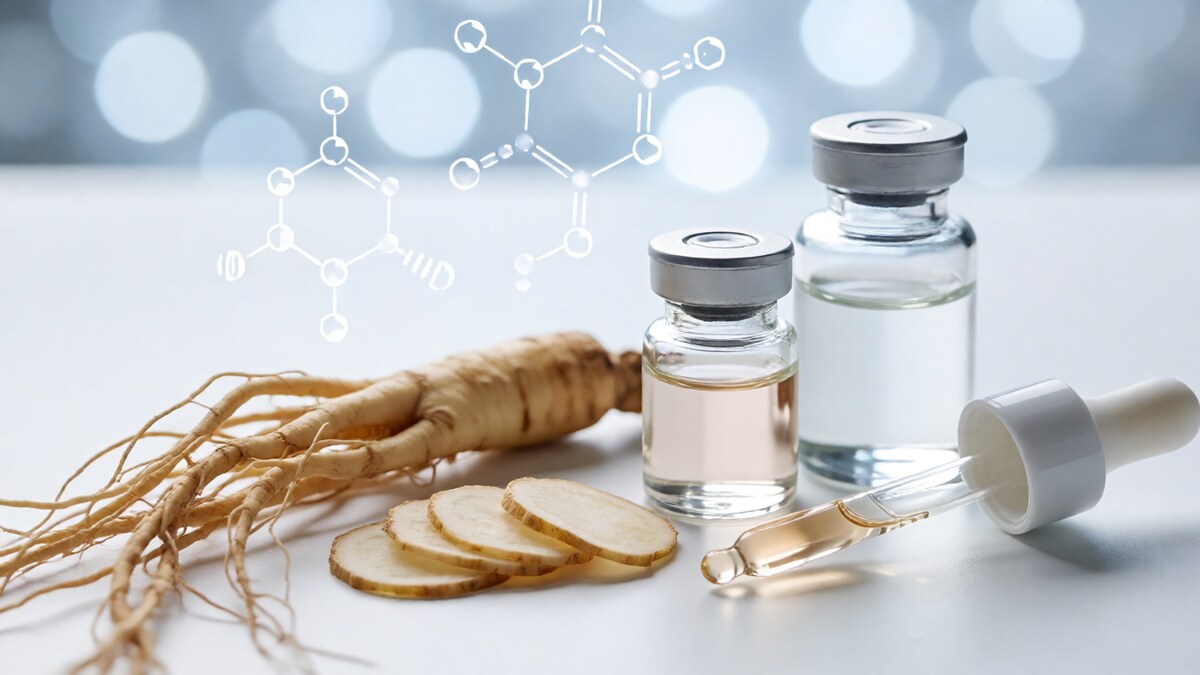
Ginseng (Panax ginseng C.A. Meyer) has become one of the most visible actives on 2026 brightening shelves. Once a fixture of traditional Korean and Chinese medicine, it now anchors hundreds of best-selling ampoules, essences and creams — and “black ginseng” has become one of the year’s loudest K-beauty hooks. Unlike the single-molecule melanin inhibitors that dominate Western brightening, ginseng works through a family of more than 30 saponins, the ginsenosides, whose fermented and heat-processed metabolites behave like a multi-target pigmentation complex.
This analysis breaks down why ginseng keeps winning on the bestseller lists, what its ginsenosides actually do at the molecular level, and what the human clinical evidence does — and does not — support.
Why ginseng is a 2026 bestseller
Three structural forces drive ginseng’s commercial momentum. First, the K-beauty engine: ginseng is the signature hero ingredient of Korea’s heritage brands, so it arrives on shelf already carrying decades of consumer recognition and a premium “glass skin” story. Second, process innovation: fermentation and repeated steaming-drying (the route from white ginseng → red ginseng → black ginseng) convert the poorly absorbed major ginsenosides into rare metabolites with far better skin bioavailability. Third, dual-format reach — the same botanical sells as a topical serum and as an ingestible “glow from within” nutricosmetic, doubling its shelf presence.
The active chemistry: not one molecule, but a family
Fresh ginseng is dominated by the “major” ginsenosides (Rb1, Rb2, Rc, Rd, Re, Rg1), which are large, hydrophilic and poorly penetrated. Steaming, drying and fermentation hydrolyse them into “minor” or rare ginsenosides — Rg3, Rg5, Rk1, Rh1, Rh3, F1 and compound K — that are smaller, more lipophilic and markedly more active on melanocytes. This is why a well-designed ginseng formulation is really a cocktail, and why the same plant name can deliver very different efficacy depending on processing.
Mechanism 1 — Tyrosinase and MITF downregulation
The most direct route is transcriptional. Ginsenoside Rb2, purified from P. ginseng berry, reduced melanogenesis in melan-a cells by 23.4% at 80 µM without cytotoxicity, lowered both tyrosinase and MITF protein expression, and inhibited body pigmentation in a live zebrafish model (Lee et al., 2015). Ginsenoside Rg3 acts upstream: it activates ERK signalling, which restrains MITF and the downstream tyrosinase and TRP-1 it controls. Rb2 is also the ginsenoside that survives best in a ginseng-lactobacillus ferment, giving formulators a stable active marker to standardise against.
Mechanism 2 — Cutting melanosome export, not just synthesis
Ginsenoside F1 is the most interesting of the family because it does not behave like a classic inhibitor. In B16F10 cells it reduced α-MSH-induced melanin secretion by 60% while leaving intracellular melanin and tyrosinase activity essentially untouched; instead it forced dendrite retraction via Rho-family GTPases, so far fewer melanosomes were delivered to keratinocytes (Kim et al., 2015). A companion human study (Han et al., AmorePacific, 2014) reported that a 0.1% F1 cream produced a measurable whitening effect on artificially tanned human skin after 8 weeks, an effect traced to F1 boosting epidermal γδ T-cell-derived IL-13, which suppresses tyrosinase and DCT. In other words, ginseng attacks hyperpigmentation at the transfer step as well as the synthesis step.
Mechanism 3 — Antioxidant and anti-inflammatory buffering of PIH
Post-inflammatory hyperpigmentation — the stubborn aftermath of acne, irritation or UV injury — is fuelled by reactive oxygen species and inflammatory cytokines. Ginseng saponins and their metabolites suppress NF-κB-driven mediators such as PGE2, IL-6 and TNF-α, while supporting Nrf2-linked antioxidant defences. Recent black-ginseng work on inflammaging likewise reports reduced MMP-1 and PGE2 alongside improved barrier markers, which supports ginseng’s role in the “keep it from coming back” half of a melasma or PIH regimen.
Human clinical evidence
| Study | Design | Finding |
| Han et al., 2014 | 0.1% ginsenoside F1 cream, 20 volunteers, UV-tanned skin, 8 weeks | Significant increase in skin luminosity (L*) |
| Lee et al., 2014 | Fermented ginseng extract, split-face randomised trial | Improved tone evenness and radiance |
| Korean Red Ginseng RCTs | Topical cream, multiple cohorts | Improved hydration, elasticity and wrinkle depth |
Honest read: the pigmentation-specific evidence is strongest at the cell and zebrafish level, with a smaller number of human trials measuring overall luminosity rather than focal melasma area. Ginseng is therefore best positioned as a well-tolerated multi-target brightening and barrier active in a combination regimen — not as a monotherapy replacement for the strongest melanin inhibitors.
Formulation science
- Standardise to a marker, not the plant: quantify total ginsenosides or, better, specific actives (Rb2, Rg3/Rk1/Rg5, F1 or compound K).
- Process for rare ginsenosides: fermentation or heat-processing shifts the profile toward smaller, more bioavailable metabolites.
- Pair intelligently: ginsenoside Rb2 works synergistically with low-dose niacinamide in B16F10 cells — niacinamide blocks melanosome transfer while Rb2 suppresses tyrosinase and MITF.
- Match the vehicle: saponins are hydrophilic, so use glycol/aqueous systems or encapsulation; lipophilic rare ginsenosides can enter oil phases.
- Lean into adjacencies: ginseng’s humectant polysaccharides and collagen-supporting saponins make it a natural partner for peptides and retinoids in an anti-aging brightening formula.
Bottom line
Ginseng earns its bestseller status through breadth rather than a single knockout number: tyrosinase and MITF suppression, reduced melanosome export, and antioxidant/anti-inflammatory buffering, all from one standardisable family of actives with a decades-long safety record. For 2026, the winning approach is not more ginseng — it is the right ginsenosides, correctly processed and intelligently paired.
References
- Lee DY, et al. Melanin Biosynthesis Inhibition Effects of Ginsenoside Rb2 Isolated from Panax ginseng Berry. J Microbiol Biotechnol. 2015;25(12):2011-5.
- Kim JH, et al. Ginsenoside F1 attenuates hyperpigmentation in B16F10 melanoma cells by inducing dendrite retraction and activating Rho signalling. Exp Dermatol. 2015;24(2):150-2.
- Han J, et al. Role of epidermal γδ T-cell-derived interleukin 13 in the skin-whitening effect of Ginsenoside F1. Exp Dermatol. 2014;23(11):860-2.
- Lee JE, et al. Inhibitory effects of ginsenosides on basic fibroblast growth factor-induced melanocyte proliferation. J Ginseng Res. 2017;41(3).
- The regulatory role of Korean ginseng in skin cells. J Ginseng Res (review).
- Chang TM, et al. Ginseng-Lactobacillus Ferment Exerts Synergistic Anti-Melanogenic Effects with Low Doses of Niacinamide In Vitro. Biomed J Sci Tech Res. 2020;26(4).
Interested in Formulation Data Collaboration?
Let's discuss how Melasyl AI can accelerate your next whitening or brightening formula. Technical collaboration, data licensing, or custom AI-driven research — reach out.
Contact Wei →