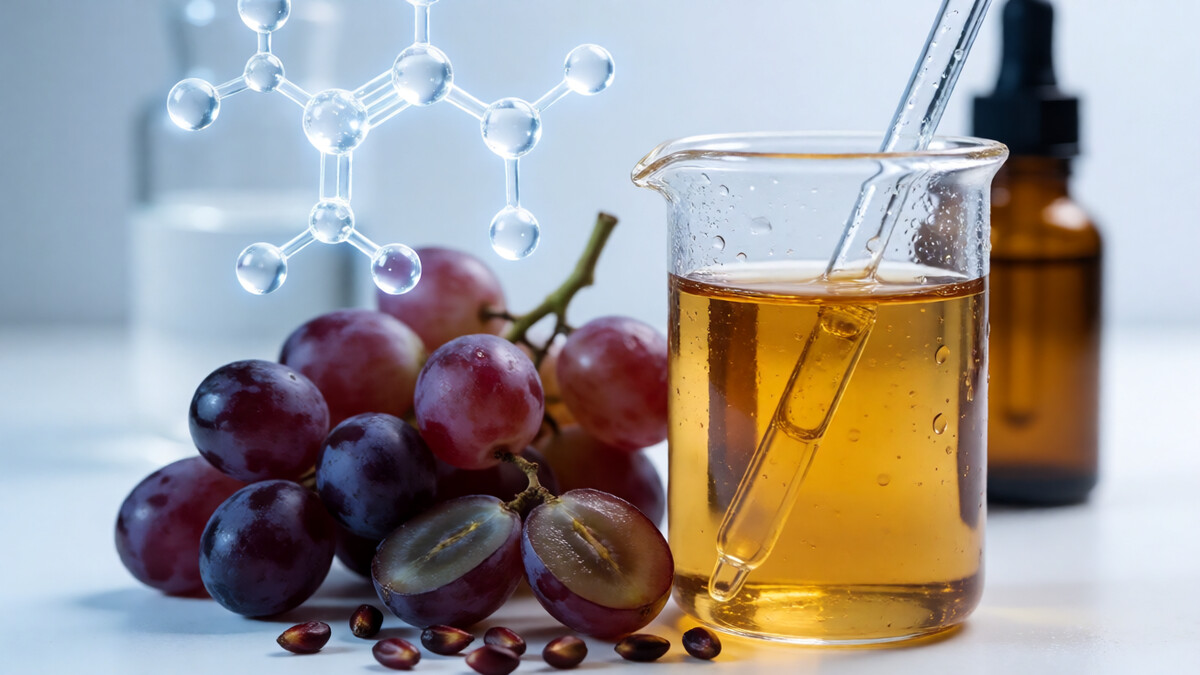
Grape seed extract has spent two decades in cosmetics as a quiet antioxidant — a supporting player in vitamin C serums and “anti-pollution” blends. In 2026 that positioning is being re-examined. Its active fraction, oligomeric proanthocyanidins (OPCs), does more than quench free radicals: it inhibits tyrosinase, interrupts the oxidative signalling that drives melanocyte activation, and has a genuine — if modest — human trial behind it in melasma. This article breaks down the chemistry, the clinical evidence, and how to formulate with it.
What Is Grape Seed Extract?
Grape seed extract (GSE) is a standardized extract from the seeds of Vitis vinifera, the wine grape. Its pharmacologically dominant constituents are proanthocyanidins — oligomers and polymers of catechin and epicatechin flavan-3-ol units, mostly B-type (C4→C8 bonds), ranging from dimers through large polymers, plus a smaller fraction of monomeric catechins, gallic acid and, in some feedstocks, stilbenes such as ε-viniferin. Cosmetic grades are typically standardized to 95% OPCs. Because potency tracks the degree of polymerization, “grape seed extract” on a label says little about how the material will behave — the OPC content and oligomer profile do.
Mechanism of Action: A Three-Front Attack on Pigmentation
1. Direct tyrosinase inhibition
Tyrosinase is the copper-dependent, rate-limiting enzyme that converts tyrosine to DOPA and onward to melanin. Proanthocyanidins inhibit it in two complementary ways: their catechol and pyrogallol hydroxyls chelate the dinuclear copper centre, and their planar aromatic rings allow competitive occupancy of the catalytic pocket. Oligomeric proanthocyanidins from grape seed suppressed tyrosinase activity and melanin synthesis in cultured melanocytes (Biological & Pharmaceutical Bulletin, 2004). Notably, the grape stilbenoid ε-viniferin has been reported to be roughly four times more effective than kojic acid in vitro — a benchmark many brightening actives are measured against. Inhibition is mild-to-moderate compared with hydroquinone, which is precisely why GSE is best understood as a well-tolerated multi-pathway active rather than a monotherapy.
2. Antioxidant interruption of the UV–ROS–melanocyte axis
UV and visible light raise reactive oxygen species (ROS) in keratinocytes and melanocytes, and ROS both stimulate tyrosinase activity and drive melanocyte proliferation and dendricity. OPCs are potent radical scavengers that reduce UV-induced oxidative damage and inflammatory signalling in skin models, so GSE acts upstream of melanin production, not only at the enzyme itself.
3. Anti-inflammatory and barrier support
Inflammation is the engine of post-inflammatory hyperpigmentation (PIH). OPCs inhibit collagenase, elastase and hyaluronidase activity and dampen inflammatory mediators, which helps stabilise the microenvironment in which pigment forms — and, practically, supports barrier function in skin already stressed by other actives.
Clinical Evidence: Real but Modest
The human dataset is small but honest. The best-known trial — Yamakoshi et al. (Phytotherapy Research, 2004; PMID 15597304) — gave an oral proanthocyanidin-rich grape seed extract to 12 Japanese women with chloasma (melasma) for six months in an open-label design. After six months, 10 of 12 (83%, p<0.01) improved or slightly improved; melanin index fell significantly from 0.025 to 0.019 (p<0.01), and L* lightness increased. The effect plateaued after six months. Two caveats matter: it was oral and open-label, and the sample was tiny.
Topical evidence now exists too. A formulation study published in Cosmetics (MDPI, 2021) used an encapsulated activated grape seed extract (E-AGSE) enriched in PP2A-activating flavonoids. In native human melanocytes it reduced melanin production and dose-dependently inhibited tyrosinase in vitro; in a four-week, 31-subject clinical assessment of a 2% essence, skin tone improved by roughly 5% at two weeks and up to 9% at four weeks, alongside wrinkle and hydration gains. A further randomized, double-blind, placebo-controlled trial (Cosmetics, 2023) evaluated an oral blend combining grape seed extract, grape pomace extract, licorice and vitamin C; the blend inhibited tyrosinase in vitro, and the authors reported improved facial dark spots versus placebo. The bottom line: mechanistically strong, clinically supportive, but not a hydroquinone-class effect.
Formulation Science
- Specify the fraction. Demand a stated OPC content (e.g. 95%) and, ideally, an oligomer distribution. A generic extract may be mostly tannins that contribute colour and astringency but little activity.
- Solubility. Proanthocyanidins are water- and glycol-soluble, which suits serums, essences and gels. Penetration is the limiting factor. Consider glycol-rich vehicles or encapsulation — the E-AGSE data suggest encapsulation improves both stability and delivery.
- Use level. Typical cosmetic use is 0.1–2% extract, with encapsulated grades used lower. Optimize delivery rather than overloading; high tannin loads increase astringency and colour.
- pH and chelation. Formulate mildly acidic to near-neutral (pH 4.5–6.5). Avoid iron contamination — polyphenols chelate metals and form coloured complexes. Use a chelator such as phytic acid for stability.
- Oxidation and colour. OPCs oxidize and drift toward tan-brown. Add during cool-down (below 40 °C), protect with a co-antioxidant network (ferulic acid, tocopherol, sodium metabisulfite) and package in airless or opaque containers.
- Synergy. GSE is additive with vitamin C derivatives, niacinamide, tranexamic acid and alpha-arbutin, each hitting a different node of the melanogenesis cascade. In antioxidant systems it also recycles oxidised vitamin C and E.
Safety and Expectations
Grape seed extract is generally well tolerated at topical and oral doses. The main theoretical caution is an additive antiplatelet effect with anticoagulants when taken orally; topical use is not associated with systemic effects. Set consumer expectations honestly: GSE brightens and evens tone gradually over weeks, and belongs in a regimen alongside daily broad-spectrum sunscreen — not as a replacement for it or for prescription melasma therapy.
Outlook
Grape seed extract is a rare case of a familiar consumer ingredient with an underused, mechanistically credible pigment story. The enzymology is sound, the safety record is long, and one human trial plus modern encapsulation data make it defensible — provided brands specify the OPC fraction, invest in delivery, and avoid over-claiming. For Southeast Asian markets, where pollution, UV and inflammation-driven PIH dominate, a multi-pathway polyphenol is a natural fit.
References
- Yamakoshi J, Sano A, Tokutake S, et al. Oral intake of proanthocyanidin-rich extract from grape seeds improves chloasma. Phytotherapy Research. 2004;18(11):895–899. doi:10.1002/ptr.1537 (PMID 15597304)
- Encapsulated Activated Grape Seed Extract: A Novel Formulation with Anti-Aging, Skin-Brightening, and Hydration Properties. Cosmetics (MDPI). 2021;9(1):4. doi:10.3390/cosmetics9010004
- Effect of an Oral Formulation on Skin Lightening: from In Vitro Tyrosinase Inhibition to a Double-Blind Randomized Placebo-Controlled Clinical Study. Cosmetics (MDPI). 2023;10(5):143. doi:10.3390/cosmetics10050143
- Inhibitory effects of oligomeric proanthocyanidins from grape seeds on tyrosinase and melanin synthesis. Biological & Pharmaceutical Bulletin. 2004.
Interested in Formulation Data Collaboration?
Let's discuss how Melasyl AI can accelerate your next whitening or brightening formula. Technical collaboration, data licensing, or custom AI-driven research — reach out.
Contact Wei →