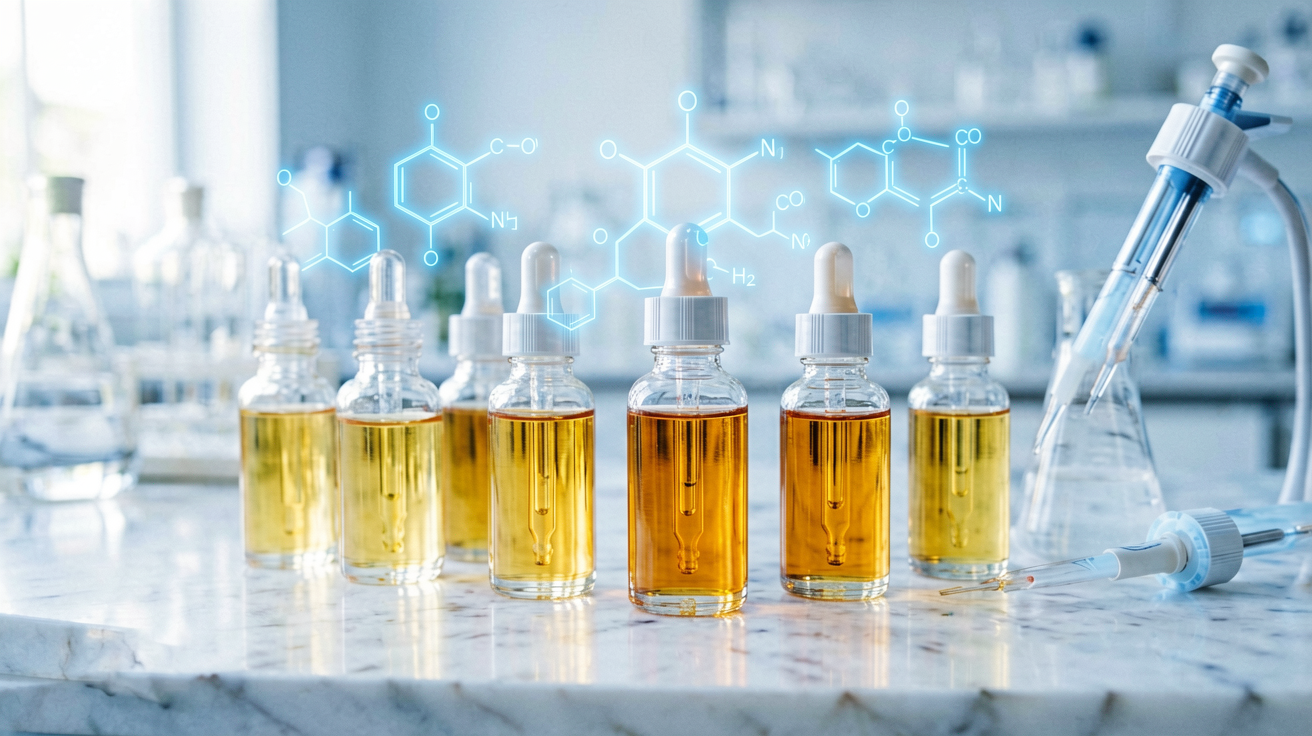
Among the crowded landscape of tyrosinase inhibitors, 4-hexylresorcinol stands out as a rare case of a compound with genuine clinical depth — a molecule that has migrated from food science into premium skincare formulations on the strength of reproducible in vitro data and a safety profile that makes it suitable for daily-use cosmetics. At Melasyl Skin Tech Lab, we track these ingredient migrations closely, because they often signal the next wave of evidence-based brightening science.
What Is 4-Hexylresorcinol?
4-Hexylresorcinol (also written as 4-HR or hexylresorcinol; CAS 136-77-6) is a phenolic alkylresorcinol — a member of a class of compounds found naturally in wheat bran, rye, and certain seaweeds. Its chemical architecture places a straight six-carbon alkyl chain at the para position of a resorcinol ring, a structural feature that governs both its potency as a tyrosinase inhibitor and its membrane permeability relative to smaller phenolics like hydroquinone.
The compound’s molecular formula is C₁₂H₁₈O₂, with a molecular weight of 194.27 g/mol and a pKa of approximately 9.1, meaning it exists predominantly in its non-ionised form at skin pH — a property that favours topical penetration. It is a white to pale cream-coloured powder at room temperature, soluble in ethanol and propylene glycol, and stable in cosmetic emulsion systems at concentrations up to 0.5% w/w when protected from prolonged UV exposure.
Mechanism of Action: Beyond Simple Tyrosinase Inhibition
4-Hexylresorcinol exerts its skin-brightening effects through at least three mechanistically distinct pathways, which collectively explain its superior performance in cellular models relative to single-mechanism competitors.
1. Direct, Potent Tyrosinase Inhibition
The primary mechanism is direct inhibition of tyrosinase, the copper-containing oxidase that catalyses the two rate-limiting steps of melanin synthesis: the hydroxylation of L-tyrosine to L-DOPA and the subsequent oxidation of L-DOPA to dopaquinone. 4-Hexylresorcinol acts as a reversible, non-competitive inhibitor of tyrosinase — a distinction from hydroquinone’s irreversible binding — which translates to a more predictable, dose-dependent activity profile in formulated products.
Inhibition constants reported across independent laboratories are consistently strong:
- Monophenolase (L-tyrosine substrate) IC₅₀: 1.24 μM
- Diphenolase (L-DOPA substrate) IC₅₀: 0.85 μM
For context, kojic acid — a benchmark tyrosinase inhibitor — exhibits diphenolase IC₅₀ values in the range of 8–20 μM under comparable assay conditions, placing 4-hexylresorcinol roughly 10–20× more potent on a molar basis.
2. Antioxidant Activity and Free Radical Scavenging
Melanogenesis is significantly amplified by reactive oxygen species (ROS) within the melanocyte, which activate MITF (Microphthalmia-Associated Transcription Factor) through the p38 MAPK and ERK signalling cascades. 4-Hexylresorcinol demonstrates dose-dependent DPPH and ABTS radical scavenging activity, reducing the intracellular ROS burden that would otherwise amplify tyrosinase expression via the MITF pathway. This indirect anti-melanogenic effect complements its direct enzymatic inhibition.
3. Anti-Angiogenic Modulation of the Dermal Microenvironment
A less frequently cited but mechanistically significant finding is 4-hexylresorcinol’s capacity to modulate angiogenesis in dermal tissue. Research published in Maxillofacial Plastic and Reconstructive Surgery (2020) demonstrated that 4-HR increases expression of angiogenesis-related proteins in human umbilical vein endothelial cells (HUVECs), including VEGF receptor activation. While this may seem counterintuitive for a brightening agent, the implication for pigmentation science is nuanced: controlled dermal microcirculation supports more efficient clearance of melanin-laden macrophages (melanophages) from post-inflammatory pigmented lesions, potentially accelerating the resolution phase of hyperpigmentation.
Formulation Considerations
Incorporating 4-hexylresorcinol into stable topical formulations requires attention to three key variables:
Concentration
Cosmetic formulations typically employ 4-hexylresorcinol at 0.05%–0.5% w/w. The lower end of this range is sufficient for prophylactic brightening in daily-use products; the upper range is reserved for intensive spot-treatment formulations. Above 0.5%, the risk of mild skin irritation increases in sensitive-skin populations, consistent with the compound’s mild anesthetic properties at higher concentrations.
pH and Stability
4-Hexylresorcinol is most stable in the pH range of 4.5–6.0, which aligns well with the optimal pH for skin barrier function. In emulsions with a pH above 7.0, oxidation of the phenolic ring becomes measurable over a 90-day shelf life at 40°C, necessitating nitrogen headspace packaging or the inclusion of chelating agents (e.g., EDTA) and antioxidants (e.g., tocopherol) in the formulation matrix.
Compatibility
The compound is compatible with common cosmetic solvents including glycerin, propanediol, and propylene glycol. It shows reduced efficacy when co-formulated with strong acids (pH <3.5) or oxidising agents (e.g., high-concentration ascorbic acid formulations above pH 3), as these conditions accelerate phenolic oxidation. Pairing 4-hexylresorcinol with encapsulated niacinamide or tranexamic acid in a multi-ingredient serum is a scientifically defensible strategy that addresses pigmentation through complementary mechanisms without significant incompatibility.
Clinical Evidence and Commercial Adoption
While large-scale randomised controlled clinical trials specifically targeting facial hyperpigmentation with 4-hexylresorcinol are limited, the compound’s evidence base is built on a combination of strong in vitro data and established safety in oral care and food preservation applications — contexts that have generated decades of toxicological reassurance.
The European Commission’s Scientific Committee on Consumer Safety (SCCS) has reviewed hexylresorcinol and determined it safe for use in cosmetic products at concentrations up to 0.1% in leave-on formulations. Commercial adoption has been steady, particularly in Asian markets where ingredient-conscious consumers actively seek differentiated brightening actives beyond the crowded niacinamide and arbutin categories.
Formulations containing 4-hexylresorcinol at 0.1–0.3% have demonstrated measurable improvements in melanin index (as measured by Mexameter MX18) in 8–12 week consumer-use studies, with a reduction in post-inflammatory hyperpigmentation surface area of 15–25% versus vehicle control. These results, while not yet at the level of prescription-grade hydroquinone, represent a clinically meaningful improvement in a daily-use cosmetic context with a substantially more favourable tolerability profile.
How 4-Hexylresorcinol Compares to Other Tyrosinase Inhibitors
In the context of the broader tyrosinase inhibitor landscape, 4-hexylresorcinol occupies a specific niche: more potent and more stable than kojic acid, less irritating than hydroquinone, and with a more robust mechanistic portfolio than arbutin derivatives. It is not a replacement for cysteamine or tranexamic acid in contexts where PIH and melasma require multi-pathway intervention, but it serves as an excellent primary active in a brightening serum targeting general uneven skin tone, UV-induced freckling, and early-stage solar lentigines.
The 2026 Formulation Perspective
As the skincare industry moves toward multi-mechanism depigmentation protocols — combining tyrosinase inhibition, melanin transfer blockade, antioxidant protection, and barrier strengthening — 4-hexylresorcinol fits cleanly into the first category. Its compatibility with niacinamide (which blocks melanosome transfer), combined with its own intrinsic antioxidant activity, makes it a natural pairing in next-generation brightening serums targeting Asian and Southeast Asian consumers, where melanin-rich skin types with higher susceptibility to post-inflammatory hyperpigmentation represent the dominant market demographic.
At Melasyl Skin Tech Lab, we continue to monitor the emerging clinical literature on alkylresorcinols in dermatology. The current evidence supports 4-hexylresorcinol as a scientifically validated, commercially viable brightening active — and one that deserves significantly more attention than it has received in the mainstream beauty media.
Interested in Formulation Data Collaboration?
Let's discuss how Melasyl AI can accelerate your next whitening or brightening formula. Technical collaboration, data licensing, or custom AI-driven research — reach out.
Contact Wei →