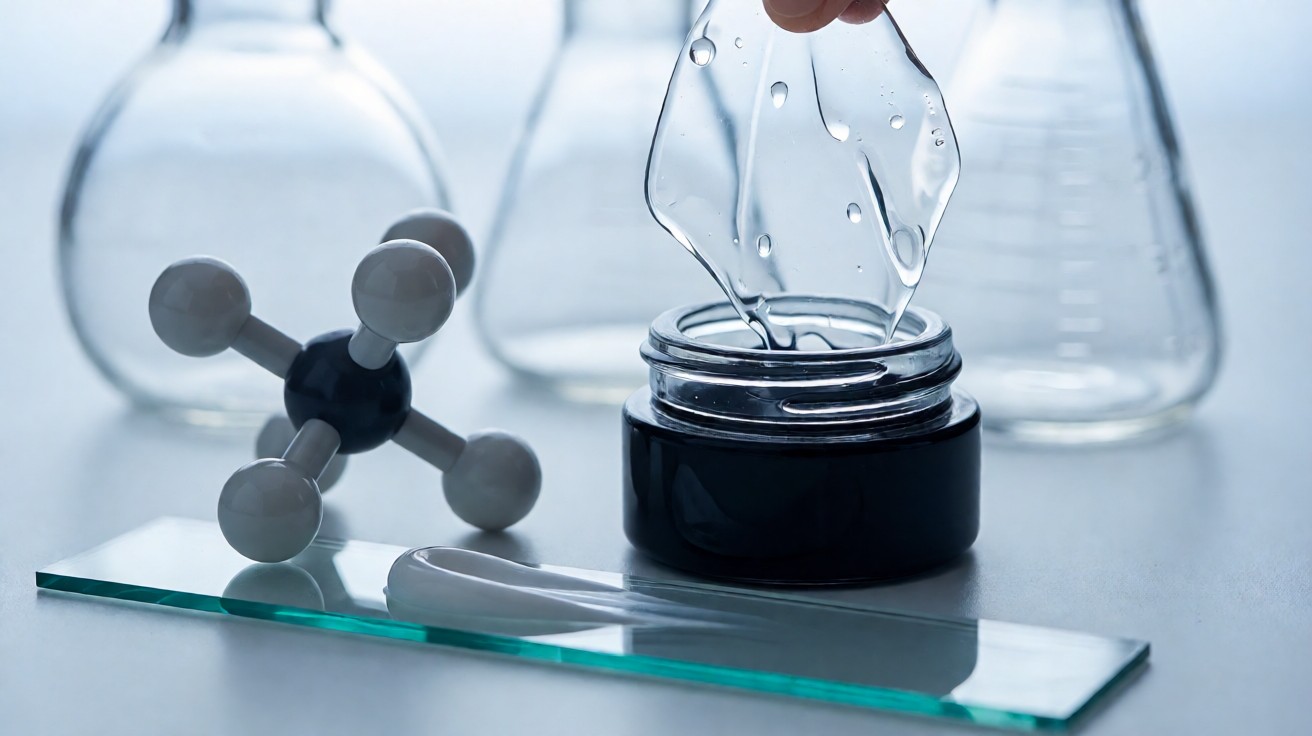
Gel masks are the least understood of the brightening formats, and for good reason. Everything else you’ve made is a pre-mixed cream, serum, or lotion that sits static on the skin. A gel mask is a reactive system: two clear components that flow separately but polymerize together into a thin, flexible, occlusive film that sets on the skin in five to eight minutes. Done right, it boosts the delivery of every brightening active in it. Done wrong, it stings, slides off, or traps heat under a tight film the skin resents.
This guide walks you through building a brightening gel mask from the base up: the solvent system, the crosslinking pair, the active loading, the setting-time tuning, and the stability checks that decide whether it ships. No fluff.
Why a Gel Mask Delivers Differently
A gel mask is anhydrous. There is no aqueous phase to dilute actives or carry them away, and the setting film is thin and conforming. Three things follow from that:
- Higher local concentration. Because the base is a low-molecular-weight PEG rather than a water phase, actives partition into the film and stay at the surface while the film sets. Occlusion is mild and temporary, enough to raise local concentration without the long-occlusion irritation that plagues cream-on-skin brighteners on reactive skin.
- Uniform coverage. The two components mix in the user’s hands or in a dispenser, so the active dose per square centimeter is consistent across the whole face, unlike a cream that migrates toward the thinned areas.
- Time-limited exposure. The film is removed after 15–20 minutes. That short, bounded exposure window is exactly what you want for tyrosinase-inhibiting actives like niacinamide and AA2G, which are best kept at moderate concentrations rather than left on for hours.
The occlusion mechanism itself is well documented: a hydrogel film raises the stratum corneum hydration and the thermodynamic activity of water at the surface, which increases the thermodynamic activity of co-applied actives and pushes penetration into the upper viable epidermis. That is the entire reason the format exists. Don’t waste it on an active that degrades before it gets there.
The Base: PEG-400 and the Diluent
The gel mask base is polyethylene glycol 400 (PEG-400). It is hydrophilic, low-viscosity, and transparent, and it dissolves both the crosslinking pair and most water-soluble actives. It is also the diluent, which means the formula is defined by a ratio, not a fixed weight.
As PEG-400 is added, the gel becomes softer and the setting time slows. As PEG-400 is reduced, the gel stiffens and the setting time drops. Tuning the setting time is the single most important variable in a gel mask, and it is done entirely with PEG-400 and the carbonyl/carboxylate ratio, not with extra diluent.
The Crosslinking Pair
The setting reaction is a classic carbonyl/carboxylate crosslink. The two components are:
- Carbonyl crosslinker — the acrylate monomer. It supplies the C=C bonds.
- Carboxylate crosslinker — the carboxylate monomer. It supplies the crosslinking sites.
They are stored separately and mixed at the point of use. The ratio between the two sets the setting time. A 1:1 weight ratio gives a setting time of roughly five to eight minutes, which is the target window. More carbonyl speeds up the gel and makes it firmer. More carboxylate slows it and makes it softer. Tune one variable at a time and log every batch.
Choosing the Active Loading
Three actives perform consistently in a gel mask format:
- Niacinamide 3–5%. The tyrosinase-inhibition and keratinocyte-transport data are extensive. A 10% niacinamide cream reduced melanin transfer to keratinocytes in a controlled trial (Bane et al., J Soc Invest Dermatol, 1999). At 3–5% in a gel mask the concentration is well within the range that suppresses melanosome transfer without the irritation of the 10% cream study, and the film delivers it over a bounded exposure rather than hours.
- Licorice root extract (Glabra) 5–10%. The depigmenting mechanism is tyrosinase inhibition plus anti-inflammatory action in a single molecule. Kaga et al. (J Dermatol Sci, 2003) showed that a licorice extract formulation reduced pigmentation in human subjects without the irritation that accompanies higher-dose hydroquinone. The extract is water-soluble and loads cleanly into a PEG base.
- Ascorbyl glucoside (AA2G) 2–3%. The stable ascorbate derivative. Nakagawa et al. (Int J Cosmet Sci, 2001) showed it is stable at neutral pH and penetrates the skin without the degradation that free vitamin C suffers. In a gel mask it is the only form of vitamin C worth using.
Avoid free vitamin C and any active that hydrolyzes above pH 5.5. The gel mask’s pH range is 5.0–6.0, and the film is on the skin long enough for hydrolysis to matter.
Step-by-Step: Building the Batch
- Weigh PEG-400 to target. This is the diluent and the bulk of the batch.
- Pre-mix the carbonyl and carboxylate at a 1:1 weight ratio into a separate small container. The two must be homogenized before they enter the batch.
- Charge actives into PEG-400 first: niacinamide, licorice extract, and AA2G. Mix until the licorice extract disperses. Actives that are only partially soluble will settle, so stir just before dispensing.
- Combine the two phases and mix. Start timing immediately.
- Check setting time by placing a drop on glass. Target 5–8 minutes to full set. If it sets too fast, add PEG-400 and re-test. If it sets too slow, reduce PEG-400.
- Adjust pH to 5.0–6.0. Use citric acid or sodium hydroxide, and re-test setting time after any pH change.
- Stability test: store three batches at 25 °C for 4 weeks. Check color, viscosity, and gel integrity. A gel mask that has set in storage has lost its setting margin and must be discarded.
Common Failures
- Setting too fast. The film cures before the user finishes application. Reduce PEG-400 and increase the carbonyl share of the crosslinking pair.
- Setting too slow. The film slides off the face before it sets. Increase the carbonyl share or reduce PEG-400.
- Film stings. Almost always pH-related. Raise pH toward 5.5 and re-test.
- Active settles out. The licorice extract is the usual culprit. Stir before dispensing, and consider a light dispersant if settlement recurs.
- Batch is not uniform. The carbonyl/carboxylate pair was not pre-mixed. Always pre-mix the pair before it enters the batch.
What to Track
Log every batch: PEG-400 weight, carbonyl:carboxylate ratio, setting time, pH, and active weights. After four batches you will have a repeatable setting-time window and a repeatable pH window, and both are the two variables that decide whether the mask works on skin or on a lab bench.
The gel mask is not a harder format than a cream. It is a different one. The setting reaction gives you a delivery mechanism a cream cannot, and the trade-off is that you must tune it the way you tune a cream. Build the batch, set the time, adjust the pH, and ship it.
Interested in Formulation Data Collaboration?
Let's discuss how Melasyl AI can accelerate your next whitening or brightening formula. Technical collaboration, data licensing, or custom AI-driven research — reach out.
Contact Wei →