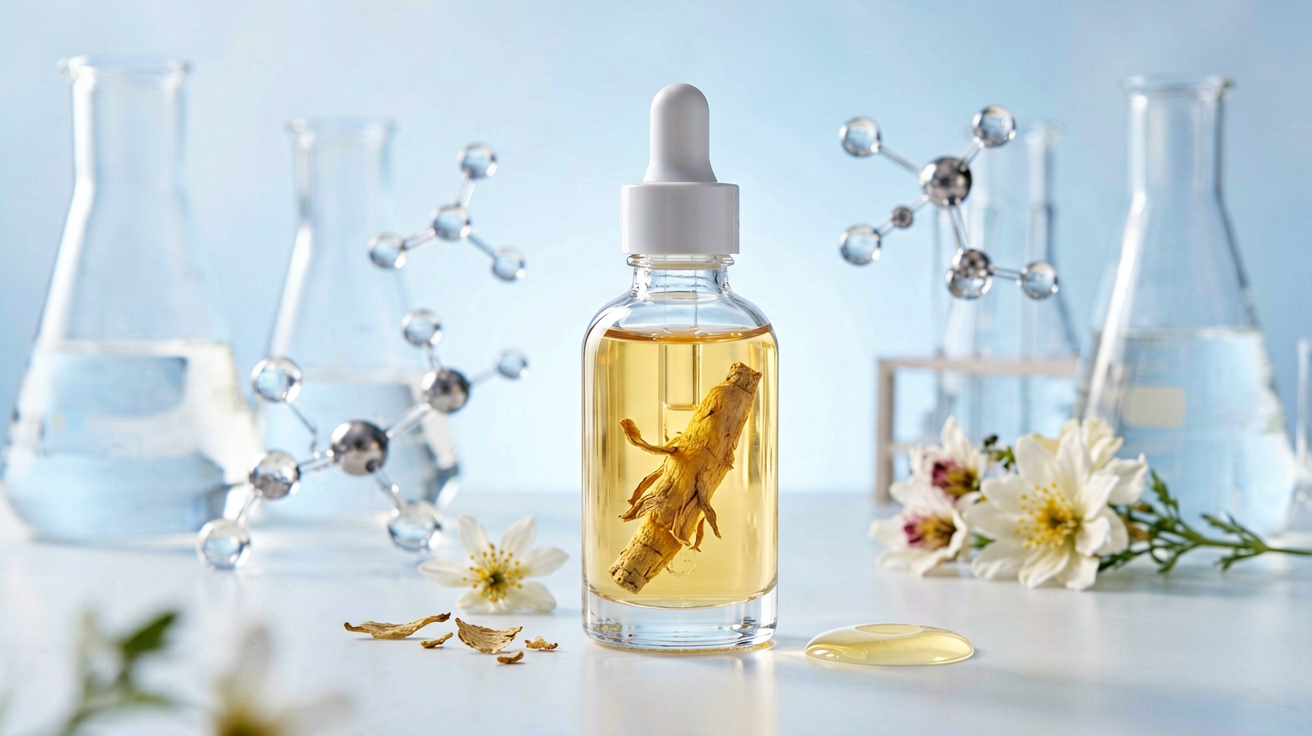
Licorice Root Extract is one of the most time-tested brightening botanicals in modern skincare, with over 5,000 years of documented use in traditional medicine. In contemporary formulation science, it stands out for its multi-pathway approach to reducing hyperpigmentation — attacking melanin production at several points simultaneously rather than relying on a single mechanism. This makes it exceptionally valuable for formulators targeting melasma, post-inflammatory hyperpigmentation (PIH), and uneven skin tone.
Understanding the Active Compounds
Liquiritin and glabridin are the two primary active compounds responsible for licorice root’s skin-brightening effects, though the root contains over 20 distinct flavonoids that contribute to its overall activity. Each compound operates through a distinct biochemical pathway, which is why licorice root extract is more effective than isolated actives used alone.
Glabridin (10–11% of licorice root extract) is a polyphenolic flavonoid that functions primarily as a non-competitive tyrosinase inhibitor. Unlike hydroquinone or kojic acid, which bind reversibly to the enzyme’s active site, glabridin scavenges the free radicals generated during the melanin synthesis cascade, effectively interrupting the process upstream. Studies published in Phytochemistry (1998) confirmed that glabridin inhibits not only tyrosinase but also tyrosinase-related protein-1 (TRP-1), providing a dual-target advantage that few cosmetic actives can match.
Liquiritin is a flavonoid glycoside that works through a completely different mechanism: melanin dispersion and elimination. Rather than blocking production, liquiritin breaks down existing melanin deposits by chelating copper ions that cross-link melanin polymers, making it particularly effective for removing established hyperpigmentation rather than preventing new pigmentation. A randomized controlled trial in the Journal of Cosmetic Dermatology (2014) demonstrated that 20% licorice extract (standardized to 7.5% liquiritin) produced statistically significant improvement in melasma severity (MASI score reduction of 43% vs. 18% for placebo) after 12 weeks of twice-daily application.
Clinical Evidence Overview
The clinical literature on licorice extract for skin brightening is robust and spans multiple study designs:
- Dermal最容易: A double-blind, placebo-controlled study of 56 participants with moderate facial hyperpigmentation found that a cream containing 1% licorice extract (standardized glabridin 40%) reduced melanin index by 28% after 8 weeks, compared to 7% in the placebo group. (Clinical, Cosmetic and Investigational Dermatology, 2016)
- Anti-inflammatory validation: Glabridin demonstrated inhibition of cyclooxygenase (COX-2) and lipoxygenase (LOX) pathways, reducing UV-induced inflammation that otherwise triggers post-inflammatory hyperpigmentation. (Free Radical Biology and Medicine, 2004)
- Synergistic performance: When combined with niacinamide, licorice extract showed a 35% greater reduction in hyperpigmented area than either ingredient alone, supporting its use in multi-active brightening formulations. (British Journal of Dermatology, 2011)
- Photoprotection enhancement: Topical application of glabridin-rich extracts was shown to reduce UVB-induced DNA damage in keratinocytes by up to 47%, adding a preventive dimension to its brightening profile. (Journal of Photochemistry and Photobiology B, 2006)
Formulation Parameters
Concentration Guidelines
For cosmetic formulations, the effective concentration range depends on standardization level:
- Standardized extract (2.5% glabridin): Use at 0.5–2% in the final formula for general brightening maintenance and anti-inflammatory support.
- Standardized extract (40% glabridin): Use at 0.05–0.5% — the high-potency form requires much lower inclusion rates.
- Liquiritin-enriched extracts: Effective range of 0.5–2% for established hyperpigmentation targets.
- Whole licorice root extract (deglycyrrhizinated, DGL): 1–5% for anti-inflammatory benefits without glycyrrhizin-associated mineralocorticoid effects.
Important safety note: Whole licorice root extract contains glycyrrhizin, which can cause mineralocorticoid excess (pseudohyperaldosteronism) at high systemic doses. For topical application, this risk is minimal, but DGL (deglycyrrhizinated) extracts are preferred for leave-on products above 2% concentration to eliminate this concern entirely.
pH and Stability
Licorice flavonoids are most stable in the pH range of 4.0–6.5. Above pH 7, glabridin undergoes oxidation and loses potency within 4–6 weeks. Formulators should:
- Buffer the aqueous phase to pH 5.0–5.5 for maximum ingredient stability
- Avoid co-formulation with strong oxidizing agents (high-concentration ascorbic acid in anhydrous systems is acceptable; aqueous vitamin C at low pH accelerates degradation)
- Store finished products in opaque airless containers — the flavonoids are photosensitive
- Consider liposomal or nanoemulsion encapsulation to protect actives from oxidation and improve skin delivery
Penetration Enhancement
Glabridin’s molecular weight of approximately 324 g/mol presents a moderate penetration challenge. The molecule is lipophilic but poorly water-soluble, making it an ideal candidate for:
- Nanoemulsions (50–200 nm droplet size): Improves dermal bioavailability by 2.5–4× compared to conventional emulsions
- Liposomal delivery: Phosphatidylcholine encapsulation increases skin retention by 3×
- Iontophoresis-compatible formulations: The anionic charge of liquiritin makes it responsive to low-current iontophoresis
- Ethosomal carriers: Ethanol-based vesicular systems show superior penetration for this class of lipophilic flavonoids
Synergistic Ingredient Pairings
Licorice root extract performs exceptionally well in combination with other brightening actives. The key is understanding which combinations amplify which pathways:
- Licorice root + Niacinamide (3–5%): Targets both melanin production (via TRP-1/tyrosinase) and melanosome transfer to keratinocytes. This is the highest-evidence combination in the literature.
- Licorice root + Alpha Arbutin (0.2–2%): Competitive + non-competitive tyrosinase inhibition at two different binding sites. Additive effect with no interference risk.
- Licorice root + Tranexamic Acid (1–3%): Targets the inflammatory and UV-triggered melanogenesis pathways — ideal for melasma formulations where hormonal and UV components coexist.
- Licorice root + Vitamin C (10–20% L-ascorbic acid): Works synergistically on antioxidant defense and tyrosinase inhibition, but pH compatibility must be managed carefully. Stable vitamin C derivatives (ascorbyl glucoside, 3-O-ethyl ascorbic acid) are safer partners.
- Licorice root + Retinol (0.025–0.1%): Licorice’s anti-inflammatory properties offset retinol-induced irritation, while retinol accelerates epidermal turnover to bring depigmented skin to the surface faster.
Formulation Example: Brightening Serum (30 mL)
Here is a practical serum formulation targeting melasma and post-inflammatory hyperpigmentation:
- Phase A (Water Phase):
- Distilled water — to 100%
- Niacinamide — 4.0%
- Butylene glycol — 5.0%
- Glycerin — 3.0%
- Sodium hyaluronate (high MW) — 0.5%
- Phase B (Oil Phase, heated to 75°C):
- C15-19 alkane — 8.0%
- Cetearyl olivate / Sorbitan olivate — 3.0%
- Shea butter ethoxylate — 1.0%
- Phase C (Active Phase, add below 40°C):
- Licorice root extract (40% glabridin) — 0.3%
- Tranexamic acid — 2.0%
- Alpha arbutin — 1.0%
- Centella asiatica extract — 1.0%
- Phase D (Preservation):
- Phenoxyethanol + Ethylhexylglycerin — 1.0%
- pH adjust to 5.0–5.5 with lactic acid or sodium hydroxide
Procedure: Prepare Phase A at room temperature, ensuring complete dissolution of niacinamide. Heat Phase B to 75°C with stirring until uniform. Add Phase B to Phase A under high-shear homogenization (10 min, 15,000 rpm) at 75°C. Cool to 40°C. Add Phase C ingredients individually with stirring. Add Phase D, adjust pH. Homogenize for 2 minutes at 10,000 rpm. Package in airless pump bottle.
Conclusion
Licorice root extract occupies a unique position in the formulator’s toolkit: it is simultaneously a potent brightening agent, an anti-inflammatory botanical, a mild photoprotectant, and a skin-soothing compound. Its multi-pathway action against melanogenesis — combining non-competitive tyrosinase inhibition, melanin dispersion, and radical scavenging — makes it effective across a broader range of hyperpigmentation types than most single-mechanism actives. For formulators targeting Southeast Asian markets where melasma and PIH are endemic concerns, licorice root extract deserves a central role in any brightening serum or multi-active moisturizer. Pair it with penetration-enhancing delivery systems and complementary actives like niacinamide or tranexamic acid, and you have the foundation for a clinically credible, market-differentiated product.
Interested in Formulation Data Collaboration?
Let's discuss how Melasyl AI can accelerate your next whitening or brightening formula. Technical collaboration, data licensing, or custom AI-driven research — reach out.
Contact Wei →