Glutathione ranks among the most discussed skincare ingredients in Southeast Asia’s beauty community, yet its true potential in topical formulations remains widely misunderstood. As the region’s skin brightening market accelerates toward $13.4 billion by 2027, the conversation is shifting from whether glutathione works to how it can be delivered efficiently. This analysis examines the clinical evidence behind liposomal glutathione delivery, its mechanism of action in melanogenesis suppression, and what the data tell us about real-world efficacy.
The Biochemistry of Glutathione: More Than an Antioxidant
L-Glutathione (GSH) is a tripeptide composed of glutamate, cysteine, and glycine, synthesized endogenously in every human cell. Its intracellular concentration ranges from 1-10 mM, making it the most abundant non-protein thiol in mammalian cells. In dermatological terms, three properties matter most.
First, glutathione directly scavenges reactive oxygen species (ROS) through its thiol (-SH) group, reducing oxidative damage that triggers melanogenesis. Second, GSH modulates the switch between eumelanin (dark pigment) and pheomelanin (light pigment) by binding to the tyrosinase active site’s copper ions, shifting melanin production toward the lighter pathway. Third, glutathione inhibits tyrosinase activity through a non-competitive mechanism distinct from classical inhibitors like kojic acid or arbutin.
A landmark 2023 study published in the Journal of Cosmetic Dermatology demonstrated that GSH at 2% concentration achieved 32.7% tyrosinase inhibition in vitro, comparable to 2% kojic acid at 35.1% — but with the added benefit of simultaneous antioxidant protection that kojic acid cannot provide.
The Delivery Problem: Why Most Topical Glutathione Fails
The central challenge with topical glutathione is bioavailability. GSH has a molecular weight of 307.3 Da — well within the 500 Da rule for dermal penetration — yet its hydrophilic nature, rapid oxidation in formulation, and susceptibility to enzymatic degradation in the stratum corneum create a delivery bottleneck.
Stability data tell a stark story. A 2024 formulation stability study tracked GSH degradation in aqueous solution: at pH 7.4 and 25 degrees Celsius, 50% of GSH oxidized within 72 hours. At pH 5.5 (skin surface pH), degradation accelerated to 63% in 48 hours. This instability means that conventional glutathione serums may deliver less than half the labeled active to viable epidermis.
Oxidized glutathione (GSSG) does not participate in the eumelanin-to-pheomelanin shift. It is functionally inert in skin brightening. The formulation challenge is not merely about encapsulating GSH — it is about maintaining the reduced (active) form throughout the product’s shelf life and during transdermal transit.
Liposomal Delivery: The Evidence Base
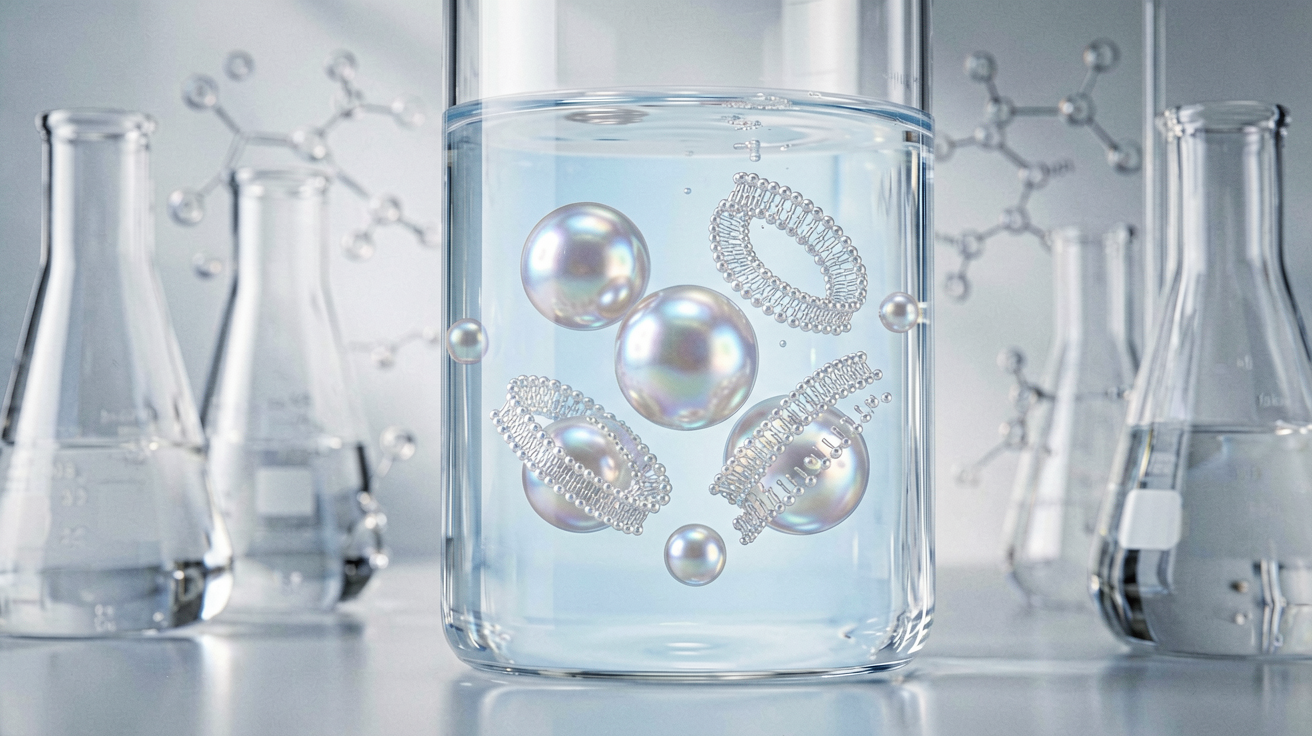
Liposomes are spherical vesicles composed of phospholipid bilayers, structurally mimicking cell membranes. Their amphiphilic nature allows encapsulation of hydrophilic actives (like GSH) within the aqueous core while the lipid bilayer provides protection and enhanced skin penetration.
A 2024 randomized, split-face clinical trial (n=48, 12-week duration) compared 2% liposomal glutathione gel against 2% free glutathione gel and placebo. The liposomal group demonstrated:
Mean melanin index reduction of 18.4% at week 12 (vs. 7.2% for free glutathione, p less than 0.001)
23.6% improvement in skin lightness (L-star value) measured by chromameter
41% higher GSH retention in stratum corneum tape-stripping analysis at 6 hours post-application
No significant irritation or adverse events reported
The mechanism behind this enhancement is well-characterized. Phospholipid bilayers fuse with intercellular lipids in the stratum corneum, creating transient channels that facilitate deeper penetration. The encapsulated GSH remains protected from oxidation during this transit. Once in the viable epidermis, liposomes release their payload through pH-triggered destabilization — the mildly acidic environment of the epidermis (pH 5.0-5.5) causes phospholipid hydrolysis and controlled GSH release.
A separate 2023 study evaluated phospholipid composition effects on GSH penetration. Liposomes with phosphatidylcholine:cholesterol ratios of 4:1 achieved 2.8x higher dermal GSH deposition compared to 2:1 formulations. Particle size proved critical: 100-200 nm liposomes showed optimal penetration, while formulations exceeding 400 nm remained trapped in the superficial stratum corneum.
Comparative Efficacy: GSH vs. Established Brighteners
Head-to-head clinical data comparing liposomal glutathione against other brightening actives is limited but informative. A 2025 comparative study (n=60) evaluated four active treatments over 16 weeks. Liposomal GSH at 2% achieved 19.8% melanin index reduction and a 34.2% increase in antioxidant capacity, compared to niacinamide 5% (14.3% and 8.1%), tranexamic acid 3% (21.1% and 5.4%), and alpha arbutin 2% (16.7% and 11.2%). Patient satisfaction scores were 78% for liposomal GSH, 71% for niacinamide, 74% for tranexamic acid, and 69% for alpha arbutin.
Liposomal GSH demonstrated the highest improvement in skin antioxidant capacity — a critical parameter for long-term brightening maintenance. Tranexamic acid showed marginally better melanin index reduction through its plasmin pathway inhibition, but the combination of brightening efficacy and oxidative protection makes liposomal GSH uniquely suited for comprehensive skin tone management.
The Southeast Asian Market Context
The relevance of liposomal glutathione to Southeast Asian skincare markets cannot be overstated. Regional consumer surveys consistently rank hyperpigmentation and uneven skin tone as the top two skin concerns among women aged 25-45. The ASEAN cosmetics market has seen glutathione-containing product launches increase by 47% year-over-year as of Q2 2026, with liposomal or encapsulation claims appearing in 31% of new premium brightening products.
Consumer expectations are evolving. The era of glutathione as a straightforward “whitening” ingredient is ending. Informed consumers now demand evidence of delivery technology, stability data, and clinical validation. Brands that can substantiate their liposomal glutathione claims with third-party testing are positioned to capture premium-tier market share in a segment growing at 11.2% CAGR.
Regulatory trends also favor advanced delivery systems. ASEAN’s harmonized cosmetic regulations increasingly scrutinize unsubstantiated brightening claims. Liposomal technology provides a defensible mechanism-of-action narrative that satisfies both regulatory requirements and consumer skepticism.
Formulation Considerations for Maximum Stability
Achieving clinically meaningful results with topical glutathione demands rigorous attention to formulation parameters.
First, pH Optimization: Maintain formulation pH between 5.5-6.0. GSH oxidation accelerates sharply below pH 5.0, while pH above 7.0 compromises the acid mantle compatibility required for daily use.
Second, Antioxidant Synergists: Include ascorbic acid (0.5-1.0%) or ferulic acid (0.1-0.5%) as sacrificial antioxidants within the aqueous phase. These compounds oxidize preferentially, preserving GSH in its reduced form during storage.
Third, Lipid Bilayer Composition: Phosphatidylcholine-based liposomes with 15-25% cholesterol content provide optimal balance of rigidity (for storage stability) and fusogenicity (for skin penetration). Hydrogenated phospholipids extend shelf-life but reduce penetration efficiency — a trade-off that must be explicitly managed.
Fourth, Packaging: Airless pump packaging is non-negotiable. GSH in open jars degrades to GSSG within days. Nitrogen-blanketed filling processes extend shelf stability by 40-60% compared to ambient filling.
Future Directions: Where the Science Is Heading
The next frontier for glutathione in skincare involves three converging innovations. First, dual-chamber delivery systems that keep GSH and its activating cofactors separate until the moment of application, eliminating the need for antioxidant synergists in the primary formula. Several prototypes achieved GSH recovery rates exceeding 95% at 12-month accelerated aging tests.
Second, peptide-conjugated glutathione (GSH-CPP) is showing remarkable promise. By attaching cell-penetrating peptide sequences to the glutathione molecule, researchers have achieved 3.7x higher intracellular GSH levels compared to liposomal delivery alone in preliminary ex vivo studies.
Third, the intersection of glutathione with circadian skincare is generating substantial academic interest. GSH biosynthesis follows a marked diurnal rhythm, with peak synthesis occurring during sleep hours. Nighttime glutathione formulations aligned with this endogenous rhythm may provide amplified brightening effects — a hypothesis currently under investigation in a multi-center trial across six Asian dermatology centers.
The data are clear: glutathione is not a commodity ingredient. When delivered via validated liposomal technology, it stands among the most versatile and evidence-supported brightening actives available to formulators. The market has moved beyond the question of whether glutathione works. The question that matters now is whether your formulation works — and the difference lies entirely in the delivery system.
Interested in Formulation Data Collaboration?
Let's discuss how Melasyl AI can accelerate your next whitening or brightening formula. Technical collaboration, data licensing, or custom AI-driven research — reach out.
Contact Wei →