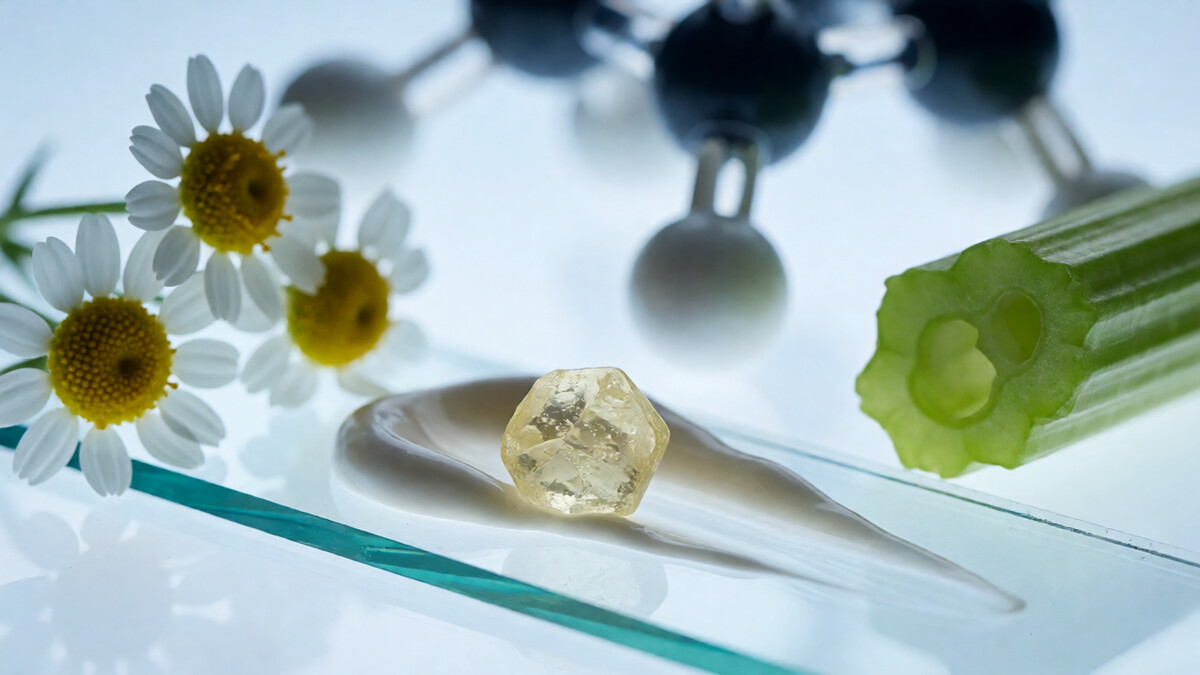
Most brightening actives earn their reputation by attacking tyrosinase directly. Luteolin, the 3’,4’,5,7-tetrahydroxyflavone found in chamomile, celery, parsley and dyers’ weld (Reseda luteola), does something different — and the difference is exactly what makes it interesting in 2026. In B16 melanoma assays luteolin fails to inhibit the enzyme in a test tube, yet it still suppresses melanin production in living cells. That contradiction has been resolved by two decades of signalling research, and it points to a mechanism that sits one step upstream of the enzyme everyone else chases.
Luteolin Is Not a Tyrosinase Inhibitor — It Is a cAMP Brake
Choi and colleagues at Chung-Ang University were the first to dissect this. In α-MSH-stimulated B16 melanoma cells, luteolin produced dose-dependent inhibition of both tyrosinase activity and melanin synthesis, yet it showed no direct inhibition of tyrosinase itself in cell-free assays (Arch Pharm Res, 2008; PMID 18806960). The explanation lay upstream: luteolin dose-dependently lowered cAMP levels in cells stimulated by α-MSH and by forskolin, pointing to direct inhibition of adenyl cyclase. By cutting the cAMP signal, luteolin starves the PKA–CREB axis that would otherwise switch on the melanogenic programme.
That finding matters because it reframes luteolin as a signalling modulator rather than an enzyme blocker. Where hydroquinone and resorcinol derivatives compete for the tyrosinase active site, luteolin reduces the cell’s decision to build tyrosinase in the first place.
The CREB–MITF Switch and a Metabolite That Outperforms the Parent
The downstream picture was filled in by Lee and Boo’s group at Kyungpook National University. Working with luteolin-7-sulfate isolated from the marine plant Phyllospadix iwatensis, they showed that the sulfated metabolite attenuated forskolin-induced MITF and tyrosinase expression at both mRNA and protein levels, and reduced CREB phosphorylation, in B16-F10 cells and primary human epidermal melanocytes (Antioxidants, 2019; PMID 30987288). MITF is the master transcription factor that coordinates tyrosinase, TRP-1 and TRP-2, so suppressing MITF expression collapses the entire melanogenic cascade at once.
Critically, luteolin-7-sulfate was less cytotoxic than the parent flavone, and its antimelanogenic potency was reported to be several dozen times greater than arbutin’s — a striking result for a metabolite most formulators have never considered.
MAPK and PI3K/Akt: The Second and Third Handles
Byun and co-workers added a further layer using gamma-irradiated luteolin in IBMX-stimulated B16BL6 cells. The derivative suppressed MITF and CREB, and also reduced phosphorylation of PI3K/Akt and ERK; the effect was abolished by the specific inhibitors PD98059 and LY294002, confirming that ERK and PI3K signalling are mechanistically required (J Med Food, 2017; PMID 28753056). Luteolin therefore touches at least three nodes — adenyl cyclase/cAMP, MAPK, and PI3K/Akt — which is unusual for a single small molecule.
A structure-activity caution is worth stating. Apigenin differs from luteolin by a single hydroxyl group yet stimulates melanin synthesis, while luteolin inhibits it. In human A375 cells, luteolin was reported to upregulate Agouti-signalling protein (ASIP) roughly 17-fold, which would antagonise MC1R and blunt α-MSH signalling through a route that has nothing to do with enzyme inhibition. Small structural changes flip the sign of the effect; this is not a family where one flavonoid can stand in for another.
The Photoprotection Evidence Is the Strongest Human Data
For all the cell biology, the most translationally useful evidence for luteolin is photoprotective. Wölfle and colleagues at Freiburg showed that luteolin absorbs across both UVB and UVA, with transmission below 370 nm under 10%, and that topical application reduced UVB-induced cyclobutane pyrimidine dimers in human skin. It also inhibited UVB-induced erythema and the upregulation of COX-2 and prostaglandin E₂ via MAPK interference (Free Radic Biol Med, 2011; PMID 21281711). In the H₂DCFDA keratinocyte assay, luteolin’s EC₅₀ for radical scavenging was 3 µg/mL versus 12 µg/mL for Trolox and 847 µg/mL for N-acetylcysteine — an order-of-magnitude advantage over the antioxidant most formulations rely on.
A follow-up study showed the effect is synergistic: combining luteolin with tocopherol and ubiquinone at a 4:1:4 ratio produced complete photoprotection at 2 µg/mL, a concentration at which none of the three worked alone. That is a ready-made antioxidant-triad blueprint.
The Formulation Problem Nobody Should Skip
Luteolin’s weakness is physicochemical, not biological. Its aqueous solubility is roughly 0.005 mg/mL, its log P sits near 2.4, and its molecular weight (286.24 g/mol) lands it in the awkward middle for passive skin penetration. Unprotected, it can lose a large fraction of activity within weeks through oxidation, and its reported half-life in aqueous solution at physiological pH is only 8–12 hours. A 2021 study found it stable in propylene glycol and Labrasol, with maximum stability at pH 5.5–6.5 — conveniently close to skin’s own pH.
Delivery engineering fixes most of this. A 2026 hyaluronate-stabilised luteolin microemulsion gel achieved 28.77 nm droplets and improved ex vivo skin permeation 2.09-fold over a plain gel, with 60-day physicochemical stability (Colloids Surf B, 2026; PMID 41638005). A self-emulsifying phospholipid preconcentrate raised permeability seven-fold and improved ROS scavenging 203% versus unformulated luteolin in HaCaT cells (Pharmaceutics, 2022; PMID 36145644). Nanosuspensions, cyclodextrin complexation and SLN/NLC systems all report similar gains, and β-cyclodextrin inclusion can lift apparent solubility up to 12–20 fold.
The Honest Reality Check
Nearly all the pigmentation data are in vitro or animal. The human evidence that exists concerns photoprotection endpoints — erythema, DNA damage, prostaglandins — not melanin or lesion clearance. No published randomised trial has yet demonstrated that topical luteolin fades melasma or post-inflammatory hyperpigmentation in humans. Anyone claiming otherwise is extrapolating.
That does not make luteolin a bad active; it makes it an honest one. Its mechanism is genuinely distinct from the tyrosinase-inhibitor crowd, its antioxidant and photoprotective profile is strong and partly human-validated, and its delivery science is mature. The right framing is a supporting active that reduces the upstream signalling load and defends against the UV and inflammatory drivers of pigmentation — not a standalone depigmenting hero.
Practical Formulation Notes
- Solubilise first. Use a glycol/Labrasol blend, a microemulsion or a cyclodextrin complex; an undissolved flavonoid is a wasted one.
- Hold pH 5.5–6.5. This protects both stability and skin compatibility.
- Build the antioxidant triad. Luteolin with tocopherol and ubiquinone is synergistic at low concentrations.
- Shield from light and oxygen. Consider airless packaging and NLC encapsulation for shelf life.
- Position it honestly. A photoprotection and anti-inflammatory support active, not a melanin-removal claim.
Luteolin’s value in 2026 is that it attacks pigmentation from a different angle than the market’s tyrosinase obsession — through adenyl cyclase, CREB and MITF, backed by credible antioxidant and DNA-protective data. Formulate it with the same rigour the mechanism demands, and it earns a place in a multi-pathway brightening system.
References
- Choi MY et al. Whitening activity of luteolin related to the inhibition of cAMP pathway in α-MSH-stimulated B16 melanoma cells. Arch Pharm Res. 2008;31(9):1166-71. PMID 18806960.
- Lee SW et al. Luteolin 7-sulfate attenuates melanin synthesis through inhibition of CREB- and MITF-mediated tyrosinase expression. Antioxidants. 2019;8(4):87. PMID 30987288.
- Byun EB et al. Gamma-irradiated luteolin inhibits IBMX-induced melanogenesis through CREB/MITF, PI3K/Akt and ERK pathways in B16BL6 cells. J Med Food. 2017. PMID 28753056.
- Wölfle U et al. UVB-induced DNA damage, ROS and inflammation are attenuated by luteolin in vitro and in vivo. Free Radic Biol Med. 2011;50(9):1081-93. PMID 21281711.
- Wölfle U et al. Photoprotective and antioxidative properties of luteolin are synergistically augmented by tocopherol and ubiquinone. Planta Med. 2013.
- Huang C et al. Sodium hyaluronate-stabilized luteolin-loaded microemulsion gel. Colloids Surf B. 2026;262:115496. PMID 41638005.
- Hsieh YS et al. Self-emulsifying phospholipid preconcentrates for enhanced photoprotection of luteolin. Pharmaceutics. 2022;14(9):1896. PMID 36145644.
- Elmowafy M et al. Influence of stabilizer on luteolin nanosuspension for cutaneous delivery. Pharmaceutics. 2021;13(11):1812. PMID 34834227.
- Gendrisch F et al. Luteolin as a modulator of skin aging and inflammation. Biofactors. 2021;47(2):170-180.
Interested in Formulation Data Collaboration?
Let's discuss how Melasyl AI can accelerate your next whitening or brightening formula. Technical collaboration, data licensing, or custom AI-driven research — reach out.
Contact Wei →