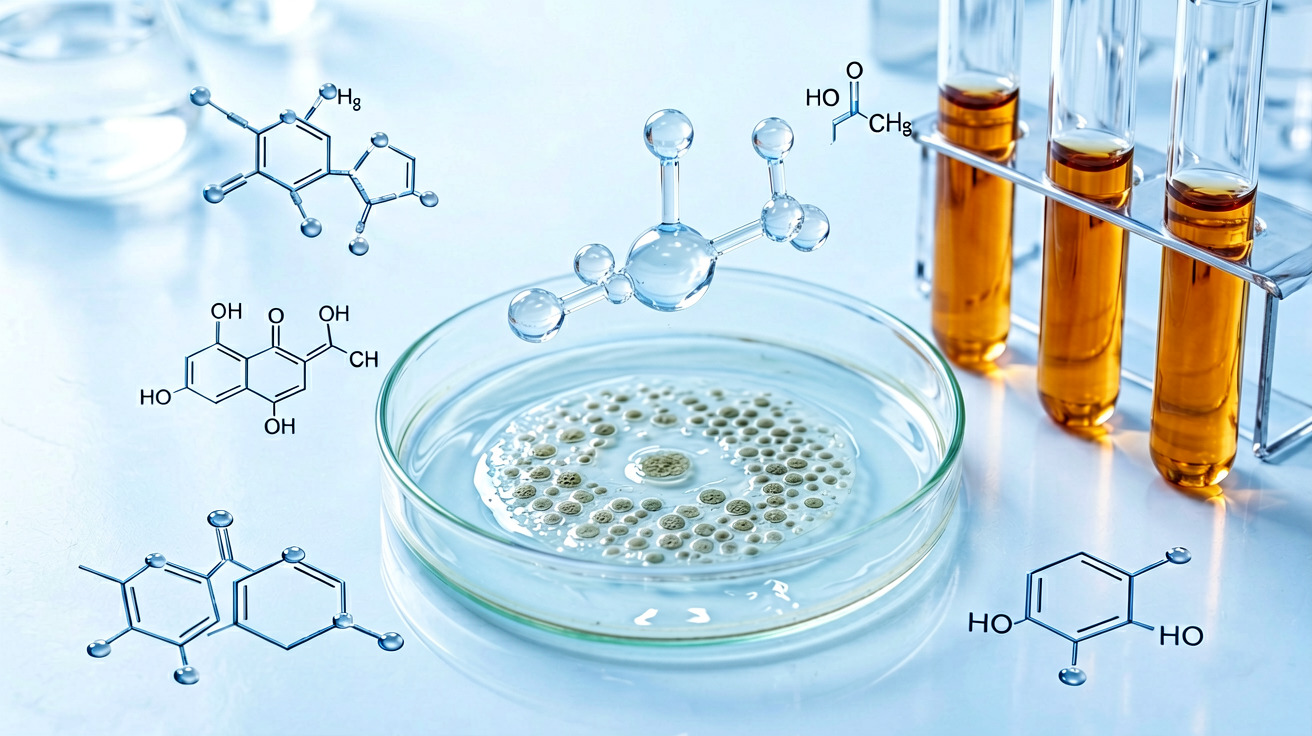
Malassezia furfur, a yeast living on your skin right now, produces a compound that can selectively kill hyperactive melanocytes — the cells responsible for dark spots. That compound is malassezin, and in 2026 it became one of the most talked-about ingredients in pigmentation science.
What Is Malassezin?
Malassezin is a naturally occurring indole alkaloid synthesized by Malassezia furfur, a lipophilic yeast that colonizes human skin as part of its normal microbiome. First isolated and characterized by Krämer et al. (2005) at Justus Liebig University Giessen, researchers identified malassezin as a potent agonist of the aryl hydrocarbon receptor (AhR) — a ligand-activated transcription factor with broad regulatory functions in skin homeostasis [1].
The discovery emerged from a clinical observation: patients with pityriasis versicolor, a common Malassezia-driven skin condition, develop long-lasting depigmented patches that persist even after the yeast is eradicated. Researchers traced this depigmentation not to tyrosinase inhibition, but to malassezin’s ability to induce apoptosis in primary human melanocytes — programmed cell death of pigment-producing cells [1].
This mechanism is fundamentally different from every conventional brightening agent. Hydroquinone, kojic acid, arbutin, tranexamic acid, and niacinamide all work by inhibiting enzymes or blocking melanin transfer. Malassezin removes the melanocyte itself — specifically the hyperactive ones — while sparing normally functioning pigment cells.
The AhR Pathway: A New Target in Pigmentation Science
The aryl hydrocarbon receptor is a cytoplasmic transcription factor that, upon ligand binding, translocates to the nucleus and modulates gene expression. In melanocytes, AhR activation by malassezin triggers a cascade that suppresses tyrosinase, TYRP-1, and dopachrome tautomerase (TRP-2/DCT) — the three core enzymes of melanogenesis — while simultaneously inducing apoptotic markers in cells with elevated melanin output [2].
This dual action — enzyme suppression plus selective apoptosis — explains why malassezin-treated skin shows durable depigmentation rather than the rebound pigmentation commonly seen with tyrosinase inhibitors. When you stop applying kojic acid or hydroquinone, melanocytes resume normal melanin production within weeks. When malassezin eliminates hyperactive melanocytes, the pigment-producing capacity itself is reduced, and the effect persists even after treatment cessation.
Clinical Evidence: From Proof-of-Concept to Head-to-Head with Hydroquinone
The 2022 Proof-of-Concept Study
The first clinical investigation of topical malassezin was a 22-week, double-blind, dose-ranging study led by Dr. Pearl E. Grimes at the Vitiligo & Pigmentation Institute of Southern California. Twenty subjects with melasma (n=8) or photodamage-induced dyschromia (n=12) were randomized to vehicle, 0.1%, 0.5%, or 1.0% malassezin formulations, applied twice daily for 14 weeks followed by 8 weeks of observation [3].
Results were striking:
- Mexameter colorimetry showed improvement as early as week 2 — a remarkably rapid onset compared to the 4-8 week onset typical of tyrosinase inhibitors.
- At 14 weeks, 69% of subjects showed decreased facial hyperpigmentation on clinical assessment.
- The 1.0% formulation group achieved a 2.93% reduction in melanin index versus 0.27% for vehicle.
- Lightening effects persisted for 8 weeks after treatment cessation with no observed relapse — an outcome rarely reported with any other topical agent [3].
A companion histopathological study published in the Journal of Drugs in Dermatology confirmed the mechanism: biopsies at weeks 8 and 14 showed decreased epidermal melanin in all subjects, with melanocytes appearing less dendritic and slightly reduced in number. By week 22 (8 weeks post-treatment), melanin levels had returned toward baseline — confirming the process is reversible and does not permanently destroy melanocytes [4]. No melanocyte atypia was observed in any biopsy, addressing early safety concerns.
The 2026 Randomized Split-Face Trial
The pivotal study arrived in 2026. Grimes et al. published a randomized, controlled, split-face, double-blind trial in the Journal of Drugs in Dermatology directly comparing 0.75% topical malassezin to 4% hydroquinone — the gold standard — in 20 adult women with symmetrical mild-to-moderate melasma [5].
Each participant applied malassezin to one side of the face and hydroquinone to the other, twice daily for 12 weeks. The split-face design controlled for individual variation in skin type, UV exposure, and hormonal status.
Results at 12 weeks:
- Brightening scores: malassezin 1.85 vs. hydroquinone 1.95 (P=0.027 and P=0.008 respectively vs. baseline)
- Global improvement scores: malassezin 2.2 vs. hydroquinone 2.3 (P=0.004 and P=0.001)
- Hemi-MASI reduction: malassezin 2.49 vs. hydroquinone 2.33 (P<0.001 for both)
- No statistically significant difference between malassezin and hydroquinone at any visit
- Side effects were mild in both groups, with no serious adverse events [5]
Notably, malassezin achieved a marginally higher numerical reduction in hemi-MASI than hydroquinone — though this did not reach statistical significance. The clinical implication is clear: malassezin matches the gold standard in efficacy while operating through an entirely different mechanism, opening the door to combination strategies.
Why the Persistence Profile Matters
The 8-week post-treatment durability observed across both clinical studies is malassezin’s most distinguishing feature. Every conventional brightening agent — hydroquinone, tranexamic acid, thiamidol, kojic acid, retinoids — requires continuous use to maintain results. Discontinuation typically leads to relapse within 4-6 weeks as melanocytes recover normal (or elevated) activity.
Malassezin’s persistence stems from its mechanism. By inducing apoptosis in hyperactive melanocytes rather than temporarily suppressing enzyme activity, the pigment-producing capacity itself is diminished. The melanocyte population gradually recovers over weeks, explaining both the durability and the eventual reversibility — a critical safety feature that distinguishes malassezin from permanent depigmenting agents.
This profile is particularly relevant for melasma, a condition notorious for relapse. Current maintenance protocols require year-round photoprotection plus rotating active ingredients. A treatment that maintains effect for 8 weeks post-cessation could fundamentally change maintenance protocols, reducing the cumulative irritation and compliance burden that undermines long-term melasma management.
Market Context: The Microbiome-to-Pigmentation Pipeline
Malassezin sits at the intersection of two of the fastest-growing categories in skincare science: microbiome-derived actives and next-generation hyperpigmentation treatments. The global skin microbiome market is projected to exceed $3 billion by 2030, while the hyperpigmentation treatment market continues to grow at 8-10% annually driven by rising melasma prevalence and post-inflammatory hyperpigmentation in skin of color populations [6].
At the 2026 American Academy of Dermatology Annual Meeting in Denver, Dr. Heather Woolery-Lloyd (Director, Skin of Color Division, University of Miami) presented malassezin as a prime example of microbiome-derived therapeutics, highlighting its selective apoptosis mechanism and the head-to-head hydroquinone data [7]. The presentation generated significant interest among dermatologists seeking hydroquinone alternatives — particularly for long-term maintenance protocols where hydroquinone’s ochronosis risk necessitates treatment holidays.
Commercial availability remains limited as malassezin progresses through clinical validation, but the ingredient has already entered the development pipelines of several specialty skincare brands. The 2026 landscape also includes 2-MNG (Melasyl) from L’Oréal and thiamidol from Beiersdorf/Eucerin — both offering alternatives to hydroquinone through different mechanisms. Malassezin’s unique apoptosis-driven pathway positions it as a complementary rather than competitive agent: combination protocols with tyrosinase inhibitors could theoretically address both melanin production and melanocyte hyperactivity simultaneously.
Safety Profile and Regulatory Outlook
Across all published studies, malassezin has demonstrated no clinically significant adverse events. The proof-of-concept study reported no irritation, no post-inflammatory hyperpigmentation, and no depigmentation of normally pigmented skin — a critical safety distinction from non-selective cytotoxic agents [3]. The 2026 split-face trial confirmed mild side effects comparable to hydroquinone, with no serious reactions [5].
Histopathological data provides additional reassurance: melanocyte numbers recover to baseline within 8 weeks of treatment cessation, with no evidence of atypia, permanent destruction, or vitiligo-like depigmentation [4]. This reversible, selective action addresses the primary safety concern that has limited other melanocyte-targeting approaches.
However, important questions remain. The published trials involve small sample sizes (n=7 to n=20), and larger confirmatory studies across diverse skin phototypes and ethnicities are needed before regulatory approval and widespread commercialization. Long-term safety data beyond 14 weeks of continuous use has not been published. Optimal concentration, dosing frequency, and combination protocols require further investigation.
Formulation Considerations for Future Development
For formulators watching malassezin’s clinical trajectory, several technical considerations will shape commercial viability:
- Stability: As an indole alkaloid, malassezin’s photostability and oxidation kinetics in finished formulations have not been publicly characterized. Encapsulation strategies (lipid carriers, niosomes) may be necessary to protect the active during shelf life.
- Penetration: Effective delivery requires reaching melanocytes in the basal epidermis. The 0.75% formulation used in the 2026 trial achieved sufficient penetration, but vehicle optimization will be critical for broader commercial formulations.
- Selectivity: The clinical data suggests malassezin preferentially targets hyperactive melanocytes, but the selectivity mechanism is not fully understood. Formulation factors that alter penetration depth or concentration gradients could affect this selectivity profile.
- Combination compatibility: The AhR pathway does not directly interact with tyrosinase inhibition, melanosome transfer blockade, or cell turnover mechanisms, suggesting malassezin could be combined with niacinamide, tranexamic acid, or retinoids without mechanistic conflict.
The Broader Implication: Skin Microbiome as a Pigmentation Thermostat
Malassezin’s emergence signals a paradigm shift in how we think about the skin microbiome’s role in pigmentation. For decades, Malassezia was viewed primarily as a pathogen — the cause of pityriasis versicolor, seborrheic dermatitis, and malassezia folliculitis. The discovery that its metabolites can regulate melanocyte function reveals a more nuanced picture: the skin microbiome doesn’t just protect against pathogens; it actively modulates pigment production.
This opens a broader research frontier. Malassezia furfur produces over a dozen tryptophan-derived indoles, several of which show biological activity relevant to skin pigmentation, UV protection, and immune modulation [8]. Pityriacitrin, another Malassezia-derived indole, demonstrates potent UV-absorbing properties and could serve as a microbiome-derived photoprotective agent. The full pigmentation-regulating capacity of the skin microbiome remains largely unexplored.
For the skincare industry, this means the next decade of brightening science may be defined less by discovering new synthetic tyrosinase inhibitors and more by mining the skin’s own microbial chemistry for compounds that regulate pigmentation at the cellular level.
References
- Krämer HJ, Podobinska M, Bartsch A, et al. “Malassezin, a novel agonist of the aryl hydrocarbon receptor from the yeast Malassezia furfur, induces apoptosis in primary human melanocytes.” ChemBioChem. 2005;12(3):287-298. PMID: 15812864.
- Grimes PE, Bhawan J, Howell MD, et al. “A novel proof-of-concept study assessing the lightening effects and safety of malassezin for treatment of facial hyperpigmentation.” J Am Acad Dermatol. 2022;87(2):456-458.
- Grimes PE, Bhawan J, Howell MD, et al. “A novel proof-of-concept study assessing the lightening effects and safety of malassezin for treatment of facial hyperpigmentation.” J Am Acad Dermatol. 2022;87(2):456-458. DOI: 10.1016/j.jaad.2021.10.008.
- Grimes PE, Bhawan J, Howell MD, et al. “Histopathological Changes Induced by Malassezin: A Novel Natural Microbiome Indole for Treatment of Facial Hyperpigmentation.” J Drugs Dermatol. 2022;21(2):141-145. PMID: 35133118.
- Grimes PE, Dias S, Oparaugo NC, Tatarinova T, McCraw T. “A Randomized, Controlled, Split-Face, Double-Blind Study Comparing Topical Malassezin to Hydroquinone 4% for Melasma.” J Drugs Dermatol. 2026. PMID: 41493251.
- Global Skin Microbiome Market Analysis 2024-2030. Industry market research composite estimate.
- Woolery-Lloyd H. “Late Breaking Skin of Color Cosmeceutical Concepts.” American Academy of Dermatology Annual Meeting, Denver, CO, March 27-31, 2026. Reported in HPC Today, June 2026.
- Gaitanis G, Magiatis P, Hantschke M, et al. “The Malassezia genus in skin and system diseases.” Clin Microbiol Rev. 2012;25(1):106-141. And: PMC11357556, “A New Generation of Postbiotics for Skin and Scalp,” 2024.
Conclusion
Malassezin represents the first clinically validated pigmentation treatment derived from the skin microbiome. Its AhR-mediated apoptosis mechanism offers a fundamentally new approach to hyperpigmentation — one that produces durable results without continuous treatment and without the safety liabilities of hydroquinone. The 2026 split-face trial data showing equivalence to 4% hydroquinone elevates malassezin from an interesting scientific curiosity to a serious clinical candidate.
As the skincare industry pivots toward microbiome science and mechanism-diverse brightening agents, malassezin stands as proof that the next breakthrough in pigmentation treatment may come not from a synthesis lab, but from the microorganisms already living on our skin.
Interested in Formulation Data Collaboration?
Let's discuss how Melasyl AI can accelerate your next whitening or brightening formula. Technical collaboration, data licensing, or custom AI-driven research — reach out.
Contact Wei →