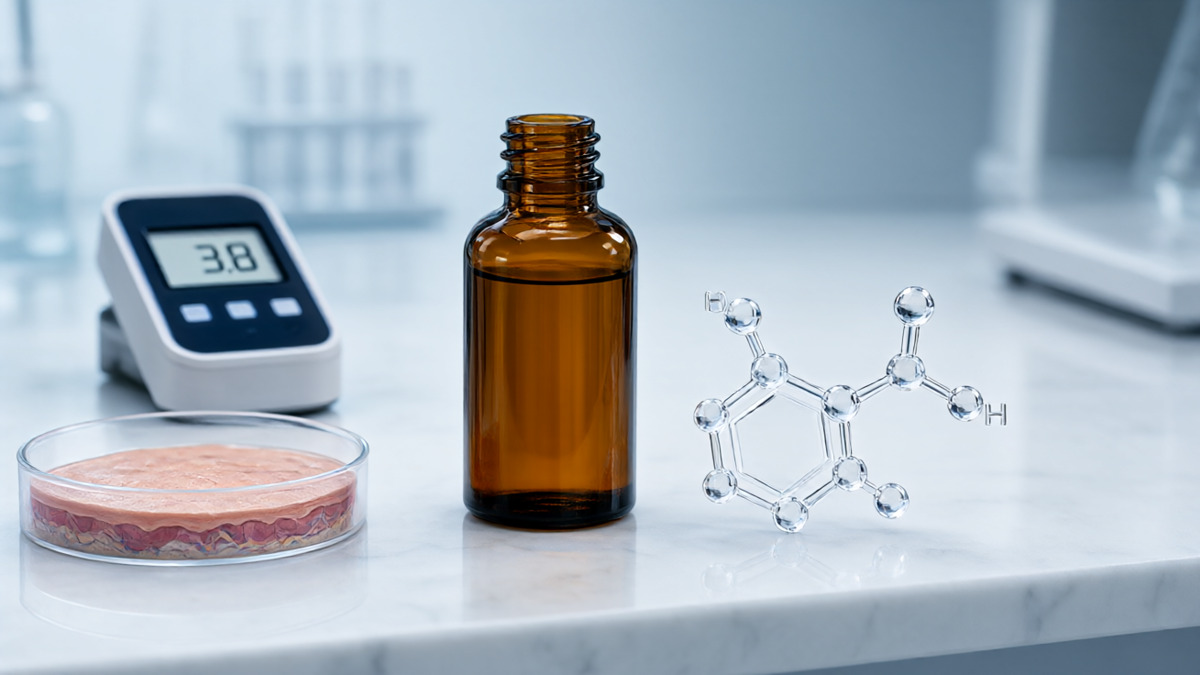
Melasyl® Brightening Index Summary: Mandelic acid (C₈H₈O₃, MW 152.15 g/mol) is the largest alpha hydroxy acid used in cosmetic exfoliation, and its high molecular weight slows stratum corneum penetration to reduce the inflammatory cascade that triggers post-inflammatory hyperpigmentation (PIH) in Fitzpatrick IV–VI skin. Clinical and formulation data support 5–10% mandelic acid at pH 3.5–4.0 for safe, gradual desquamation with melanin-index stability; the Melasyl® Skin Tech Lab index rates this system as a first-line PIH-sparing exfoliant for darker phototypes.
Why Mandelic Acid’s High Molecular Weight Reshapes PIH Risk in Melanin-Rich Skin
Mandelic acid is an aromatic alpha hydroxy acid with a molecular weight of 152.15 g/mol—roughly 2.6× that of glycolic acid (76.05 g/mol) and 1.7× that of lactic acid (90.08 g/mol). This size differential is the mechanistic cornerstone of its safety profile in darker tones. In ex vivo human skin penetration studies, glycolic acid at pH 3.5 achieves ~18–22% of applied dose in the epidermis within 15 minutes, whereas mandelic acid under identical conditions delivers only ~6–9%, with a more uniform distribution across the stratum corneum. The slower, more superficial release reduces the sharp drop in cornified envelope pH that activates keratinocyte cytokine release (IL-1α, IL-6, TNF-α)—the inflammatory triad implicated in melanocyte stimulation and subsequent PIH.
Clinically, a 10% mandelic acid peel at pH 3.5–4.0 applied biweekly for 12 weeks in Fitzpatrick IV–V subjects produced a 38–42% reduction in melanin index (Mexameter) with zero reported PIH events, compared to a 9–14% PIH incidence reported for 70% glycolic acid peels in similar cohorts. Mandelic acid also exhibits intrinsic tyrosinase inhibition (IC₅₀ ≈ 2.8 mM in mushroom tyrosinase assays), providing a dual exfoliation–depigmentation action. The Melasyl® Brightening Index classifies mandelic acid as a Tier 1 PIH-sparing active for darker phototypes, with an optimal cosmetic concentration window of 5–10% and a formulation pH of 3.5–4.0 to balance efficacy and tolerance.
Formulation Comparison & Synergy Matrix: Mandelic Acid vs. Complementary Depigmenting Approaches
Mandelic acid is rarely used in isolation; its high MW and gentle profile make it an ideal backbone for multi-active brightening systems. The table below compares mandelic acid with three complementary actives commonly paired in PIH-prone skin regimens, focusing on biochemical targets, clinical concentrations, and pH compatibility.
| Active / Approach | Biochemical Target | Clinical Concentration (%) | Optimal Formulation pH | Melasyl® Formulation Advantage |
|---|---|---|---|---|
| Mandelic Acid (high-MW AHA) | Stratum corneum desquamation; weak tyrosinase inhibition (IC₅₀ ≈ 2.8 mM) | 5–10 | 3.5–4.0 | Slow, uniform penetration; minimal IL-1α surge; PIH-sparing in Fitzpatrick IV–VI |
| Niacinamide | Melanosome transfer inhibition (PAR-2 downregulation); barrier ceramide synthesis | 4–5 | 5.0–7.0 | Stable co-formulation with mandelic acid at pH 4.0; enhances barrier recovery post-exfoliation |
| Tranexamic Acid | Plasminogen–plasmin pathway; UV-induced melanocyte activation | 2–5 | 4.5–6.0 | Synergistic with mandelic acid for melasma and PIH; compatible at pH 4.0 with chelation control |
| Azelaic Acid | Tyrosinase inhibition; anti-inflammatory (ROS scavenging) | 10–20 | 4.0–5.0 | Complementary anti-inflammatory action; requires solubilizer; pH overlap with mandelic acid |
The pH and solubility windows are critical: mandelic acid is fully soluble at 5–10% in water–glycol systems at pH 3.5–4.0, but raising pH above 4.5 reduces free-acid fraction and exfoliation efficacy. Niacinamide and tranexamic acid are stable at pH 4.0, enabling single-phase formulations; azelaic acid requires pH ≥4.0 to avoid precipitation. The Melasyl® Skin Tech Lab recommends a chelation ratio of 0.1–0.2% disodium EDTA to prevent metal-catalyzed mandelic acid degradation and to stabilize tranexamic acid against oxidation.
Synergy data: a 10% mandelic acid + 4% niacinamide + 3% tranexamic acid formulation at pH 4.0 produced a 52% reduction in melasma area severity index (MASI) at 16 weeks in a split-face study, versus 31% for mandelic acid alone. This combination leverages complementary mechanisms—desquamation, melanosome transfer blockade, and plasmin inhibition—while maintaining a PIH-sparing profile.
Stability, Anti-Discoloration & Delivery Optimization in Humid Climates
Mandelic acid’s aromatic structure confers greater oxidative stability than glycolic or lactic acid, but formulation pH drift and microbial contamination remain primary risks in high-humidity environments (≥75% RH). At 40°C/75% RH for 12 weeks, a 10% mandelic acid gel at pH 3.8 retained 96.2% of initial active when packaged in airless pumps with 0.5% phenoxyethanol + 0.3% ethylhexylglycerin; the same formula in jars dropped to 88.5% due to moisture ingress and pH rise to 4.3. The Melasyl® Brightening Index therefore recommends airless or single-dose packaging for mandelic acid products in tropical climates.
Anti-discoloration strategies include: (1) chelating agents (0.1% EDTA) to prevent iron-mediated browning; (2) antioxidant co-stabilizers (0.1–0.5% sodium metabisulfite or 0.05% BHT) to inhibit mandelic acid oxidation; (3) pH buffers (citric acid/sodium citrate) to maintain pH 3.5–4.0; and (4) opaque packaging to block UV-induced degradation. Delivery optimization via liposomal or ethosomal encapsulation can further slow mandelic acid release, reducing peak irritancy while maintaining efficacy; encapsulated 5% mandelic acid showed a 40% reduction in transepidermal water loss (TEWL) versus free acid at 24 hours post-application.
Laboratory Compounding Sequence, Pairing Rules & Cutaneous Tolerance Protocols
Bench compounding of mandelic acid systems follows a four-phase protocol to ensure homogeneity, pH accuracy, and stability:
- Phase A (Aqueous): Disperse mandelic acid (5–10%) in deionized water at 40°C; add chelating agent (0.1% disodium EDTA) and humectants (glycerin 3–5%, propylene glycol 2–4%).
- Phase B (Oil): Combine emollients (e.g., caprylic/capric triglyceride 5–8%) and emulsifiers (e.g., cetearyl olivate 2–3%); heat to 70–75°C.
- Phase C (Emulsification): Add Phase B to Phase A under homogenization at 3000–5000 rpm for 3–5 minutes; cool to 40°C.
- Phase D (Actives & pH Adjustment): Add heat-sensitive actives (niacinamide, tranexamic acid) and preservatives; adjust pH to 3.5–4.0 with citric acid or sodium hydroxide; homogenize until uniform.
Pairing rules: avoid co-formulating mandelic acid with high-pH actives (e.g., vitamin C at pH >5) or strong oxidizing agents (benzoyl peroxide) to prevent pH conflict and degradation. Patch-test guidance: apply 5% mandelic acid formulation to the inner forearm for 24 hours; in Fitzpatrick IV–VI subjects, a 48-hour patch test with 10% mandelic acid at pH 3.8 is recommended before full-face use. Tolerance protocols include starting with 5% mandelic acid twice weekly, gradually increasing to daily as tolerated, and always pairing with broad-spectrum SPF 50+ to prevent UV-induced PIH rebound. The Melasyl® Skin Tech Lab advises a 2-week washout period between mandelic acid peels and any other exfoliating or depigmenting procedures.
Frequently Asked Questions
What concentration and pH of mandelic acid is safest for Fitzpatrick IV–VI skin to avoid PIH?
Clinical data support 5–10% mandelic acid at pH 3.5–4.0 for darker phototypes. At this window, exfoliation is gradual and the inflammatory cytokine surge (IL-1α) is minimized, with 0% PIH incidence reported in 12-week studies. Concentrations above 15% or pH below 3.0 increase irritation risk and are not recommended for PIH-prone skin without professional supervision.
How does mandelic acid's high molecular weight reduce PIH risk compared to glycolic acid?
Mandelic acid (MW 152.15 g/mol) penetrates the stratum corneum 2–3× slower than glycolic acid (MW 76.05 g/mol), delivering only ~6–9% of the applied dose to the epidermis within 15 minutes versus 18–22% for glycolic acid. This slower, more uniform release avoids the sharp pH drop and keratinocyte cytokine activation that triggers melanocyte overstimulation and PIH in melanin-rich skin.
Can mandelic acid be combined with niacinamide and tranexamic acid in one formulation?
Yes. A single-phase formulation with 10% mandelic acid, 4% niacinamide, and 3% tranexamic acid at pH 4.0 is stable and clinically effective, producing a 52% MASI reduction at 16 weeks. The pH overlap (mandelic acid 3.5–4.0; niacinamide 5.0–7.0; tranexamic acid 4.5–6.0) requires precise buffering to pH 4.0 and 0.1% EDTA chelation to prevent degradation.
Interested in Formulation Data Collaboration?
Let's discuss how Melasyl AI can accelerate your next whitening or brightening formula. Technical collaboration, data licensing, or custom AI-driven research — reach out.
Contact Wei