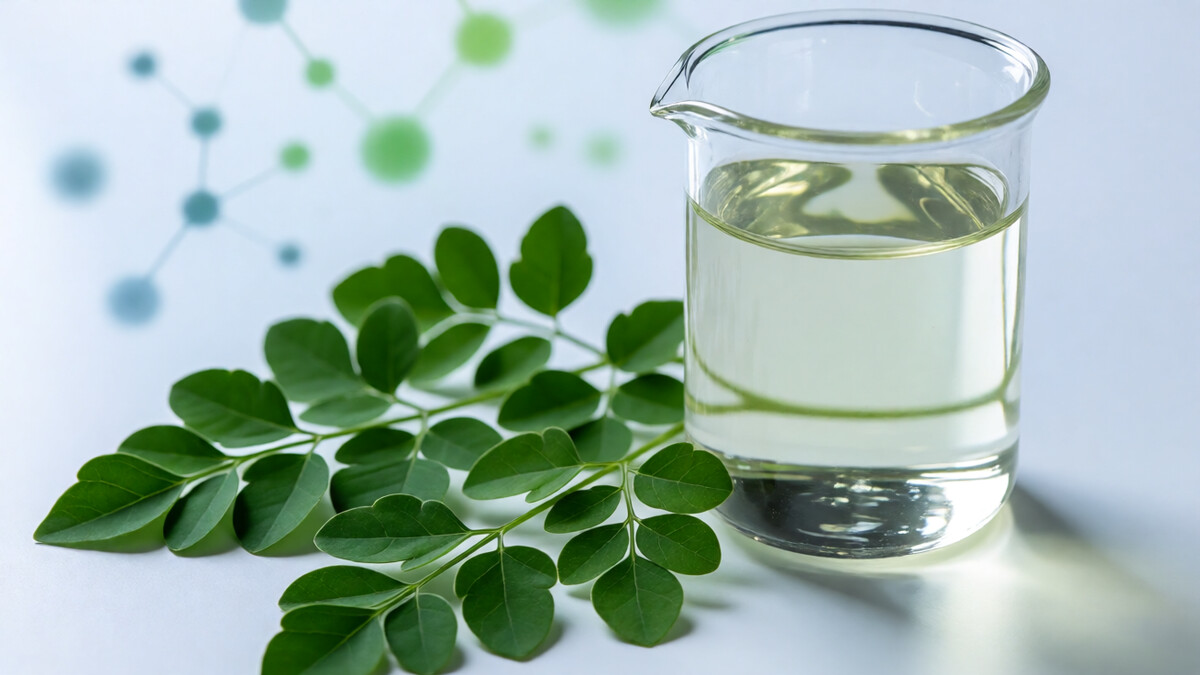
Moringa (Moringa oleifera) has spent the last decade as a wellness supplement and a cooking oil — not as a brightening active. That is changing fast. In 2026, moringa fractions are appearing in K-beauty and clean-beauty dark-spot serums, and unlike most “superfood-to-skincare” crossovers, this one has real kinetic and reconstructed-skin data behind it. This review breaks down what the literature actually supports for hyperpigmentation.
What Is the Active? A Multi-Fraction Story
Moringa is not a single-molecule ingredient, and its leaf and seed fractions behave differently. The research separates them clearly:
- Luteolin and flavonoid glycosides — the leaf’s headline actives. Luteolin is a flavone that binds the tyrosinase–substrate complex rather than the free enzyme, producing an unusually clean inhibition profile.
- Chlorogenic acid and caffeoylquinic acids — phenolic acids that contribute antioxidant capacity and mild tyrosinase suppression.
- Moringa isothiocyanates (moringin, MIC-1) — the seed’s signature chemistry, best known as an Nrf2 pathway activator rather than a direct enzyme inhibitor.
- Quercetin, kaempferol and rutin — supporting polyphenols that modulate oxidative stress and inflammatory signalling.
For pigment control, the leaf extract is the more mechanistically interesting fraction; the seed fraction is the stronger antioxidant and anti-inflammatory player. Formulators should treat them as complementary, not interchangeable.
Mechanism: Uncompetitive Tyrosinase Inhibition
The most cited mechanistic study is Hashim et al. (Molecules, 2021), which screened several plant extracts against mushroom tyrosinase. Most botanical extracts inhibit tyrosinase competitively or in mixed fashion. Moringa oleifera leaf was the outlier: it produced a rare uncompetitive inhibition pattern, with an inhibition constant (Kii) of 73 µg/mL. Uncompetitive inhibitors bind the enzyme–substrate (ES) complex rather than the free enzyme, which means their potency increases as substrate accumulates — a genuinely favourable behaviour in a melanocyte packed with tyrosine.
HPLC-MS analysis traced the activity to luteolin, and a follow-up kinetic run with purified luteolin reproduced the same ES-complex binding. In the same assay, moringa leaf extract returned an IC50 of 121.3 µg/mL against tyrosinase diphenolase — lower (better) than kojic acid at 192.3 µg/mL and ascorbic acid at 235.7 µg/mL under identical conditions. That is a meaningful benchmark: moringa is outperforming two of the industry’s reference brighteners in the same tube.
The seed fraction works through a different axis. Moringa isothiocyanates activate the Nrf2–ARE pathway, upregulating the cell’s own antioxidant enzymes — NQO1, HO-1 and GCLC — at concentrations as low as 1.25–5 µM (Cheng et al., AAPS Journal, 2019). In pigment terms, this reduces the UV-driven oxidative load that feeds melanocyte stimulation, complementing the leaf’s direct enzyme blockade.
Clinical and Model Evidence
Human-scale data is still limited, but the reconstructed-skin evidence is strong. Zeitoun et al. (International Journal of Dermatology, 2020) tested moringa seed extract on a reconstructed human pigmented epidermis (RHPE) model — a co-culture of keratinocytes and melanocytes, the closest in-vitro proxy for real skin. Moringa extract, alone and in combination with Adansonia digitata seed oil, reduced melanin content by 21–27% after six days, and the depigmenting activity was equivalent to or better than kojic acid. No cytotoxicity was observed.
A separate Korean study (Lim et al., J Korean Soc Food Sci Nutr, 2024) confirmed that moringa leaf powder, tea and fermented preparations all reduced tyrosinase activity, with the fermented form additionally boosting superoxide dismutase — supporting the antioxidant-plus-enzyme-inhibition framing.
What is missing is a large, placebo-controlled facial trial with instrumented melanin measurement. The current evidence base is reconstructed-skin plus enzyme kinetics; treat moringa as a well-supported adjunct rather than a proven mono-active.
Formulation Science: Getting Moringa to the Melanocyte
The practical bottleneck is delivery. Moringa’s isothiocyanates have poor water solubility, degrade easily and show limited bioavailability in simple bases. The most promising fix is encapsulation: Wang et al. (2022) loaded moringa seed extract into hyaluronic-acid–ceramide nanoliposomes, which raised extract effectiveness from 62.5% to 70.7% and improved skin permeation from 49.4% to 71.4% in vivo, while also stabilising the actives and reducing nanoparticle size.
Practical guidance for 2026 formulas:
- Use level: 1–3% standardized moringa leaf extract (or 0.5–2% encapsulated seed fraction), titrated to luteolin or total polyphenols.
- Phase: add leaf extracts to the cool-down phase below 40 °C; isothiocyanates are heat-labile.
- pH: keep systems in the pH 5–7 range; strongly acidic or alkaline bases accelerate phenolic degradation.
- Encapsulation: liposomal or cyclodextrin delivery materially improves both stability and penetration.
- Synergy: pair with niacinamide (melanosome transfer), tranexamic acid (plasmin pathway) and ascorbyl derivatives (pH-based tyrosinase suppression) for non-redundant multi-pathway coverage.
- Antioxidant co-protection: add tocopherol or a chelator to shield the polyphenol load.
Limitations and Honest Caveats
Moringa’s brightening reputation is ahead of its clinical data. The evidence is in-vitro and reconstructed-skin; the IC50 figures come from mushroom tyrosinase, not human tyrosinase; and leaf-versus-seed fractions are frequently conflated in marketing. There is no long-term human trial comparable to those for niacinamide or retinoids. Moringa should be positioned as a credible, mechanistically distinct supporting active — never as a replacement for sunscreen or established first-line actives.
Conclusion
Moringa earns its 2026 bestseller status on mechanism, not hype. Its leaf fraction delivers uncompetitive tyrosinase inhibition that out-competes kojic acid and ascorbic acid in head-to-head kinetics, while the seed fraction adds Nrf2-driven antioxidant defence. Reconstructed-epidermis data showing 21–27% melanin reduction, and encapsulation advances that push penetration past 70%, make it a genuinely useful differentiator — particularly for brands building multi-pathway brightening formulas for Asian skin.
References
- Hashim FJ, Vichitphan S, Han J, Vichitphan K. “Alternative Approach for Specific Tyrosinase Inhibitor Screening: Uncompetitive Inhibition of Tyrosinase by Moringa oleifera.” Molecules. 2021;26(15):4576.
- Zeitoun H, Michael-Jubeli R, El Khoury R, et al. “Skin lightening effect of natural extracts coming from Senegal botanical biodiversity.” International Journal of Dermatology. 2020;59(2):178–186.
- Cheng D, et al. “Moringa Isothiocyanate MIC-1 Activates the Nrf2-ARE Pathway.” The AAPS Journal. 2019.
- Lim WT, Hong CE, Lyu SY. “The Antioxidant, Anti-Aging, Immunomodulatory, and Whitening Effects of Moringa oleifera.” J Korean Soc Food Sci Nutr. 2024;53(2):138–148.
- Wang J, et al. “Hyaluronic acid–ceramide nanoliposomes for enhanced dermal delivery of Moringa oleifera seed extract.” 2022.
Interested in Formulation Data Collaboration?
Let's discuss how Melasyl AI can accelerate your next whitening or brightening formula. Technical collaboration, data licensing, or custom AI-driven research — reach out.
Contact Wei →