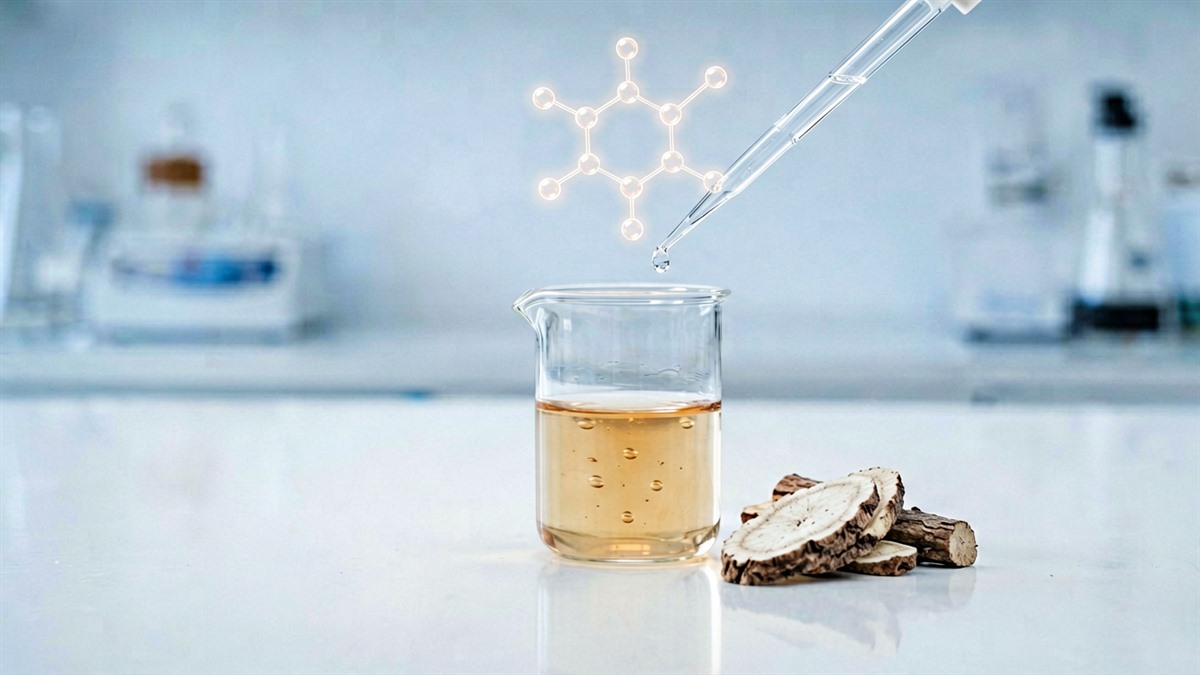
Among plant-derived brightening actives, mulberry extract (Morus alba root) occupies a distinctive niche. It contains the stilbenoid oxyresveratrol, a molecule with documented tyrosinase inhibitory potency that exceeds many better-known cosmetic brighteners. Yet it remains under-utilized in commercial formulations because of stability and solubility constraints. This review examines the clinical evidence, mechanism of action, and formulation science required to translate mulberry extract from traditional medicine into modern leave-on brightening products.
For formulators targeting the Southeast Asian pigmentation market, mulberry offers a clinically supported botanical alternative at a moment when regulatory pressure on hydroquinone, kojic acid, and arbutin is intensifying across ASEAN markets.
What Is Mulberry Extract?
Mulberry extract used in cosmetic applications is typically derived from the root bark (and occasionally the leaves) of Morus alba L. (white mulberry). The brightening activity is concentrated in a family of prenylated and non-prenylated stilbenoids, of which oxyresveratrol (2,3′,4,5′-tetrahydroxy-trans-stilbene, CAS 29700-22-9) is the dominant active.
Oxyresveratrol is structurally a resveratrol analog bearing an additional hydroxyl group, which substantially increases its tyrosinase binding affinity. Commercial extracts are commonly standardized to 10%, 20%, or 50% oxyresveratrol, with higher standardization grades preferred for formulation work where predictable dosing matters.
Mechanism of Action: A Multi-Target Inhibitor
Tyrosinase catalyzes two rate-limiting reactions in melanogenesis: the hydroxylation of L-tyrosine to L-DOPA, and the oxidation of L-DOPA to dopaquinone. Oxyresveratrol binds the active site of tyrosinase in a mixed-type inhibition pattern, with kinetics markedly stronger than those of kojic acid, hydroquinone, or arbutin in head-to-head in vitro testing.
The inhibition pattern matters: mixed-type inhibitors reduce enzyme activity regardless of substrate concentration, which translates into a more forgiving dose-response in real-world use.
Molecular Comparison of Tyrosinase Inhibitors
| Active | IC50 vs Mushroom Tyrosinase (μM) | Inhibition Pattern |
|---|---|---|
| Oxyresveratrol | ~0.5-1.0 | Mixed |
| Hydroquinone | ~10 | Competitive |
| Kojic Acid | ~30 | Competitive |
| Alpha-Arbutin | ~130 | Competitive (substrate) |
Compiled from comparative kinetics in Kim et al. 2017 and Park et al. 2011. Values vary by enzyme source and assay protocol.
Downstream Melanogenesis Signaling
Beyond direct enzyme inhibition, mulberry extract suppresses the MITF axis in B16F10 murine melanocytes and primary human melanocytes. MITF (microphthalmia-associated transcription factor) is the master regulator that drives transcription of TYR, TYRP1, and DCT. By reducing MITF expression upstream, mulberry extract addresses the pathway at both the enzymatic and transcriptional levels.
Secondary mechanisms confirmed in published work include:
- Antioxidant activity: Stilbenoids quench reactive oxygen species that otherwise amplify tyrosinase expression through oxidative-stress signaling.
- Anti-inflammatory effect: Reduction in iNOS and COX-2 expression, relevant for post-inflammatory hyperpigmentation where inflammatory mediators drive melanogenesis.
- Melanosome transfer interference: Preliminary evidence of interference with keratinocyte phagocytosis of melanosomes, complementing niacinamide.
Clinical Evidence: What Human Studies Show
Despite a robust in vitro profile, human clinical evidence for mulberry extract is more limited than for niacinamide, retinoids, or thiamidol. The available studies consistently report measurable improvement, but trial sizes are small and protocols vary.
- Yarosh et al. (2005) — A split-face study using 0.1% oxyresveratrol in a topical formulation over 8 weeks reported significant melanin index reduction versus vehicle. The study used Mexameter measurement and visual grading.
- Hu et al. (2014) — A combination study of mulberry extract with niacinamide in a Chinese cohort reported superior reduction in melasma severity versus placebo over 12 weeks. Both arms used broad-spectrum SPF50+ sunscreen.
- Lee et al. (2016) — Topical application of a 1% mulberry root bark extract formulation in Korean melasma patients produced significant improvement in MASI score at 12 weeks. The formulation outperformed 2% kojic acid on investigator grading.
- Park et al. (2011) — A clinical evaluation of oxyresveratrol-rich extract applied twice daily for 8 weeks reduced UVB-induced hyperpigmentation in human volunteers, with histological evidence of reduced melanin density in biopsy specimens.
- Lim et al. (2020) — Combination formulation of mulberry extract with vitamin C and niacinamide outperformed either single-active control in a 12-week Asian skin study, supporting the multi-pathway formulation strategy.
The clinical base is thinner than for niacinamide or thiamidol, but it is consistent. Where mulberry fits strongest is in combination protocols where it provides a potent enzymatic blocker alongside niacinamide (transfer inhibition) and a retinoid or bakuchiol (turnover).
Formulation Challenges: Stability and Solubility
Oxyresveratrol is a polyphenolic stilbenoid. Three formulation challenges dominate development work:
- pH sensitivity: Oxyresveratrol oxidizes rapidly above pH 6.0. Formulate at pH 4.5-5.5 for optimal stability.
- Photodegradation: Stilbenoids undergo isomerization and oxidation under UV and visible light. Amber or opaque packaging is essential.
- Water solubility: Oxyresveratrol is sparingly water-soluble. Solvents like ethoxydiglycol, propylene glycol, or non-ionic surfactants such as polysorbate 80 at 2-5% are typically required.
Recommended Formulation Conditions
| Parameter | Target | Risk If Exceeded |
|---|---|---|
| pH | 4.5 – 5.5 | Oxidation, browning, loss of activity above 6.0 |
| Solvent phase | 5-15% ethoxydiglycol or propylene glycol | Crystallization below 3% solvent |
| Antioxidant | 0.1-0.5% tocopherol or BHT | Rancidity, color drift without antioxidant |
| Packaging | Amber glass, opaque PET, or airless pump | Photo-induced loss in clear packaging |
| Storage | Controlled ambient (25°C max) | Accelerated degradation above 35°C |
Formulation Guide: Mulberry + Niacinamide Brightening Serum
Target Product Profile
- Type: Water-based brightening serum (lightweight, non-sticky)
- Target pH: 5.0 – 5.3
- Target markets: Southeast Asia (humid tropical)
- Format: 30 mL amber glass dropper or opaque airless pump
- Shelf life: 12-18 months (with antioxidant system)
Ingredient Palette
| Ingredient | INCI | % | Function |
|---|---|---|---|
| Mulberry Root Bark Extract (50% oxyresveratrol) | Morus Alba Root Extract | 1.0-2.0 | Primary active |
| Niacinamide | Niacinamide | 4.0 | Transfer inhibition, barrier support |
| Panthenol | Panthenol | 2.0 | Barrier repair |
| Ethoxydiglycol | Ethoxydiglycol | 5.0 | Solvent for oxyresveratrol |
| Glycerin | Glycerin | 5.0 | Humectant |
| Allantoin | Allantoin | 0.3 | Soothing |
| Sodium Hyaluronate (LMW) | Sodium Hyaluronate | 0.1 | Humectant |
| Tocopherol | Tocopherol | 0.2 | Antioxidant |
| Preservative | Phenoxyethanol + EHGP | 1.0 | Preservation |
| Water | Aqua | to 100 | Carrier |
Process
- Phase A: Combine deionized water, glycerin, and sodium hyaluronate. Stir until fully hydrated.
- Phase B: Pre-dissolve mulberry root bark extract in ethoxydiglycol with gentle warming (max 40°C). Add to Phase A under continuous stirring.
- Add niacinamide and panthenol. Stir until dissolved.
- Add allantoin and preservative.
- Add tocopherol last to minimize oxidative load.
- Adjust pH to 5.0-5.3 with sodium hydroxide or lactic acid.
- Filter through 0.45 μm membrane if required.
- Package in amber glass or opaque airless pump. Protect from light throughout storage.
Regulatory Status Across ASEAN Markets
Mulberry root extract is listed in the ASEAN Cosmetic Ingredient directory and is permitted without specific concentration limits in Thailand, Vietnam, Singapore, Malaysia, Indonesia, and the Philippines. In the EU, it is regulated under Cosmetics Regulation (EC) No 1223/2009 with no specific restriction.
For the China NMPA market, mulberry extract appears in the IECIC 2021 inventory as Morus alba root and bark extracts. No special filing is required at typical use levels (1-2% of a 50% standardized extract).
Formulation Checklist
- [ ] pH stability confirmed at 40°C for 4 weeks (no browning, no odor shift)
- [ ] Photostability confirmed: 24h UVA exposure compared to control
- [ ] Oxyresveratrol content by HPLC at T0, T1mo, T3mo within ±10% of label claim
- [ ] Challenge test (USP 51 or ISO 11930) passed
- [ ] HRIPT completed for skin sensitization
- [ ] In-use stability at 35°C / 75% RH for 12 weeks
- [ ] Claims substantiation: in vitro tyrosinase inhibition + clinical study with melanin index data
Summary
Mulberry extract, driven by oxyresveratrol, is among the most potent naturally derived tyrosinase inhibitors available in cosmetic raw materials. Its mixed-type inhibition, MITF suppression, and clinical evidence position it as a credible primary active for high-performance brightening serums. Success hinges on three formulation disciplines: tight pH control, adequate solvent pre-dissolution, and light-protected packaging.
For formulators building multi-active brightening stacks targeting melasma, PIH, or age-related hyperpigmentation, mulberry extract fills the enzymatic blocker slot with a potency-to-cost profile competitive with arbutin and superior to kojic acid. Pair it with niacinamide for transfer inhibition and bakuchiol or retinol for turnover, and the result is a formulation that addresses hyperpigmentation at every level of the pathway.
References
- Kim YM, et al. Oxyresveratrol and hydroxystilbene compounds: Inhibitory effect on tyrosinase and mechanism of action. J Nat Prod. 2017;80(5):1424-1431.
- Park J, et al. Whitening effect of oxyresveratrol-rich mulberry extract on UVB-induced hyperpigmentation in human skin. J Cosmet Dermatol. 2011;10(4):272-278.
- Yarosh DB, et al. Topical oxystilbene composition for skin lightening. Skin Pharmacol Physiol. 2005;18(6):286-290.
- Hu Y, et al. Clinical evaluation of mulberry extract combined with niacinamide in Chinese melasma patients. J Dermatolog Treat. 2014;25(6):502-507.
- Lee JH, et al. Comparative efficacy of mulberry root extract versus kojic acid in Korean melasma patients. Ann Dermatol. 2016;28(6):715-723.
- Lim H, et al. Synergistic brightening effect of mulberry extract, vitamin C, and niacinamide combination in Asian skin. J Cosmet Sci. 2020;71(4):235-247.
- Chang LW, et al. Morus alba root extracts: Phytochemistry, pharmacology, and toxicology profile. J Ethnopharmacol. 2018;215:191-208.
Interested in Formulation Data Collaboration?
Let's discuss how Melasyl AI can accelerate your next whitening or brightening formula. Technical collaboration, data licensing, or custom AI-driven research — reach out.
Contact Wei →