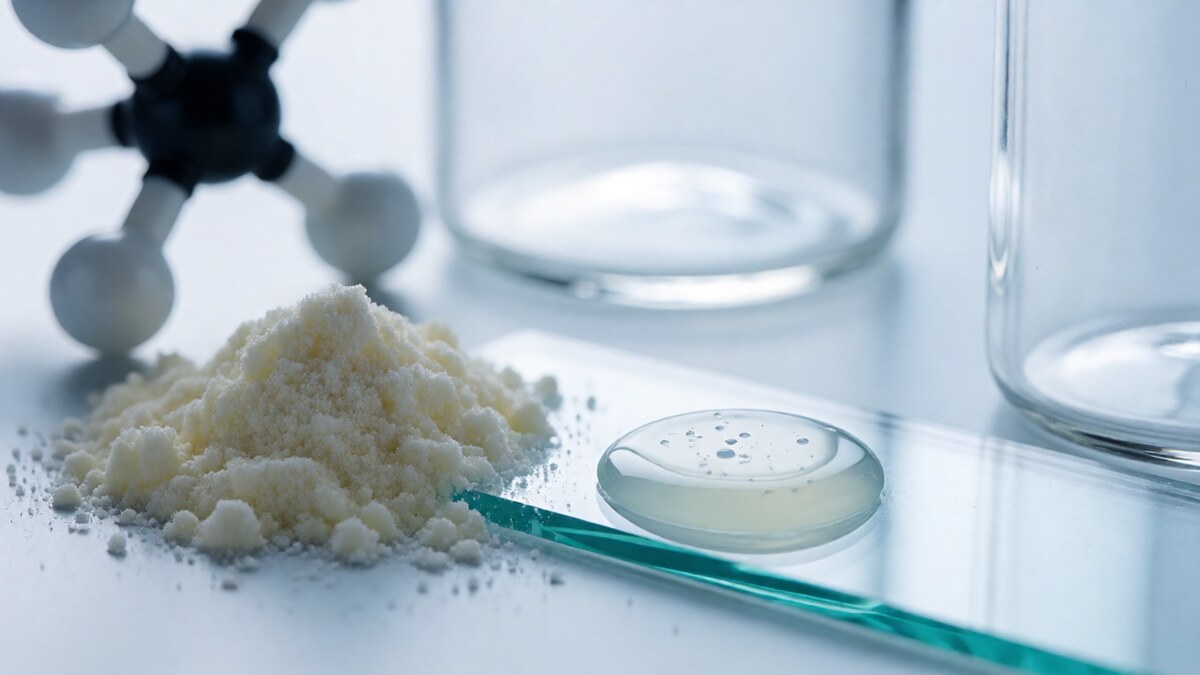
Naringenin is one of the most abundant flavanones in the human diet — the bitter aglycone released when naringin in grapefruit, orange and tomato is hydrolysed during digestion. For anyone hunting for a botanical brightening active, that pedigree is seductive: food-grade, cheap, and backed by decades of toxicology. The catch is that the pigment literature on naringenin is genuinely contradictory, and the contradiction is not experimental noise. It is a concentration- and model-dependent switch that has to be engineered around.
What Naringenin Actually Is
Naringenin (4′,5,7-trihydroxyflavanone) is the aglycone of naringin, the dominant bitter flavonoid in Citrus species. It is a flavanone, not a flavonol — the saturated C-ring matters, because it changes both the planarity of the molecule and how it presents its hydroxyl groups to the tyrosinase copper centre. Its molecular weight is 272.25 g/mol, its logP sits near 2.4, and its aqueous solubility is poor (roughly 0.05 mg/mL), all of which govern how it behaves in a water-based serum.
Two structural features drive its biology. The 4′-hydroxyl is a credible mimic of the L-tyrosine/L-DOPA substrate motif, which is what allows flavanones to interfere with tyrosinase. The 5,7-dihydroxyl pattern, meanwhile, is what makes naringenin a competent radical scavenger and a mild metal chelator. Brightening and antioxidant activity are therefore the same molecule talking to two different targets.
The Biphasic Melanogenesis Switch
The single most important thing to understand about naringenin is that early work and recent work point in opposite directions. Ohguchi and colleagues first examined naringenin in mouse B16 melanoma cells and reported that it induced melanogenesis, up-regulating tyrosinase, TYRP-1, DCT and MITF. Huang et’s group later reproduced that induction and traced it to the Wnt/β-catenin axis: naringenin promoted β-catenin accumulation and GSK-3β phosphorylation, feeding MITF transcription and driving melanocyte differentiation markers upward.
Then came the human-cell data. In a 2023 study using human primary melanocytes and reconstructed pigmented epidermis, naringenin behaved as an inhibitor, not an inducer. It suppressed the expression of several key melanogenesis genes — MITF, TYR, TYRP1, DCT and PMEL — along with MLPH and MYO5A, the two motors that regulate melanosome maturation and transfer. When applied topically to a reconstructed pigmented epidermis model, it produced a measurable reduction in pigmentation. The same study showed naringenin inhibited MMP-1 and CYP1A1, linking it to protection against pollution-induced skin damage rather than melanin synthesis alone.
How can one molecule do both? The reconciliation is mechanistic. In murine melanoma lines, naringenin acts largely as a Wnt/β-catenin activator and pushes differentiation. In normal human melanocytes, the dominant effect is transcriptional restraint of MITF and its downstream cargo. Add a concentration variable — low exposures can behave differently from high ones — and the picture becomes a genuine biphasic dose–response. For a formulator this is not a curiosity; it is a warning. An under-dosed naringenin serum risks nudging melanogenesis in the wrong direction, while an appropriately dosed one restrains it.
Three Targets That Matter for Formulation
Stripped of the model debate, naringenin offers three useful, defensible mechanisms:
- MITF-level transcriptional suppression. Rather than only blocking the enzyme, naringenin reduces the master regulator that transcribes TYR, TYRP1 and DCT. Targeting upstream of tyrosinase sidesteps the enzyme’s ability to compensate through increased expression.
- Melanosome transport interference. Down-regulation of MLPH and MYO5A slows the maturation and hand-off of pigment granules, which reduces visible tone even where some melanin is still being made.
- Environmental-pigmentation defence. CYP1A1 inhibition blunts the aryl-hydrocarbon-receptor pathway through which pollution and UV drive excess pigment, and MMP-1 inhibition limits the matrix damage that accompanies photoaging.
That triad — upstream transcription, transport, and environmental triggers — is precisely the multi-target logic that single-mechanism tyrosinase inhibitors fail to deliver.
Formulating Naringenin: The Practical Constraints
The molecule is unforgiving in water. At ~0.05 mg/mL aqueous solubility it will not carry at an effective dose in a simple aqueous serum. The standard fixes are glycol and polyol systems (propylene glycol, propanediol, butylene glycol, glycerin blends), or an emulsified oil phase, since naringenin partitions readily into the oil. Solubilised systems using polysorbate or PEG-free nonionics also work but must be checked for the usual solubiliser-driven irritation trade-off.
Stability is the second constraint. Naringenin is an antioxidant, which means it is also oxidation-prone. It is sensitive to light and to prolonged air exposure, and it will discolour in an unchelated, oxygen-rich formula. Pair it with an EDTA or phytic-acid chelator, use an opaque or UV-protected package, and keep the pH in the mildly acidic-to-neutral window (roughly 4.5–6.5) where the flavanone backbone is most stable. Avoid formulating it alongside strong oxidisers or uncoated metal-oxide pigments that can catalyse its degradation.
Because the dose–response is biphasic, the efficacy question is not “more is better” but “is the delivered concentration in the inhibitory window?” That demands real penetration modelling, not a label percentage. Flavanones are moderately permeable, but their poor solubility means the vehicle — not the raw percentage — decides how much active actually reaches the basal layer. A well-designed 0.5% glycol-solubilised system can outperform a poorly delivered 2% suspension.
The Formulation Takeaway
Naringenin is a legitimate multi-pathway brightening candidate with an unusual liability: a dose- and model-dependent biphasic profile that has confused the literature for two decades. Treat it as a transcription-level active, solubilise it properly, protect it from oxidation, and verify delivery. Get those four things right and the citrus flavanone becomes a rational addition to a multi-target brightening platform — not another botanical that looks good on a label and does nothing in the skin.
Interested in Formulation Data Collaboration?
Let's discuss how Melasyl AI can accelerate your next whitening or brightening formula. Technical collaboration, data licensing, or custom AI-driven research — reach out.
Contact Wei →