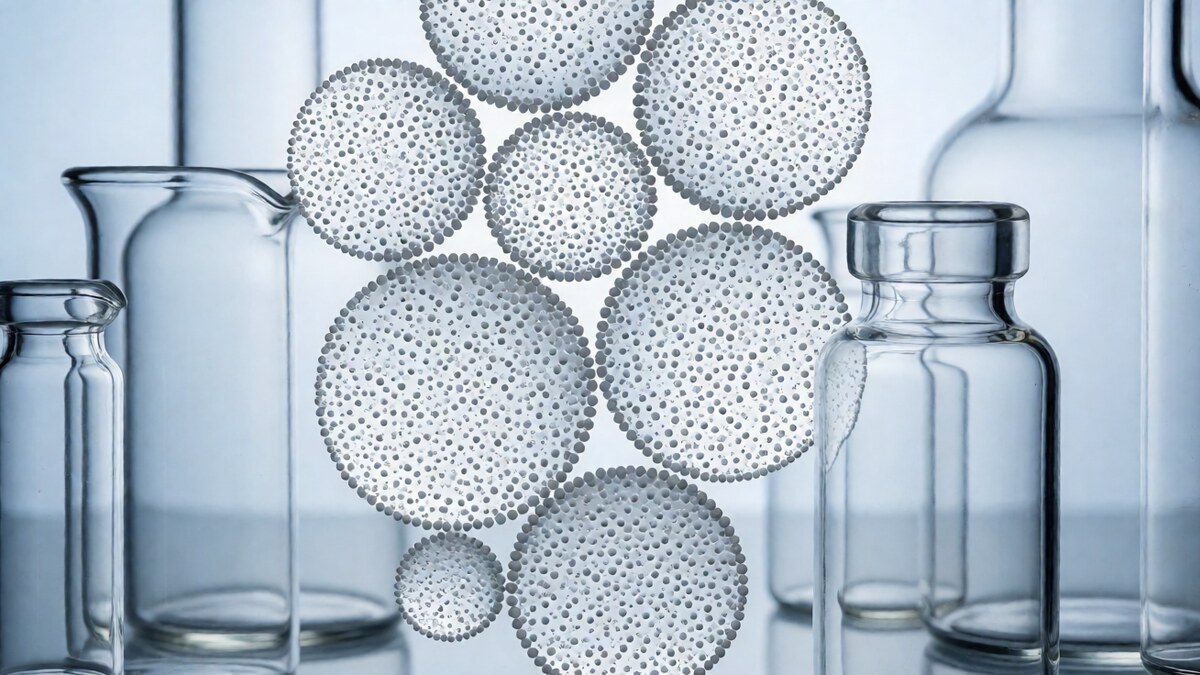
For a century, the oil-and-water emulsions in almost every cream and lotion have been held together by surfactant molecules — the same class of material that, at the wrong concentration or chain length, drives the stinging, tightness and barrier disruption that sensitive-skin consumers complain about. A different architecture has been quietly moving from pharmaceutical labs into the cosmetic mainstream: the Pickering emulsion, stabilised not by surfactants but by solid colloidal particles adsorbed at the oil–water interface. In 2026 it is the most credible “surfactant-free” claim on the shelf — provided the formulation science is done properly. This analysis covers the mechanism, the clinical and physicochemical evidence, and the real formulation constraints.
What Makes a Pickering Emulsion Different
In a conventional emulsion, surfactant molecules lower interfacial tension and form a dynamic, reversible monolayer around each oil droplet. In a Pickering emulsion, the interface is instead covered by solid particles — silica, metal oxides, cellulose nanocrystals, starch granules, protein–polysaccharide complexes, or mesoporous carriers. Because desorbing a particle from the interface costs far more energy than desorbing a surfactant molecule, the layer is effectively irreversibly anchored (Binks, Curr Opin Colloid Interface Sci, 2002). The practical consequences are threefold: exceptional resistance to coalescence and Ostwald ripening; the ability to load and protect lipophilic actives inside the droplet; and the complete removal of surfactant-driven irritation.
Whether the system forms oil-in-water (O/W) or water-in-oil (W/O) depends on particle wettability — conventionally expressed as the three-phase contact angle. Particles wetted slightly more by water give O/W emulsions; those wetted more by oil give W/O. Around 90° the particle is balanced at the interface and stabilisation is most efficient, which is why surface modification (alkylation, silanisation) is a recurring step in the literature.
The Evidence: Where Pickering Systems Beat Conventional Emulsions
1. Photoprotection and UV-filter encapsulation
The strongest data come from sunscreen. A 2022 study in China Surfactant Detergent & Cosmetics stabilised a W/O Pickering emulsion with alginate–TiO₂ microspheres: the system remained physically stable after 100 days at room temperature, and out-performed three comparator sunscreens (including a commercial product) in UV absorption, while rinsing easily from skin. A more mechanistically detailed 2025 paper (China Surfactant Detergent & Cosmetics, 55(12)) encapsulated avobenzone in mesoporous silica to form AB@MPS particles and used them as the sole stabiliser. Versus free avobenzone, the encapsulated form reduced skin permeation by 73.9%, increased photostability 14.3-fold, and delivered an SPF 2.41× that of a 20% propylene-glycol vehicle and 6.77× that of a conventional cream. That combination — less systemic penetration, less photodegradation, higher measured SPF — is exactly the profile a modern sunscreen brief asks for.
2. Active retention and sustained release
The dense interfacial particle film that gives Pickering emulsions their stability also throttles release, converting a bolus into a reservoir. Marto and colleagues (Drug Delivery, 2016) built a melatonin-based Pickering sunscreen stabilised by ZnO, TiO₂ and modified starch; the formulation achieved SPF 50+, passed the Human Repeat Insult Patch Test, and retained sunscreen water resistance in vivo. A 2025 study in the International Journal of Pharmaceutics (S0378517325001206) tuned the surface charge of spirulina-protein/chitosan composite particles and showed that positively charged Pickering droplets significantly increased retention of α-bisabolol in the stratum corneum — direct evidence that particle engineering, not just the active, controls where a molecule ends up.
3. Sensitive and flavonoid actives
Pickering systems are especially useful for oxidation-prone actives. A 2025 Polymers paper (17(13):1871) formulated quercetin — notoriously insoluble and oxidation-sensitive — in Pickering emulsions stabilised by chitosan/gum arabic nanoparticles, achieving >90% encapsulation efficiency with stable antioxidant retention. Related work on high-internal-phase emulsions found resveratrol deposition in deeper skin layers increased roughly 3–5× versus a non-structured control.
4. The residual film on real skin
Terescenco and colleagues (International Journal of Pharmaceutics, 2024; 657:124130) compared Pickering emulsions stabilised by TiO₂, ZnO and SiO₂ against a classical surfactant emulsion on human skin in vivo. The particle-stabilised systems formed a hydrophobic residual film rather than the conventional film, with droplet organisation, rheology and friction directly governed by particle type and concentration — and the particles visibly blunted the glossy shine of the oil phase. This is the sensory argument for Pickering: the interface, not the emulsifier, determines the after-feel.
Formulation Science: The Variables That Actually Matter
- Particle wettability (contact angle). The single most important lever. Match it near 90° for maximum interfacial anchoring; deviate and you either fail to emulsify or invert the phase.
- Particle-to-oil ratio. Droplet size and emulsion type are set by the particle concentration relative to the oil phase. The Alg@TiO₂ work found a stable W/O emulsion at a 1:1 oil/water ratio with 3% (w/w) microspheres.
- Particle size. Because colloidal stabilisers are typically micro-scale, Pickering droplets rarely penetrate skin directly; actives must first partition out of the droplet at the stratum corneum. Design for release, not for droplet penetration.
- Rheology. Highly concentrated Pickering emulsions are viscous and shear-thinning, which limits injectable or ultra-light formats. The emerging fix is the Pickering emulsion hydrogel (PEH): embedding the particle-stabilised emulsion in a gel network (e.g., polysaccharide nanogels) improves spreadability and skin residence while adding a second release barrier (reviewed in Advances in Colloid and Interface Science, 2024, PMID 39486631).
- Processing. Pickering emulsions generally require high-energy emulsification, and batch-to-batch droplet-size reproducibility is the classic scale-up failure point.
Honest Limitations
Pickering systems are not a free lunch. The particle film that protects the active also slows its release — a liability for actives that must act quickly. Suitable stabilisers must be simultaneously biodegradable, non-toxic and cosmetically acceptable, and surface modification to hit the right contact angle is chemically demanding. Particles are hard to redisperse once dried, high-viscosity systems resist light textures, and there is currently no FDA-approved drug labelled as a Pickering emulsion — so the cosmetic evidence base, while real, is still thinner than the marketing implies. The most defensible near-term route for skincare is the PEH hybrid: particle-stabilised droplets for stability and protection, suspended in a gel for sensory and residence.
Conclusion
Pickering emulsions earn their place in 2026 formulation science because they solve a genuine problem — surfactant irritation and emulsion instability — with a mechanism that also improves active retention, photostability and after-feel. The evidence is strongest for sunscreens and oxidation-prone lipophilic actives, where reduced permeation and higher measured SPF are measurable rather than cosmetic claims. The formulation discipline required is real: control the contact angle, tune the particle-to-oil ratio, and accept that the interface governs both release and skin feel. Done well, it is the most technically honest way to put “surfactant-free” on a label.
References
- Binks BP. “Particles as surfactants — similarities and differences.” Current Opinion in Colloid & Interface Science. 2002;7(1–2):21–41.
- Marto J, Ascenso A, Gonçalves LM, et al. “Melatonin-based pickering emulsion for skin’s photoprotection.” Drug Delivery. 2016;23(5):1594–1607. doi:10.3109/10717544.2015.1128496.
- Terescenco D, Savary G, Picard C, Hucher N. “Topical pickering emulsion versus classical excipients: A study of the residual film on the human skin.” International Journal of Pharmaceutics. 2024;657:124130.
- “Pickering emulsion stabilized by avobenzone-loaded mesoporous particles for enhanced sunscreen performance.” China Surfactant Detergent & Cosmetics. 2025;55(12):1516.
- “Alg@TiO₂ microsphere-stabilised Pickering emulsions for sunscreen.” China Surfactant Detergent & Cosmetics. 2022;52(3):229–236.
- “Topical delivery performance of Pickering emulsions stabilized by differently charged spirulina protein isolate/chitosan composite particles.” International Journal of Pharmaceutics. 2025. S0378517325001206.
- “Formulation and Stability of Quercetin-Loaded Pickering Emulsions Using Chitosan/Gum Arabic Nanoparticles for Topical Skincare Applications.” Polymers. 2025;17(13):1871.
- “Transitioning from Pickering emulsions to Pickering emulsion hydrogels: A potential advancement in cosmeceuticals.” Advances in Colloid and Interface Science. 2024. PMID 39486631.
- Frelichowska J, Bolzinger MA, Pelletier J, et al. “Topical delivery of lipophilic drugs from o/w Pickering emulsions.” International Journal of Pharmaceutics. 2009;371(1–2):56–63.
Interested in Formulation Data Collaboration?
Let's discuss how Melasyl AI can accelerate your next whitening or brightening formula. Technical collaboration, data licensing, or custom AI-driven research — reach out.
Contact Wei →