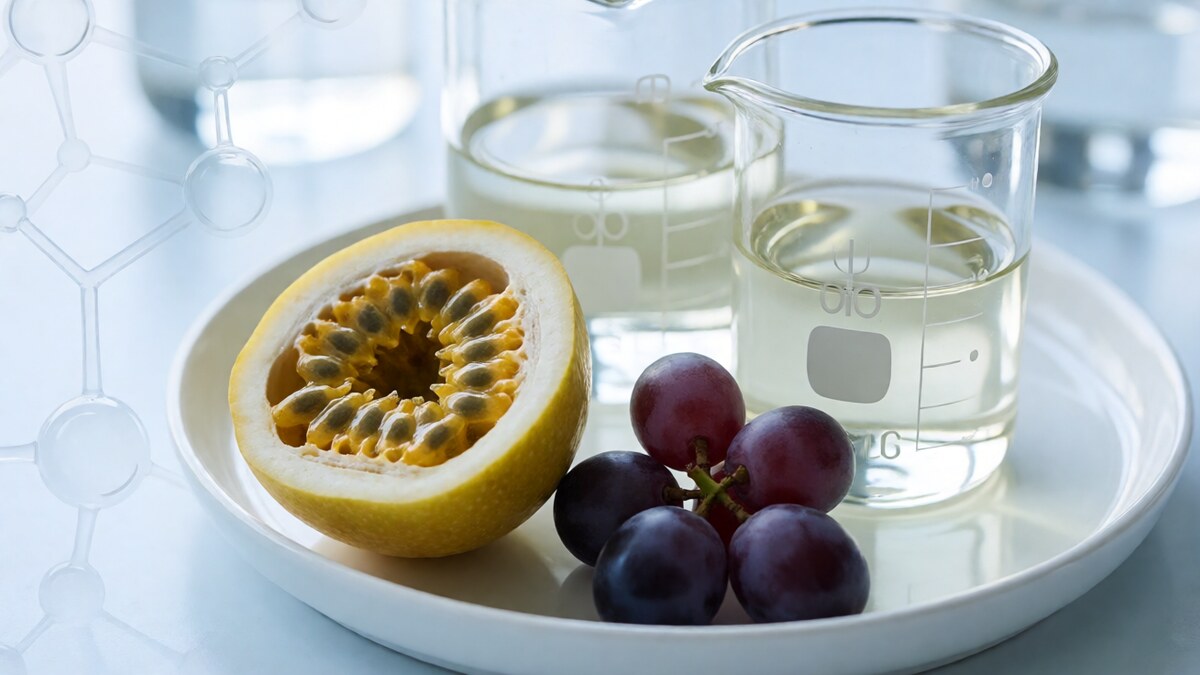
Piceatannol is the stilbenoid most formulators have never specified — and it may be the most potent natural tyrosinase inhibitor in the brightening toolbox. It is a metabolite of resveratrol, found in passion fruit seeds, grapes, blueberries and rhubarb, and it belongs to the same trans-stilbene family that gave skincare resveratrol and pterostilbene. What separates piceatannol is a single structural detail: one extra hydroxyl group that turns a respectable antioxidant into an enzyme inhibitor roughly 40 times more potent than kojic acid in head-to-head assays. This article breaks down the chemistry, the melanogenesis pathways it touches, the clinical data, and how to keep it stable in a real formula.
1. The Chemistry: One Extra Hydroxyl Changes Everything
Piceatannol (3,3′,4,5′-tetrahydroxy-trans-stilbene, PCT) differs from resveratrol by a single additional hydroxyl group on the B-ring, converting a resorcinol pattern into a catechol-like ortho-dihydroxy arrangement. That seemingly minor change matters enormously:
- The extra hydroxyl raises electron density at the ring, improving radical scavenging and metal coordination.
- It strengthens binding at the dinuclear copper active site of tyrosinase.
- It increases the molecule’s susceptibility to oxidation — the same feature that makes it potent also makes it fragile, which is the central formulation challenge.
Commercially it is supplied either as purified piceatannol (typically ≥98% HPLC) or as a standardized passion fruit (Passiflora edulis) seed extract, which is the richest natural source and the form used in most clinical work. Specify by piceatannol content, not by plant ratio.
2. Mechanism: A Multi-Pathway Antimelanogenic Profile
2.1 Direct tyrosinase inhibition
In a landmark comparative study, Yokozawa and Kim measured piceatannol’s activity against mushroom tyrosinase at an IC50 of 1.53 µM — significantly stronger than both kojic acid (IC50 50.1 µM) and resveratrol (IC50 63.2 µM) in the same assay. Docking work indicates a competitive mode of inhibition, with the bibenzyl/stilbene scaffold anchoring at the enzyme’s active site.
2.2 MITF downregulation and upstream signalling
Piceatannol’s second, more durable effect is transcriptional. A 2025 review in Pigment Cell & Melanoma Research consolidated the evidence that PCT downregulates MITF, the master transcription factor governing the entire melanogenic enzyme cassette (tyrosinase, TRP-1, TRP-2, PMEL17). The review mapped the plausible upstream routes:
- Wnt/β-catenin: PCT promotes β-catenin degradation, removing a direct MITF transactivator.
- Nrf2 activation: antioxidant response signalling that indirectly suppresses MITF.
- SIRT3 → FOXO3a: PCT upregulates SIRT3, deacetylating FOXO3a, which then restrains MITF.
- MAPK: blockade of ERK and p38 phosphorylation, preventing stress-induced MITF activation.
- Akt inhibition: cutting a survival/proliferation input that feeds MITF expression.
The net result is a compound that attacks pigmentation at both the enzyme and the gene-expression level — the profile of a “multi-pathway” brightener rather than a single-target tyrosinase inhibitor.
2.3 Antioxidant and redox modulation
In the original B16F10 melanoma model, piceatannol suppressed reactive species generation and raised the GSH/GSSG ratio, i.e. it improved the cell’s reduced-glutathione buffer. Because oxidative stress drives melanogenesis through p38/ERK, this antioxidant action is mechanistically inseparable from its depigmenting effect.
2.4 Photoprotection
Piceatannol accumulates in grape skin in response to UV-C and absorbs UV radiation directly, suggesting a genuine photoprotective role. It is a useful adjunct in day-wear formulas — never a replacement for sunscreen.
3. Clinical Evidence
3.1 Oral piceatannol and skin hydration
The most cited human trial gave 32 healthy Japanese women aged 35–54 two capsules of passion fruit seed extract (5 mg piceatannol/day) for 8 weeks against a dextrin placebo. The piceatannol group showed significantly increased skin moisture at weeks 4 and 8 and reduced transepidermal water loss over time, alongside self-reported reductions in fatigue. This establishes bioavailability and a systemic skin benefit, though it is a hydration endpoint rather than a pigmentation one.
3.2 UVB-induced pigmentation models
A 2024 study found that piceatannol-rich Passiflora edulis seed extract attenuated melanocyte morphological differentiation in UVB-stimulated B16F10 cells by reducing MITF mRNA expression and F-actin polymerization — a mechanistic demonstration that PCT blunts the UV-triggered pigmentation cascade, not merely baseline melanin output.
3.3 Comparative potency and safety
Independent enzyme work on stilbenes isolated from Streblus taxoides reported a more modest piceatannol IC50 of ~150 µg/mL, a useful reminder that assay conditions (substrate, enzyme source, purity) shift absolute numbers — but importantly recorded no significant cytotoxicity, with B16-F1 viability remaining above 80%. Piceatannol also inhibits PTP-1B (IC50 4.81 µM), an anti-inflammatory/insulin-sensitizing effect that may further help post-inflammatory hyperpigmentation.
4. Formulation Science: Keeping a Fragile Stilbene Intact
Piceatannol’s weakness is oxidative and photochemical instability — the catechol-type B-ring that gives it potency also makes it the first thing to oxidise. Protecting it is the whole game.
- pH window: Keep the aqueous phase mildly acidic, pH 4.5–6.0. Alkaline conditions accelerate autoxidation of the stilbene and can trigger discolouration.
- Solubility and delivery: PCT is poorly water-soluble. Dissolve in a glycol/ethanol co-solvent (propanediol, pentylene glycol) or deliver via liposomes, niosomes or a nanoemulsion. Encapsulation also shields it from oxygen and light.
- Antioxidant shielding and chelation: Pair with 0.02–0.05% disodium EDTA and a co-antioxidant such as tocopherol or a small ferulic fraction to mop up oxidants before they reach the stilbene.
- Processing: Add in the cool-down phase below 40°C. Never hold PCT through a 70–80°C emulsification or a high-shear/high-temperature step.
- Packaging: Airless pump or opaque tube. A clear bottle under retail lighting will visibly degrade a piceatannol serum.
- Compatibility: Synergistic with niacinamide, alpha-arbutin, tranexamic acid and panthenol. Avoid strongly alkaline systems and unchelated transition-metal ions.
Practical use level: 0.05–0.3% purified piceatannol, or 0.5–2% of a standardized passion fruit seed extract (piceatannol-normalized), in a brightening serum or cream.
5. Why Piceatannol Deserves a Slot
Piceatannol sits in a rare position: it has an unusually strong enzyme-inhibition number, a credible multi-pathway transcriptional mechanism, a clean safety profile, and a naturally derived story that travels well in Asian beauty markets. Its weaknesses are real — instability and cost — but they are engineering problems, not scientific ones. For a formulator building a differentiated brightening platform, the extra hydroxyl group is worth the extra care.
References
- Yokozawa T, Kim YJ. “Piceatannol inhibits melanogenesis by its antioxidative actions.” Biological & Pharmaceutical Bulletin. 2007;30(11):2007–2011. PMID 17978467.
- Rajan RK. “Piceatannol — Can It Be Used to Treat Hyperpigmentation of the Skin?” Pigment Cell & Melanoma Research. 2025;38(2):e70008. doi:10.1111/pcmr.70008. PMID 40091271.
- Maruki-Uchida H, et al. “Effect of passion fruit seed extract rich in piceatannol on skin.” Journal of Cosmetic Dermatology. 2018.
- Kunsorn P, et al. “Piceatannol-rich extract from Passiflora edulis seeds attenuates melanocyte differentiation via MITF mRNA reduction in UVB-induced B16F10 cells.” Journal of Pharmacy & Pharmacognosy Research. 2024.
- Parndaeng K, et al. “Anti-tyrosinase stilbenes from Streblus taxoides wood.” 2023.
- Shi et al. “UV-photoprotective mechanism of piceatannol and resveratrol from grape skin.” 2020.
- Ha MT, et al. “Piceatannol inhibits PTP-1B.” 2018.
Interested in Formulation Data Collaboration?
Let's discuss how Melasyl AI can accelerate your next whitening or brightening formula. Technical collaboration, data licensing, or custom AI-driven research — reach out.
Contact Wei →