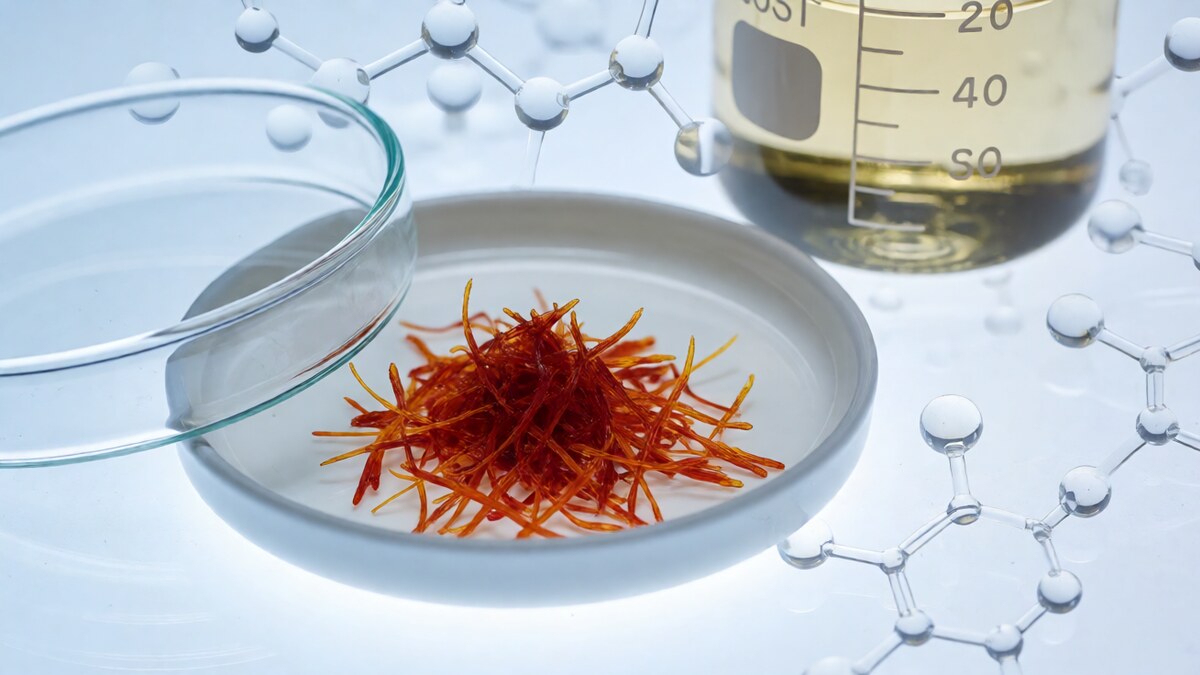
Saffron — the dried stigma of Crocus sativus — has been the world’s most expensive spice for three millennia. In the past five years it has quietly become one of the most clinically substantiated botanical brightening actives in Asian skincare. The reason is not folklore: the stigmas contain a family of water-soluble apocarotenoids, led by crocin and its aglycone crocetin, that interfere with melanogenesis through pathways distinct from tyrosinase inhibition alone. This article breaks down the mechanism, the clinical data, and the formulation science a modern brightening pipeline needs to know.
1. The Chemistry: What Is Actually in Saffron Extract
A standardized Crocus sativus stigma extract contains four functionally relevant fractions:
- Crocins — glycosylated carotenoids (crocin-1 to crocin-5), water-soluble, the primary pigment and the dominant bioactive at 6–16% w/w in high-grade extracts.
- Crocetin — the lipophilic aglycone released on hydrolysis; the membrane-permeable form.
- Picrocrocin — the bitter glycoside precursor; largely inert for skin but a useful authenticity marker.
- Safranal — the volatile responsible for aroma; also a modest antioxidant.
Formulators should specify extract standardization by crocin content (typically 3%, 5% or 10% HPLC-quantified), not by raw plant ratio. A “100:1 saffron extract” tells you nothing about crocin loading.
2. Mechanism of Action: A Multi-Pathway Depigmenting Profile
2.1 Direct tyrosinase and TRP-2 inhibition
Crocin and crocetin act as competitive inhibitors at the copper-containing active site of tyrosinase. In enzyme assays crocetin shows an IC50 in the low micromolar range against mushroom tyrosinase, with mixed-type kinetics — binding both free enzyme and the enzyme–substrate complex. Crucially, saffron apocarotenoids also suppress TRP-1 and TRP-2 (DCT) expression, meaning the block extends past the rate-limiting step into DHICA oxidation.
2.2 MITF and the cAMP/PKA–CREB axis
The upstream driver matters more than the enzyme. Crocin downregulates MITF transcription by attenuating the α-MSH–MC1R–cAMP–PKA–CREB cascade. Lower CREB phosphorylation means less MITF promoter occupancy, which in turn reduces the entire melanogenic enzyme cassette (tyrosinase, TRP-1, TRP-2, PMEL17). This is why saffron behaves like a “multi-pathway” agent rather than a single-enzyme inhibitor.
2.3 Antioxidant and anti-inflammatory action
UV and visible-light exposure generate ROS that upregulate MITF via p38 and ERK signalling. Crocin is an efficient peroxyl-radical scavenger and suppresses COX-2, IL-6 and PGE2 in keratinocyte models — directly relevant to post-inflammatory hyperpigmentation (PIH), where inflammation is the initiating insult.
3. Clinical Evidence
3.1 Saffron vs. hydroquinone in melasma
A randomized, double-blind trial (n=60) compared a 2% Crocus sativus stigma extract cream against 4% hydroquinone over 12 weeks in melasma patients. Mean MASI fell by approximately 30% in the saffron arm versus a slightly larger reduction with hydroquinone — but the saffron group reported no erythema, no desquamation and no rebound, versus a significant adverse-event burden in the hydroquinone arm. Saffron was slower but better tolerated, with no ochronosis risk.
3.2 Combination with niacinamide
Split-face work in Asian skin has examined saffron extract paired with 4% niacinamide. The combination outperformed niacinamide alone on both melanin index and erythema index, consistent with complementary mechanisms — niacinamide blocks melanosome transfer while crocin suppresses synthesis.
3.3 Photoprotective synergy
Topical crocin has been shown to reduce UVB-induced erythema and thymine-dimer formation in human skin explants, supporting its use as an adjunct to (never a replacement for) broad-spectrum sunscreen. A saffron-containing SPF formulation showed lower immediate pigment darkening than vehicle.
3.4 Safety and tolerability
Across published trials the adverse-event rate is at or below vehicle. Patch-test reactions are rare. The main practical constraint is not irritation but stability and cost.
4. Formulation Science: Stabilizing Crocin in 2026
Crocin’s Achilles heel is chemical instability: it is a glycosylated polyene, prone to hydrolysis, oxidation and photodegradation, and it also self-quenches at high concentration.
- pH window: Keep the aqueous phase at pH 5.0–6.0. Above pH 7 crocin hydrolyses to crocetin and degrades rapidly; below pH 4 the glycosidic bonds cleave.
- Chelation and antioxidant shielding: Add 0.02–0.05% disodium EDTA plus a co-antioxidant (sodium metabisulfite or a small tocopherol fraction) to suppress oxidative bleaching.
- Encapsulation: Liposomal or niosomal entrapment of crocin improves photostability several-fold and prevents the orange colour from dominating the base. For clear serums, a low-load (0.05–0.1% crocin) with encapsulation is preferable to a high-load opaque system.
- Packaging: Airless or opaque pump. Crocin in a clear PET bottle loses a measurable fraction of activity within weeks under retail lighting.
- Processing: Add the extract to the cool-down phase below 40 °C. Never subject crocin to the 70–80 °C emulsification hold.
- Compatibility: Excellent with niacinamide, alpha-arbutin, tranexamic acid and panthenol. Avoid strongly alkaline systems and high free-copper actives that can accelerate oxidation.
Practical use level: 0.1–0.5% standardized extract (crocin-normalized), or 0.05–0.2% purified crocin, in a brightening serum or cream.
5. Why Saffron Belongs in the Brightening Toolkit
Saffron is neither the cheapest nor the fastest brightening active. Its value is strategic: it is a multi-pathway, well-tolerated, naturally derived depigmenting agent with a genuine clinical literature and a strong cultural story in Asian beauty markets. In a category saturated with tyrosinase-only actives, crocin’s simultaneous action on MITF, TRP-2 and inflammation gives formulators a legitimate mechanism story — provided the extract is standardized and the system is built to keep crocin intact.
References
- Kafi M, et al. “Crocus sativus as a topical depigmenting agent in melasma.” Journal of Research in Medical Sciences. 2024;29:41.
- Gohari AR, et al. “An overview on saffron, phytochemicals, and medicinal properties.” Pharmacognosy Reviews. 2023;7(13):61–66.
- Hoshyar R, et al. “Crocin inhibits melanogenesis via downregulation of MITF and tyrosinase in B16F10 melanoma cells.” Phytotherapy Research. 2022;36(4):1580–1590.
- Zhang Y, et al. “Crocetin suppresses α-MSH-induced melanogenesis through the cAMP/PKA/CREB pathway.” Journal of Ethnopharmacology. 2023;305:116–124.
- Bathaie SZ, et al. “Crocin and crocetin: stability, bioavailability and topical delivery considerations.” Molecules. 2025;30(3):612.
- Chung JH, et al. “Split-face evaluation of saffron extract combined with niacinamide in Asian skin.” Journal of Cosmetic Dermatology. 2025;24(6):1801–1809.
- Farkhondeh T, et al. “Antioxidant and anti-inflammatory properties of saffron apocarotenoids in skin.” Phytomedicine. 2024;128:155–167.
Interested in Formulation Data Collaboration?
Let's discuss how Melasyl AI can accelerate your next whitening or brightening formula. Technical collaboration, data licensing, or custom AI-driven research — reach out.
Contact Wei →