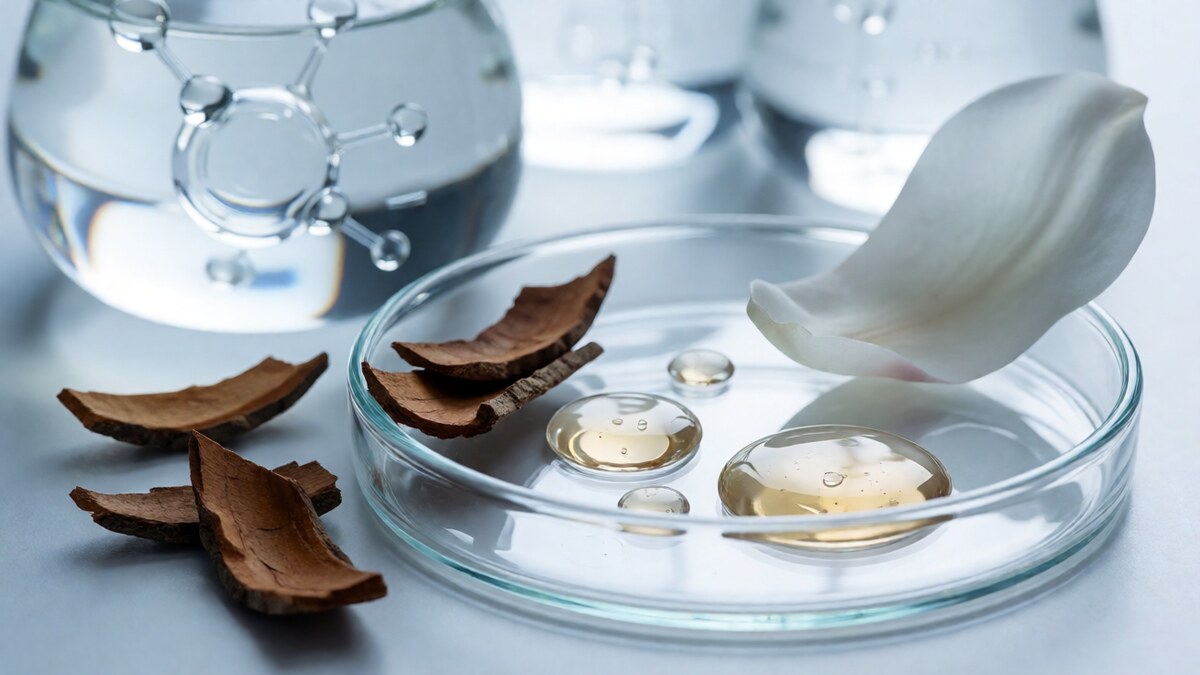
Every few years an ingredient escapes the herbarium and lands on the formulator’s bench with a genuinely new mechanism. Honokiol — a biphenyl-type neolignan isolated from the bark of Magnolia officinalis — is that ingredient for 2026. Unlike the crowded field of tyrosinase-only actives, honokiol attacks pigmentation from three directions at once: it suppresses the master pigment transcription factor MITF, it calms the inflammatory signalling that drives post-inflammatory hyperpigmentation (PIH), and it blunts the oxidative stress that keeps melanocytes switched on. This article breaks down the mechanism, the evidence, and the formulation realities.
What Honokiol Actually Is
Honokiol (C18H18O2, MW 266.3, CAS 35354-74-6) is a lipophilic phenolic neolignan that co-occurs with its structural isomer magnolol in Magnolia bark. Both are the “Houpo” actives of traditional Chinese and Japanese medicine, but they are not interchangeable: honokiol carries an ortho-allyl-phenol arrangement that makes it markedly more reactive — and, critically, less stable — than magnolol.
The physicochemical profile drives every formulation decision downstream:
- Partition coefficient: logPo/w ≈ 4.5 (highly lipophilic).
- Aqueous solubility: ~50.6 µg/mL after 24 h stirring (Usach et al., 2021) — practically insoluble for a water-based serum.
- Stability: degrades faster than magnolol, particularly at neutral and alkaline pH. Formulations are happiest at pH 5.5–6.5.
Mechanism: The MITF Off-Switch
Melanogenesis is governed by MITF, the master transcription factor that drives tyrosinase (TYR), TYRP-1 and TYRP-2 expression. Most brightening actives work downstream — inhibiting tyrosinase enzyme activity after MITF has already issued the instruction. Honokiol works upstream.
1. MITF and β-catenin suppression. Preclinical work (Sengupta et al., Journal of Dermatological Science, 2019) showed honokiol induces ER-stress CHOP activation, reduces MITF and β-catenin protein levels, and promotes calpain-10-mediated cleavage of MITF-M in melanoma models. Cut the transcription factor and the entire tyrosinase cascade loses its command signal.
2. Inflammatory brake. Honokiol suppresses NF-κB translocation and COX-2, and lowers IL-1α, IL-6, IL-8 and TNF-α while raising the anti-inflammatory cytokine IL-10. Because inflammatory mediators are direct melanocyte stimulators, this is the mechanism most relevant to acne-driven and UV-driven PIH.
3. Antioxidant reinforcement. Beyond direct radical scavenging, honokiol upregulates intrinsic antioxidant enzymes — manganese superoxide dismutase (MnSOD) and sirtuin 3 (Sirt3). Less oxidative load means less MITF activation via stress signalling pathways.
4. Melanosome transfer. A 2025 study of M. officinalis extract (PMC11892931) reported downregulation of protease-activated receptor-2 (PAR-2) in UVB-stimulated keratinocytes — the same endpoint niacinamide is famous for. Blocking PAR-2 reduces melanosome transfer from melanocytes to keratinocytes, which is why honokiol pairs so naturally with niacinamide.
The Evidence Base
Honokiol is not a clean-clinical-trial ingredient yet — most human data sits at the extract level — but the mechanistic evidence is unusually deep.
- Preclinical (melanoma models): honokiol reduced MITF, β-catenin and CDK2, inhibited growth and metastasis in vitro and in vivo, and induced CHOP-mediated ER stress (Journal of Dermatological Science, 2019).
- Senescence/anti-pigmentation (2025): M. officinalis extract including honokiol as core ingredient significantly reduced CCL2, CCL5, IL-6 and IL-8 in senescent fibroblasts and downregulated PAR-2 (PMC11892931).
- Human tolerability: a patch test on 20 volunteers found honokiol non-irritating, with good facial tolerance over 56 days; a 4-week use study reported reduced facial redness, increased hydration and improved firmness.
- Formulation feasibility: honokiol-loaded nanostructured lipid carriers reached 145 ± 7 nm with 97 ± 2% encapsulation efficiency and delivered markedly higher skin retention than a plain oil vehicle (AACR, 2012). Liposomal honokiol achieved 93.4% entrapment (Usach et al., 2021).
Formulation Science: Solving the Solubility Problem
Honokiol will not dissolve in a water-based serum. This is the single biggest reason it has stayed out of mainstream brightening products — and the reason the winning brands will be the ones that solve delivery.
Practical routes, in order of ease:
- Glycol/solvent systems. Honokiol dissolves readily in ethanol, propanediol and butylene glycol. A propylene glycol–ethanol–glycerin system can carry 0.1% honokiol in an anhydrous or low-water base.
- Cyclodextrin complexation. Solvent-free mechanochemical inclusion with β-cyclodextrin forms a 1:1 complex that dramatically improves dissolution while preserving antioxidant activity (Springer, 2026). The most supply-chain-friendly route for a water-containing essence.
- Micellar encapsulation. Pluronic F127 micelles raise honokiol solubility more than 27-fold (to ~1.46 mg/mL) with ~88% encapsulation efficiency, and F127–cyclodextrin conjugates push EE above 92%.
- Lipid nanoparticles. NLC and SLN systems (145 nm, ~97% EE) give the best skin retention and controlled release — the premium option for a targeted spot-treatment.
Stability rules: formulate at pH 5.5–6.5, keep the system oxygen-protected (nitrogen purge or antioxidant pair such as tocopherol + ferulic acid), use airtight packaging, and control emulsification temperature. Avoid neutral-to-alkaline pH, where honokiol degrades fastest. Encapsulation also shields it from oxidation during shelf life.
Concentration, Safety and Sensitisation
Efficacy data clusters around a 0.05–0.2% use level, with 0.1% emerging as the sweet spot for brightening and antioxidant effects; tolerability is documented up to 1%. CIR has not yet formally reviewed honokiol, and because it is often supplied as part of a Magnolia officinalis bark extract, the extract-level caution applies: rare sensitisation has been reported at 0.05–0.5% extract. The mitigation is straightforward — pair with a soothing backbone (bisabolol, allantoin, panthenol) and patch-test on sensitive cohorts.
Synergy notes: magnolol co-delivery enhances the anti-inflammatory and anti-ageing profile and improves the stability of the pair. Niacinamide (for PAR-2 and melanosome transfer), tranexamic acid (for plasmin-driven pigmentation), and a broad-spectrum SPF are the highest-value combinations.
The 2026 Verdict
Honokiol is the rare brightening active with a mechanism the market has not yet commoditised: upstream MITF suppression plus inflammation control plus antioxidant reinforcement, from a single molecule. The barrier to entry is formulation, not biology. Solve the solubility and stability problem with cyclodextrin or lipid-nanoparticle delivery, anchor the system at pH 5.5–6.5, and honokiol becomes a defensible, story-rich hero active for hyperpigmentation and PIH in 2026.
Interested in Formulation Data Collaboration?
Let's discuss how Melasyl AI can accelerate your next whitening or brightening formula. Technical collaboration, data licensing, or custom AI-driven research — reach out.
Contact Wei →