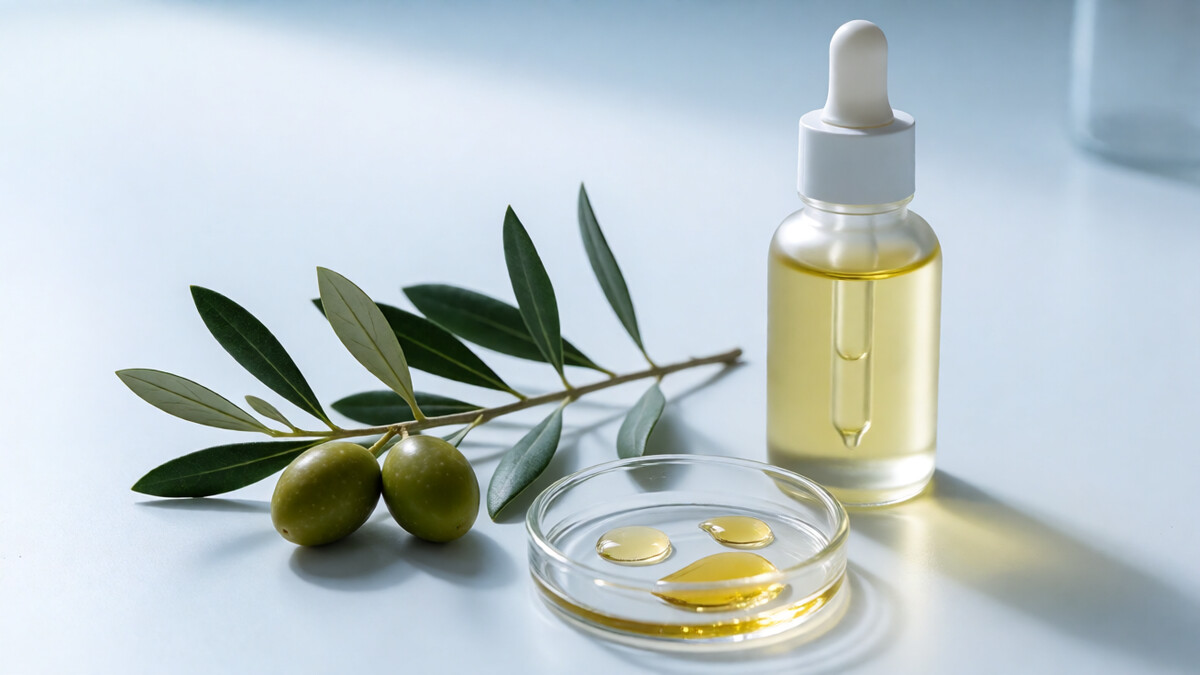
Olive leaf extract (Olea europaea) spent decades in the supplement aisle, known for antioxidant claims rather than brightening. That framing is now outdated. Over five years, mechanistic work and human trials have repositioned olive leaf polyphenols as a genuine multi-pathway anti-pigmentation ingredient — one worth a serious look for sensitive and melanin-rich skin in 2026.
What Is Olive Leaf Extract? Chemistry and Source
Unlike olive oil, which is dominated by triglycerides, olive leaf is rich in the defence metabolites the tree produces. The fractions relevant to pigmentation are:
- Secoiridoids — oleuropein (the major bitter principle) and its isomer oleuroside.
- Simple phenols — hydroxytyrosol and tyrosol; hydroxytyrosol is the principal hydrolysis product of oleuropein and the most bioavailable of the group.
- Lignans — pinoresinol, an under-studied but potent melanin inhibitor.
- Flavonoids — rutin and luteolin-7-glucoside.
Commercial extracts are standardised to oleuropein (commonly 10–20%) or hydroxytyrosol (2–20%). The marker matters: the two actives differ in solubility, stability and absorption, and clinical results differ accordingly.
Mechanism of Action: A Multi-Pathway Profile
Legacy brightening actives usually act at a single node. Olive polyphenols act at several, which is why they tolerate combination with niacinamide, arbutin and tranexamic acid without overlapping toxicity.
- Tyrosinase inhibition — Hydroxytyrosol acts as a substrate analogue that competes with L-DOPA at the active site. Inhibition is reversible and does not depend on copper chelation, so it stacks additively with chelators such as kojic acid.
- MITF and TRP downregulation — Olive polyphenols suppress α-MSH-driven signalling through the PKA/CREB and MAPK cascades, lowering MITF expression and the downstream enzymes tyrosinase, TRP-1 and TRP-2. This is an upstream transcriptional brake, not simple enzyme blockade.
- Antioxidant / ROS scavenging — Oxidative stress in the basal epidermis drives melanocyte hyperactivity; oleuropein and hydroxytyrosol are strong radical scavengers that reduce that load.
- Anti-inflammatory signalling — Inhibition of COX-2 and prostaglandin release is directly relevant to post-inflammatory hyperpigmentation (PIH), where inflammation is the initiating trigger.
- UVB photoprotection — The same molecules protect dermal fibroblasts from UVB damage, adding prevention to correction.
Clinical Evidence: What Human Trials Show
The 2020 Hydroxytyrosol Melasma Pilot RCT
Bagatin and colleagues randomised 42 women with melasma into control, oral olive extract (standardised in hydroxytyrosol), and topical arms of 14 each for 90 days, scoring monthly with mMASI plus the melanin/erythema index. The oral arm showed a significant within-group reduction in mMASI (p<0.0001) and melanin index (p=0.0466) after 60 days; the topical arm trended the same way but did not separate significantly from control. The lesson is bioavailability: systemic delivery outperformed skin delivery, so the authors proposed oral plus topical as an adjunctive strategy.
The 2026 Oil-in-Serum PIH Study
A 2026 study evaluated an oil-in-serum containing olive extract standardised in hydroxytyrosol for PIH. Over 45 days, the treated group showed increased stratum corneum water content and reduced transepidermal water loss — a measurable barrier improvement — alongside a significant reduction in the colour difference between lesional and perilesional skin, with participants reporting fewer dark spots. Pairing a pigment endpoint with barrier endpoints reflects the barrier-first direction the market has taken.
The 28-Day Encapsulated Human Trial
Because free olive polyphenols penetrate poorly, Chinese researchers encapsulated olive leaf extract with glabridin in a high-pressure-homogenised delivery system. In vitro, it reached 78.5% tyrosinase inhibition at a glabridin concentration of 20 µg/mL, with relative melanin content of only 16.5%, and in a 3D melanin model it raised L* by 6.1% while suppressing melanin by 12.9%. A 28-day human trial of a serum containing 5% of the system produced significant increases in skin L* and ITA°, with reductions in melanin content and total pigmented area. Delivery, not the molecule, was the limiting factor.
In Vitro: Oleuropein and Pinoresinol Potency
A 2025 study isolated oleuropein and oleuroside from olive leaves and pinoresinol from olive seeds. In B16 melanoma cells, pinoresinol reduced melanin content to 54 ± 5.5% at only 1.25 µg/mL with no cytotoxicity, while oleuropein reduced melanin to 35 ± 2.2% at 100 µg/mL. Oleuropein also pushed fibroblast proliferation above 120% and maintained viability at 76.5% after a 250 mJ/cm² UVB insult — a dual anti-pigmentation and photoprotective signal in one molecule.
Formulation Science: Stabilising Olive Polyphenols
Oleuropein is demanding — hydrophilic, hydrolysis-prone, heat-sensitive, and stable only across a narrow pH window. Practical rules follow:
- Delivery first — Free polyphenols penetrate the stratum corneum poorly; encapsulation is not optional for a credible efficacy claim.
- pH window — Formulate between pH 3.5 and 6.0; above pH 6, oleuropein hydrolysis to hydroxytyrosol accelerates and the actives profile drifts during shelf life.
- Dosing — 0.5–2.0% of a standardised extract (targeting roughly 0.05–0.2% hydroxytyrosol in the finished formula) matches the trial range.
- Antioxidant synergy — Pairs cleanly with L-ascorbic acid and ferulic acid, partly sparing them from oxidation; avoid free copper ions, which catalyse polyphenol degradation.
- Packaging — Airless, opaque and ideally amber; light and dissolved oxygen drive colour drift.
- Colour management — Olive polyphenols carry an amber-to-green tinge, so keep the dose low rather than masking with dye.
The best-evidenced stack is a standardised olive leaf extract plus niacinamide (which blocks melanosome transfer) and a low level of arbutin or tranexamic acid — three different nodes of the same pathway with non-overlapping tolerability risks.
Safety and Tolerability
Olive leaf polyphenols are food-derived with a long history of dietary use, supporting a favourable topical safety margin. They are not hydroquinone-class agents and carry none of the ochronosis concern linked to prolonged hydroquinone use. Reported irritation is minimal, making them attractive for sensitive and melanin-rich skin. As with any new active, patch testing is advisable, and pregnancy-related use should follow professional guidance rather than explicit claims.
Conclusion
The evidence base is still maturing — the human trials are small and the strongest single-agent mechanistic data is in vitro — but the direction is clear. Olive leaf extract offers a gentle, multi-pathway anti-pigmentation profile with a built-in antioxidant and photoprotective component, and its performance improves markedly when delivered in an encapsulated system. For sensitive-skin and melanin-rich markets, it is best positioned as a well-tolerated core brightening active alongside daily broad-spectrum SPF, rather than as a hydroquinone replacement on its own.
References
- Bagatin JDT, Bagatin E, Maia Campos PMBG. A pilot clinical study to evaluate the effectiveness of olive extract containing hydroxytyrosol for oral and topical treatment of melasma. Biomedical and Biopharmaceutical Research. 2020;17(2):250–259.
- Development, Stability, and Clinical Efficacy of an Oil-in-Serum Formulation with Olive Extract Standardized in Hydroxytyrosol for Post-Inflammatory Hyperpigmentation Treatment. AAPS PharmSciTech. 2026;27:33. doi:10.1208/s12249-025-03318-x
- Shimizu K, Gayatri A, Abdelkarem FM, Amen Y, Matsumoto M, Nagata M. Promising natural polyphenols from olive (Olea europaea) leaves and seeds: dual benefits in the prevention of UVB-induced fibroblast skin damage and anti-skin hyperpigmentation. Records of Natural Products. 2025;19(5):596–610.
- Transdermal permeation and whitening efficacy of an olive leaf extract / glabridin delivery system. Flavour Fragrance Cosmetics (香料香精化妆品). 2024.
- Mahrous MH, Abdel-Dayem SIA, Adel IM, El-Dessouki AM, El-Shiekh RA. Efficacy of natural products as tyrosinase inhibitors in hyperpigmentation therapy: anti-melanogenic or anti-browning effects. Chemistry & Biodiversity. 2025;22(6):e202403324.
- Costa G, Maia Campos PMBG. Efficacy of topical antioxidants in the control of skin hyperpigmentation: a clinical study by reflectance confocal microscopy. Journal of Cosmetic Dermatology. 2022;21(11):5834–5841.
Interested in Formulation Data Collaboration?
Let's discuss how Melasyl AI can accelerate your next whitening or brightening formula. Technical collaboration, data licensing, or custom AI-driven research — reach out.
Contact Wei →