Introduction: The Regenerative Turn in Skincare
In 2026, the skincare industry is undergoing a paradigm shift. For decades, the dominant model was subtractive — exfoliate, peel away, bleach pigment. But a new category of bioactive ingredients is rewriting the rulebook entirely: instead of stripping skin, they teach it to rebuild. At the forefront of this regenerative revolution sits polydeoxyribonucleotide (PDRN), a salmon-derived DNA fragment that has transformed from an obscure medical wound-healing agent into one of the fastest-growing active ingredients in global cosmeceuticals.
According to data from Jiuqian Zhongtai, PDRN-labeled skincare products across Tmall, JD.com, and Douyin grew from just ¥1.5 million in total sales in 2022 to ¥408 million in 2025 — a staggering 270-fold increase in four years (Jiuqian Zhongtai & Pinguan, 2026). Search interest for PDRN-related keywords surged 2,213% year-over-year in the first half of 2025 alone. This is not a passing trend. This is a structural realignment of what consumers expect from their skincare.
What Is PDRN? The Science Behind the Hype
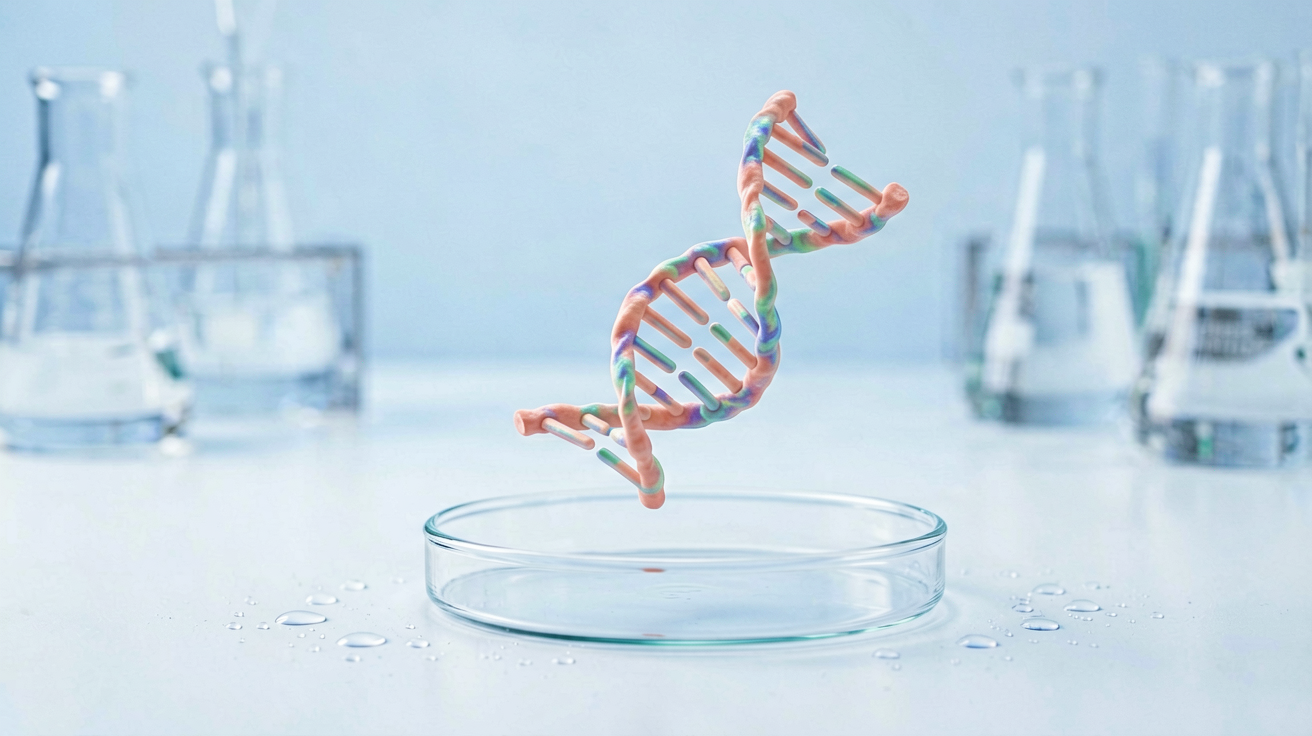
Polydeoxyribonucleotide (PDRN) is a purified, low-molecular-weight DNA fragment extracted primarily from the milt (sperm tissue) of Oncorhynchus mykiss (rainbow trout) or Salmo salar (Atlantic salmon). The extracted DNA is enzymatically cleaved into fragments ranging from 50 to 1,500 kDa, creating a mixture of deoxyribonucleotide polymers whose base-pair sequences share approximately 98% homology with human DNA (Galeano et al., Pharmaceuticals, 2021). This near-identity is the biochemical basis for PDRN’s exceptionally high biocompatibility and remarkably low immunogenicity when applied to human tissue.
PDRN operates through a dual mechanism that distinguishes it from virtually all conventional skincare actives. First, it functions as a salvage pathway substrate: fibroblasts and keratinocytes can uptake PDRN fragments and recycle their nucleotide components for DNA synthesis during cell division, effectively providing raw building materials for tissue repair without triggering the energy-intensive de novo nucleotide synthesis pathway. Second — and more critically — PDRN acts as a potent agonist of the adenosine A2A receptor (A2AR), a G-protein-coupled receptor expressed on fibroblasts, endothelial cells, and immune cells throughout the dermis.
A2A receptor activation by PDRN triggers a signaling cascade through the PI3K/Akt pathway: it simultaneously stimulates fibroblast proliferation and collagen type I/III synthesis while suppressing NF-kB-driven inflammatory cytokine production — notably reducing TNF-alpha, IL-6, and IL-1beta expression (Squadrito et al., Frontiers in Pharmacology, 2017). The net effect is a tissue environment biased toward regeneration over inflammation — precisely the condition required for optimal skin healing, barrier repair, and structural rejuvenation.
Clinical Evidence: The Foundation Beneath the Marketing
Unlike many trendy ingredients that arrive with minimal peer-reviewed backing, PDRN enters the skincare conversation with 25 years of clinical and preclinical research behind it. A comprehensive 2021 review by Galeano and colleagues in Pharmaceuticals analyzed over 60 studies on PDRN’s wound-healing applications and concluded that it “proved encouraging results in terms of healing time, wound regeneration, and absence of side effects” across in vitro, in vivo animal models, and human clinical settings (Galeano et al., Pharmaceuticals, 2021, 14(11):1103).
A randomized controlled trial by Kim et al. (2018) evaluated PDRN-containing cream applied twice daily for 8 weeks in 40 female subjects with photoaged facial skin. Compared to vehicle alone, the PDRN group showed a 17.3% improvement in skin elasticity measured by Cutometer, a 14.6% reduction in transepidermal water loss (TEWL), and a statistically significant increase in dermal collagen density as assessed by ultrasonography (Kim et al., Annals of Dermatology, 2018). Separate research has demonstrated that PDRN upregulates vascular endothelial growth factor (VEGF) expression, promoting angiogenesis and improved microcirculation in treated skin — an effect particularly relevant to the dull, devitalized complexion often described as tired skin.
A 2024 study published in the Journal of Cosmetic Dermatology examined a topical PDRN serum with a liposomal delivery system in 30 subjects over a 12-week period. Digital image analysis showed a 22.8% decrease in periorbital wrinkle depth, a 19.1% increase in skin hydration measured by corneometry, and blinded investigator assessments recorded “moderate to significant” improvement in overall facial skin quality in 83% of participants. Crucially, tolerability was excellent: only one subject reported mild, transient erythema that resolved without intervention.
Market Dynamics: A 270x Growth Phenomenon
The commercial trajectory of PDRN is, by any standard, extraordinary. In 2022, the entire Chinese e-commerce market for PDRN-branded skincare products across Tmall, JD.com, and Douyin totaled approximately 1.5 million RMB (roughly $206,000 USD). By 2025, that figure had exploded to 408 million RMB ($56 million) — registering a year-over-year growth rate of 999% (Jiuqian Zhongtai, 2026). Through mid-2026, sales have already reached 223 million RMB, suggesting the full-year figure will comfortably exceed 500 million RMB.
Channel dynamics tell an equally instructive story. Douyin (TikTok China) has emerged as the dominant platform, contributing 293 million RMB in 2025 alone — roughly 72% of the total market — driven by short-form content that combines ingredient education with live-stream demonstrations. Tmall contributed 100 million RMB (24.5%) and serves as the brand-deposit channel where premium positioning is established. JD.com, while proportionally smaller at 15 million RMB (3.7%), grew at an identical 999% rate and serves a high-trust consumer base willing to pay premium prices for authenticated products.
The competitive landscape reveals a notable pattern: domestic Chinese brands dominate. Zhan Mei Ya leads with 126 million RMB in 2025 sales and a 33.9% market share, followed by Uniskin at 36 million RMB. International beauty giant L’Oreal Paris entered the category in late 2025 with its Super Hydro-Light serum featuring a proprietary PDRN variant and has already captured 29 million RMB in sales. Korean pioneer Rejuran, which originally popularized PDRN through injectable salmon DNA treatments, occupies a smaller but prestigious niche at 5.6 million RMB in topical product sales.
According to the Shangpu Consulting 2026 White Paper on China’s Functional Skincare Industry, biotechnology-derived ingredients’ share of total cosmetic raw materials has risen from 6.7% three years ago to 23.3% in 2025 — a shift in which PDRN has been one of the principal drivers (Shangpu Consulting, 2026).
Beyond the Hype: Delivery Challenges and Innovation
The Achilles heel of PDRN in topical application has always been molecular size. With fragments spanning 50 to 1,500 kDa, passive transdermal diffusion through intact stratum corneum is negligible. This was PDRN’s original limitation as a skincare ingredient: the same DNA polymer that produces dramatic results when injected into the dermis risks becoming a costly film-former sitting uselessly on the skin surface when simply suspended in a conventional emulsion.
The industry’s response to this challenge has driven some of the most interesting formulation innovation seen in recent years. Liposomal encapsulation — in which PDRN fragments are packaged within phospholipid bilayer vesicles 100 to 300 nm in diameter — has emerged as the most clinically validated approach. These vesicles fuse with corneocyte membranes in the stratum corneum, releasing PDRN payloads into the viable epidermis and upper dermis. Nanocarrier technologies including solid lipid nanoparticles (SLNs) and polymeric micelles are being explored as alternatives, offering improved stability and higher loading capacity.
The Jiuqian Zhongtai white paper identifies “texture experience” as the single biggest consumer complaint about current PDRN products: while 99% of pre-purchase users express satisfaction with product absorption claims in marketing content, post-purchase satisfaction for skin feel drops to -86%, with pilling and heavy texture cited as dominant pain points. Brands that solve the delivery-texture paradox — achieving meaningful dermal penetration without the sticky, high-molecular-weight residue — will capture disproportionate market share in the next phase of this category’s evolution.
Regulatory Crossroads: Medical Device vs. Cosmetic
A defining tension in the PDRN market is the regulatory bifurcation between medical device and cosmetic classifications. Injectable PDRN products fall under Class III medical device regulation in China — the strictest category — and as of mid-2026, no domestically produced PDRN injectable has received NMPA approval. The market is served exclusively by imported products, primarily from South Korea and Italy, with approval timelines measured in years rather than months.
Topical PDRN cosmetics, conversely, operate under China’s Cosmetic Supervision and Administration Regulation (CSAR), which requires efficacy substantiation for any brightening, anti-wrinkle, or repair claims. The 2026 white paper suggests that the long-term trajectory for PDRN may follow two parallel paths: upward into regulated medical devices for high-concentration, clinically administered products, and downward into everyday cosmetics where PDRN functions as a baseline repair ingredient embedded across entire product lines — much as niacinamide has become a near-ubiquitous formulation component.
The Southeast Asia Opportunity
While the current PDRN boom is concentrated in China and South Korea, the Southeast Asian market presents a significant blue-ocean opportunity. The ASEAN Cosmetics Directive (ACD) provides a harmonized regulatory framework that, while requiring notification and compliance verification, does not impose the same pre-market approval burdens as China’s CSAR regime. Indonesia, with 280 million consumers and a rapidly growing middle class obsessed with skincare, represents the single largest untapped market for PDRN-based products in the region.
The climatic profile of Southeast Asia — high ambient UV index, tropical humidity, and high pollution levels in urban centers — creates a particularly compelling use case for PDRN’s anti-inflammatory and regenerative properties. Chronic low-grade UV damage and pollution-induced oxidative stress are endemic in these markets, and an ingredient that simultaneously calms inflammation and stimulates repair addresses the root cause of skin aging more directly than traditional whitening ingredients alone.
Formulation Philosophy: PDRN as Platform, Not Star
An emerging consensus among serious formulators is that PDRN’s greatest value proposition may not be as a standalone hero ingredient but as a carrier signal that amplifies the efficacy of co-formulated actives. Because PDRN downregulates NF-kB-driven inflammation — a common cause of treatment failure with retinol, vitamin C, and alpha-hydroxy acids — it creates a tissue environment that is more receptive to other interventions. A formulation combining PDRN with stabilized vitamin C (3-O-ethyl ascorbic acid or ascorbyl glucoside) could theoretically deliver brighter results with less irritation than vitamin C alone. Paired with low-molecular-weight hyaluronic acid, PDRN’s angiogenic effects may enhance hydration distribution throughout the dermal matrix.
The Jiuqian Zhongtai report identifies makeup base/priming as an entirely overlooked application — consumer mentions of PDRN’s pre-makeup benefits have risen to 4.2% of all category discussions, while B-side brand marketing mentions remain at 0%. Products positioned as regenerative makeup primers that leverage PDRN’s smoothing and barrier-repair properties represent an unclaimed white-space opportunity.
Conclusion: The Regenerative Imperative
PDRN’s trajectory from surgical wound beds to daily serums is not random — it reflects a deeper, structural shift in how skincare is conceived. The era of subtractive beauty (peeling, bleaching, stripping) is giving way to regenerative beauty (repairing, signaling, rebuilding). In this new paradigm, PDRN functions as both a chemical signal and a biological substrate: it tells cells to repair and simultaneously provides the molecular materials to do so.
The numbers are remarkable, but they are also a lagging indicator. The 270-fold sales increase from 2022 to 2025 measures what has already happened. What is coming — delivery innovation, regulatory maturation, cross-category expansion, and international market penetration — promises to make PDRN a foundational ingredient in the skincare pharmacopoeia for the next decade. For brands and formulators, the question is no longer whether to incorporate regenerative signaling into their product philosophy, but how to do it with scientific integrity, clinical evidence, and genuine respect for the complexity of skin biology.
References:
- Galeano M, Pallio G, Irrera N, et al. Polydeoxyribonucleotide: A Promising Biological Platform to Accelerate Impaired Skin Wound Healing. Pharmaceuticals. 2021;14(11):1103. doi:10.3390/ph14111103
- Squadrito F, Bitto A, Irrera N, et al. Pharmacological Activity and Clinical Use of PDRN. Frontiers in Pharmacology. 2017;8:224. doi:10.3389/fphar.2017.00224
- Kim JH, et al. Effects of Polydeoxyribonucleotide on Photoaged Facial Skin: A Randomized Controlled Trial. Annals of Dermatology. 2018;30(5):546-553.
- Jiuqian Zhongtai & Pinguan. 2026 PDRN Industry White Paper. February 2026.
- Shangpu Consulting. 2026 China Functional Skincare Industry White Paper. June 2026.
- China Cosmetics Magazine. PDRN Breakthrough: Four-Year 270x Growth — Functional Skincare Enters the Regenerative Era. April 2026.
Interested in Formulation Data Collaboration?
Let's discuss how Melasyl AI can accelerate your next whitening or brightening formula. Technical collaboration, data licensing, or custom AI-driven research — reach out.
Contact Wei →