Hyperpigmentation — melasma, solar lentigines, and post-inflammatory pigment — remains one of the most stubborn targets in cosmetic dermatology. Most brightening actives attack a single node of the melanin cascade: they inhibit tyrosinase. Pterostilbene is different. This dimethylated stilbene, an analog of resveratrol, is emerging in 2026 research as a multi-pathway agent that blocks new pigment synthesis, suppresses the UV stress signals that drive it, and helps the skin clear melanosomes that are already there. This review unpacks the mechanism science and the clinical data behind pterostilbene.
What Is Pterostilbene?
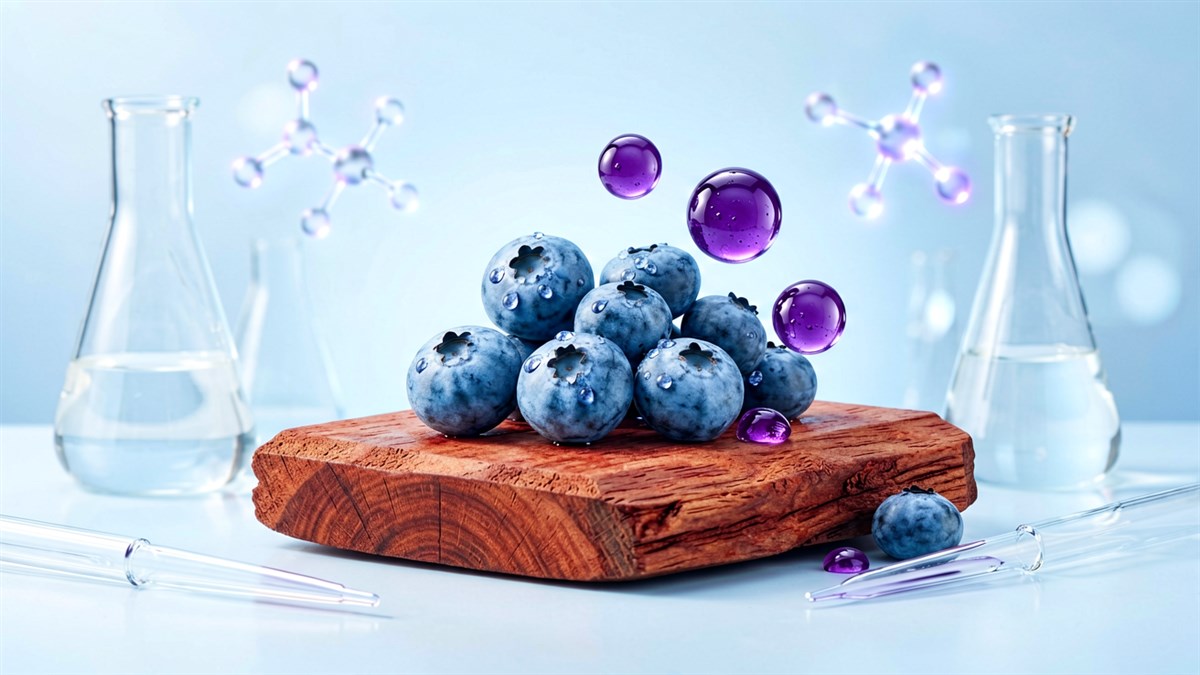
Pterostilbene (trans-3,5-dimethoxy-4-hydroxy-stilbene) is a natural polyphenol found in blueberries and several grape varieties, and it is the principal stilbenoid of Pterocarpus marsupium (Indian kino) heartwood. Structurally it is a dimethylated cousin of resveratrol — and that small substitution changes everything.
Two methoxy groups replace the hydroxyl groups of resveratrol. This raises lipophilicity and membrane permeability, and it blocks the rapid phase-II conjugation that clears resveratrol from the skin. The practical result is a molecule that penetrates the stratum corneum more readily and survives longer in formulation and in tissue — one reason formulators describe pterostilbene as “the better-behaved resveratrol.”
The Mechanism: Three Simultaneous Levers
1. Autophagy — degrading melanin that already exists
The most novel finding is that pterostilbene does not merely shut down melanin production; it accelerates the cell’s own recycling machinery. In a 2021 study published in Redox Biology, Hseu and colleagues showed that pterostilbene triggers autophagy in melanocytes, evidenced by increased LC3-II accumulation, p62/SQSTM1 activation, autophagosome formation, and a rising Beclin-1/Bcl-2 ratio, alongside suppression of the PI3K/AKT/mTOR axis. Transmission electron microscopy provided direct evidence: autophagosomes were seen engulfing melanosomes after treatment. Notably, the anti-melanogenic effect was reversed when autophagy was chemically blocked (3-MA) or when LC3 was silenced — confirming autophagy is the mechanism, not a bystander effect.
2. MITF–CREB–Tyrosinase — switching off new melanin
Pterostilbene simultaneously downregulates the master transcription program of pigmentation. In α-MSH–stimulated melanocytes it reduced MC1R, MITF, tyrosinase, and TRP-1/TRP-2 expression, cutting melanin synthesis at the source. The same study reported in vitro potency that compares favorably with established brighteners (Table 1).
| Assay (in vitro) | Pterostilbene IC₅₀ | Kojic acid IC₅₀ |
|---|---|---|
| Melanogenesis inhibition (B16F1) | 0.55 µg/mL | 50 µg/mL |
| Tyrosinase inhibition | 7 µg/mL | 3.5 µg/mL |
| Anti-collagenase | 125 µg/mL | — |
| Anti-elastase | 50 µg/mL | — |
Table 1. In vitro activity of pterostilbene versus kojic acid (Majeed et al., 2020; Hseu et al., 2021).
3. Nrf2 antioxidant defense and UV-stress signaling
Pigment is downstream of oxidative stress. Pterostilbene activates the Nrf2 antioxidant pathway, increasing HO-1, γ-GCLC, and NQO-1 expression through ERK, AMPK, and ROS-mediated signaling. In UVA-irradiated keratinocytes it suppressed the POMC/α-MSH cascade — the paracrine signal that tells melanocytes to ramp up pigment. When Nrf2 was knocked down, this protection collapsed, underlining that the antioxidant arm is essential. In vivo, pterostilbene reduced tyrosinase expression and endogenous pigmentation in a zebrafish model.
Clinical Evidence in Humans
The human dataset is smaller than for niacinamide or tranexamic acid but is specific and consistent. The pivotal study is an open-label, single-arm, monocentric trial by Majeed and colleagues (Clinical, Cosmetic and Investigational Dermatology, 2020).
| Study | Design | Regimen | Key outcomes |
|---|---|---|---|
| Majeed 2020 (n=38) | Open-label, single-arm, 8 wk | 0.4% pterostilbene cream, twice daily | Skin luminosity ↑ (cheek wk4 p=0.0001; forehead wk4 p=0.0498); hydration ↑ (p<0.0001); elasticity ↑; fine lines/wrinkles ↓; no adverse events |
| Majeed 2020 (SPF) | Randomized SPF study, 12 subjects | 0.4% pterostilbene cream | In vivo SPF 6.2 ± 1.30; in vitro SPF 8.84; ingredient SPF 21.73 |
Table 2. Human clinical data for topical pterostilbene.
Reading the results critically matters. The Majeed trial measured brightness by spectrophotometry and showed a measurable, statistically significant lift in skin luminosity, plus gains in hydration and elasticity and a reduction in fine lines — all clinically judged and instrument-confirmed, with an excellent tolerability profile. Its limitations are equally clear: it was open-label, single-arm, and enrolled 38 subjects over 8 weeks. There was no vehicle control and no melasma-specific MASI endpoint, so the pigment signal should be read as a brightening signal rather than a proven melasma endpoint. The SPF study is notable because it positions pterostilbene as a mild photoprotective adjunct — relevant when pigment control depends on daily UV defense.
More recently, a 2025 in vitro investigation (Cosmetics) reinforced the anti-aging and antioxidant profile, and 2025 delivery research into flexible pterostilbene nanoliposomes reported improved skin delivery with elasticity and brightening potential — an important direction, because a poorly delivered polyphenol cannot reach the melanocyte.
Formulation Considerations
- Use level: clinical work used 0.4% of a 90% natural pterostilbene extract. This is a realistic, well-tolerated target for a leave-on serum or cream.
- Delivery: pterostilbene is lipophilic. Nanoliposomes, cyclodextrin complexes, and well-structured emulsions improve penetration of a molecule that otherwise prefers the oil phase.
- Stability: the methoxy groups make it more oxidation-resistant than resveratrol, but it should still be protected from light and oxygen, and chelated where trace metals are present.
- Pairing: its distinct autophagy/Nrf2 mechanism makes it a logical partner for tyrosinase inhibitors (thiamidol, alpha-arbutin), transfer inhibitors (niacinamide), and anti-inflammatory actives (tranexamic acid). Always formulate with broad-spectrum SPF as the foundation.
- pH: pterostilbene tolerates the mildly acidic range used in brightening serums (pH ~4.5–6.0); avoid strongly alkaline systems that deprotonate the phenol.
Safety and Tolerability
Across the human study, pterostilbene cream produced no product-related irritation, intolerance, or adverse events over 8 weeks of twice-daily use, and it is a well-established food-derived polyphenol. As with any brightening active, patch-testing and photoprotection remain standard practice.
Bottom Line
Pterostilbene is not just “resveratrol with better numbers.” Its distinguishing feature is mechanistic breadth: autophagy-mediated clearance of existing melanosomes, MITF–CREB–tyrosinase suppression of new melanin, and Nrf2-driven antioxidant defense against UV stress. The human evidence is early — one well-tolerated 8-week trial plus photoprotection data — but the mechanistic depth is unusually strong, and 2025 delivery research is actively closing the bioavailability gap. For formulators building next-generation brightening systems, pterostilbene deserves a place on the bench.
References
- Hseu YC, Vudhya Gowrisankar Y, Wang LW, et al. The in vitro and in vivo depigmenting activity of pterostilbene through induction of autophagy in melanocytes and inhibition of UVA-irradiated α-MSH in keratinocytes via Nrf2-mediated antioxidant pathways. Redox Biology. 2021;44:102007. doi:10.1016/j.redox.2021.102007. PMID 34049220.
- Majeed M, Majeed S, Jain R, et al. An Open-Label Single-Arm, Monocentric Study Assessing the Efficacy and Safety of Natural Pterostilbene (Pterocarpus marsupium) for Skin Brightening and Antiaging Effects. Clin Cosmet Investig Dermatol. 2020;13:105–116. doi:10.2147/CCID.S238358. PMID 32099438.
- Majeed M, et al. A Randomized Study to Determine the Sun Protection Factor of Natural Pterostilbene from Pterocarpus marsupium. Cosmetics. 2020;7(1):16. doi:10.3390/cosmetics7010016.
- Cen Z, Chen Z, Wang D, et al. In vitro investigation of antiaging efficacy of pterostilbene as a cosmetic ingredient. Cosmetics. 2025;12(1):23. doi:10.3390/cosmetics12010023.
- Flexible Pterostilbene Nanoliposomes for Enhanced Skin Delivery: Elasticity and Brightening Potential. Current Pharmaceutical Biotechnology. 2025. doi:10.2174/0113892010392765250919183207.
Interested in Formulation Data Collaboration?
Let's discuss how Melasyl AI can accelerate your next whitening or brightening formula. Technical collaboration, data licensing, or custom AI-driven research — reach out.
Contact Wei →