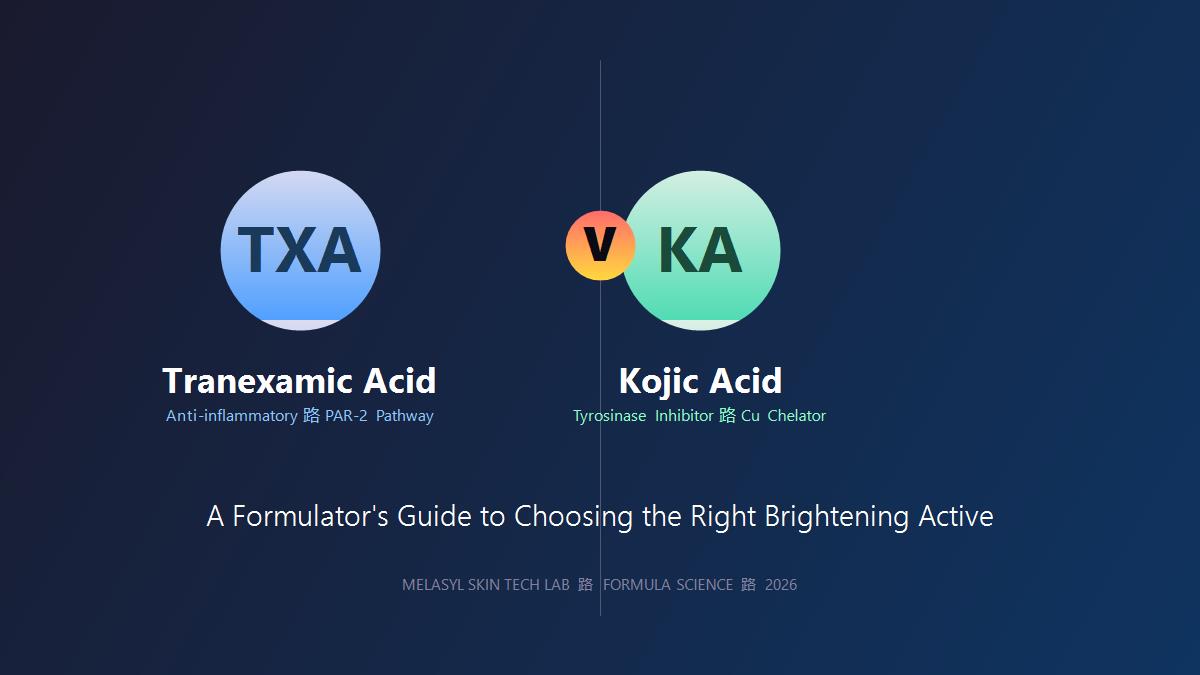
Tranexamic Acid vs Kojic Acid: A Formulator’s Guide to Melasma Treatment
When selecting brightening actives for a melasma-targeting formulation, two ingredients consistently dominate the discussion: tranexamic acid vs kojic acid. Both have demonstrated efficacy in clinical settings, yet their mechanisms, safety profiles, and formulation requirements differ substantially. This guide breaks down the science so you can make evidence-based development decisions.
Understanding Melasma: Why One Active Is Rarely Enough
Melasma is a chronic, relapsing hyperpigmentation disorder driven by UV exposure, hormonal factors, and dermal inflammation. The condition involves both melanin overproduction in melanocytes and abnormal melanosome transfer to keratinocytes, making single-mechanism actives insufficient in isolation. A 2026 Delphi consensus from the Journal of the European Academy of Dermatology and Venereology confirmed that melasma management requires long-term, multimodal strategies combining pigment inhibition, barrier support, and strict photoprotection.
Mechanism of Action: How Each Ingredient Works
Tranexamic Acid — The Anti-Inflammatory Brightener
Tranexamic acid (TXA) is a synthetic lysine analog best known for its antifibrinolytic properties in clinical hemostasis. Its dermatological application stems from a distinct anti-melanogenic pathway: TXA inhibits the conversion of plasminogen to plasmin, which in turn reduces the generation of prostaglandins and leukotrienes that activate the protease-activated receptor-2 (PAR-2) pathway. Since PAR-2 plays a key role in melanosome transfer from melanocytes to keratinocytes, suppressing this pathway effectively interrupts visible pigment formation without directly blocking tyrosinase.
Beyond the plasmin pathway, a 2026 study published in Annals of Medicine demonstrated that TXA also protects human dermal fibroblasts from D-galactose-induced senescence via the GPR30/MAPK signaling axis, suggesting additional anti-aging benefits that are relevant for long-term skin health in melasma patients.
Kojic Acid — The Direct Tyrosinase Inhibitor
Kojic acid (5-hydroxy-2-hydroxymethyl-4-pyrone) is a fungal-derived chelation agent that exerts its brightening effect by binding directly to the copper atoms at the active site of tyrosinase, the rate-limiting enzyme in melanin biosynthesis. This copper chelation is competitive and reversible, meaning sustained skin delivery is necessary for continued inhibition. Kojic acid also exhibits antioxidant properties and has demonstrated synergy with alpha-hydroxy acids in combined formulations, as shown in comparative clinical trials from the 1990s.
However, kojic acid’s direct enzyme interaction makes it more prone to causing irritation than indirect-pathway actives. Studies have noted higher irritation potential for kojic acid preparations compared to equivalent hydroquinone formulations.
Clinical Evidence: What the Trials Show
Tranexamic Acid
A 2025 randomized, double-blind clinical trial published in Scientific Reports compared niosomal tranexamic acid 2%/niacinamide 2% cream against conventional TXA 5%/niacinamide 4% cream and hydroquinone 4% as gold standard. Results showed that the niosomal formulation achieved comparable efficacy to the conventional higher-concentration formulation and to hydroquinone, while demonstrating a superior tolerability profile. This highlights the value of advanced delivery systems in reducing the effective concentration of TXA needed.
A 2025 network meta-analysis in Aesthetic Surgery Journal (PMID: 40590795) examining injectable TXA combination therapies for melasma found that TXA-based regimens produced significant MASI score improvements with fewer adverse effects than many conventional alternatives. A separate 2025 randomized controlled trial comparing oral versus topical TXA in the Journal of Cosmetic Dermatology (PMID: 40923777) confirmed that both routes are effective, with topical application offering localized benefits without systemic exposure.
Topical TXA concentrations ranging from 2% to 5% have been validated across multiple studies. The 2026 Annals of Medicine study specifically evaluated a 3% TXA serum combined with moisturizer over 8 weeks, showing measurable improvement in melasma severity in 50 randomized women.
Kojic Acid
Research on kojic acid in melasma treatment is more established but shows a more varied efficacy profile. A 1999 Dermatologic Surgery study found that adding 2% kojic acid to a glycolic acid/hydroquinone gel produced measurably better outcomes than the base formulation alone, confirming kojic acid’s role as a potent synergistic agent rather than a standalone monotherapy. A 2025 comparative study in Cureus (PMID: 40296942) evaluated 2% kojic acid against 5% cysteamine in Indian females with melasma, demonstrating measurable but moderate efficacy that was statistically lower than the cysteamine comparator.
The consensus in recent literature positions kojic acid most effectively as an adjunct in multi-active formulations rather than as a primary monotherapy for moderate-to-severe melasma.
Formulation Considerations: Stability, pH, and Delivery
Tranexamic Acid in Practice
- pH range: TXA is most stable and effective in slightly acidic to neutral formulations (pH 5.0–6.5). Above pH 7, degradation accelerates.
- Solubility: Highly water-soluble, making it ideal for aqueous serums, ampules, and light gel textures.
- Stability: Stable to heat and oxidation; compatible with niacinamide, vitamin C, and most conventional cosmetic preservatives.
- Penetration: The stratum corneum is a significant barrier. Liposomal or niosomal encapsulation (as demonstrated in the 2025 niosomal study) substantially improves delivery efficiency at lower concentrations.
- Concentration for formulation: 2–3% is supported by clinical data for topical application. Going higher does not proportionally increase efficacy and may increase the risk of transient skin sensitivity.
Kojic Acid in Practice
- pH range: Optimal efficacy between pH 4.0 and 5.0. Above pH 5.5, both stability and activity degrade significantly.
- Solubility: Soluble in water and ethanol; unstable in formulations with high pH or significant heat exposure.
- Stability: Kojic acid is photosensitive and oxidizes rapidly when exposed to UV light or elevated temperatures. Air exposure also leads to gradual browning of the formulation. Antioxidant systems (e.g., BHT, vitamin E) and opaque packaging are strongly recommended.
- Penetration: Small molecular weight favors skin penetration, but this same property can contribute to irritation. Buffering with soothing bases and pairing with humectants mitigates this.
- Concentration for formulation: Effective range is 0.5–2.0%. Above 2%, irritation risk increases significantly, particularly on sensitive or compromised skin. EU cosmetics regulations limit kojic acid in leave-on products.
Compatibility and Combination Strategies
The two actives can be used together in a complementary formulation strategy: TXA handles the inflammatory and melanosome-transfer pathway, while kojic acid provides direct tyrosinase inhibition. However, the pH tension between them (TXA prefers pH 5–6; kojic acid prefers pH 4–5) requires careful formulation balancing. A dual-chamber packaging approach or staggered application in a two-step system can preserve both actives at their optimal pH windows.
Both actives pair well with complementary brightening ingredients. TXA shows strong synergy with niacinamide (which reduces melanosome transfer) and azelaic acid (which provides additional tyrosinase inhibition and anti-inflammatory action). Kojic acid is frequently combined with glycolic acid (which accelerates epidermal turnover and enhances penetration) and hydroquinone (for compounded effect), though regulatory status of hydroquinone varies by market.
Safety and Sensitization
TXA has an excellent tolerability profile across multiple clinical trials, with minimal reported irritation or contact sensitization. Systemic absorption from topical application is negligible. TXA is considered suitable for long-term maintenance use in pigmentation regimens.
Kojic acid carries a higher sensitization risk. Contact dermatitis has been reported, particularly at concentrations above 2% or in individuals with compromised skin barriers. Kojic acid may also cause paradoxical hyperpigmentation in some users. Due to its photosensitizing potential, sun protection is mandatory in any formulation containing kojic acid.
Key Takeaways for Formulators
- Target the right pathway: TXA is preferred when inflammation and melanosome transfer are the dominant drivers. Kojic acid is more effective for direct tyrosinase-driven hyperpigmentation.
- Delivery matters more than concentration: A 2% TXA niosomal formulation matched a 5% conventional formulation in clinical trials. Invest in delivery systems.
- pH is non-negotiable: Each active has a specific pH window for stability and efficacy. Compromise here and you lose potency before the product reaches the consumer.
- Oxidation protection is essential for kojic acid: Antioxidant systems and opaque packaging are not optional — they are the difference between an effective and a degraded product.
- Combine mechanisms, not just actives: The strongest melasma formulations combine at least two non-redundant pigment-reduction mechanisms: direct enzyme inhibition plus melanosome transfer suppression plus barrier support.
References
- Lin Y et al. “Tranexamic acid protects human dermal fibroblasts from D-galactose-induced senescence via the GPR30/MAPK pathway.” Ann Med. 2026;58(1):2663263. https://pubmed.ncbi.nlm.nih.gov/42059427/
- Ghasemiyeh P et al. “Safety and efficacy of niosomal and conventional tranexamic acid/niacinamide vs. hydroquinone creams in melasma.” Sci Rep. 2025;15(1):42739. https://pubmed.ncbi.nlm.nih.gov/41315336/
- Nukaly H et al. “Comparative Efficacy and Safety of Injectable Tranexamic Acid Combination Therapies for Melasma: A Network Meta-analysis of RCTs.” Aesthet Surg J. 2025;45(9):947-956. https://pubmed.ncbi.nlm.nih.gov/40590795/
- Heidary B et al. “Randomized Clinical Trial on the Efficacy of Oral Tranexamic Acid Versus Topical Tranexamic Acid in Treatment of Melasma.” J Cosmet Dermatol. 2025;24(9):e70428. https://pubmed.ncbi.nlm.nih.gov/40923777/
- Suliman RS et al. “Emerging topical therapies for melasma: a comparative analysis of efficacy and safety.” J Dermatolog Treat. 2025;36(1):2591502. https://pubmed.ncbi.nlm.nih.gov/41307217/
- Patil R et al. “Comparison of the Effectiveness and Safety of 5% Cysteamine and 2% Kojic Acid Creams in the Treatment of Melasma.” Cureus. 2025;17(3):e81330. https://pubmed.ncbi.nlm.nih.gov/40296942/
- Lim JT. “Treatment of melasma using kojic acid in a gel containing hydroquinone and glycolic acid.” Dermatol Surg. 1999;25(4):282-284. https://pubmed.ncbi.nlm.nih.gov/10417583/
- Sarkar R et al. “Delphi consensus on melasma management by international experts and pigmentary disorders society.” J Eur Acad Dermatol Venereol. 2026;40(4):680-692. https://pubmed.ncbi.nlm.nih.gov/40996222/
- Pisano L et al. “Biomedical applications of tyrosinases and tyrosinase inhibitors.” Enzymes. 2024;56:261-280. https://pubmed.ncbi.nlm.nih.gov/39304289/
- Capp Zilles J et al. “Polymeric Nanocapsules Containing Kojic Acid Dipalmitate and Rosehip Oil for Skin Whitening.” ACS Omega. 2025;10(51):62987-63002. https://pubmed.ncbi.nlm.nih.gov/41487226/
Interested in Formulation Data Collaboration?
Let's discuss how Melasyl AI can accelerate your next whitening or brightening formula. Technical collaboration, data licensing, or custom AI-driven research — reach out.
Contact Wei →