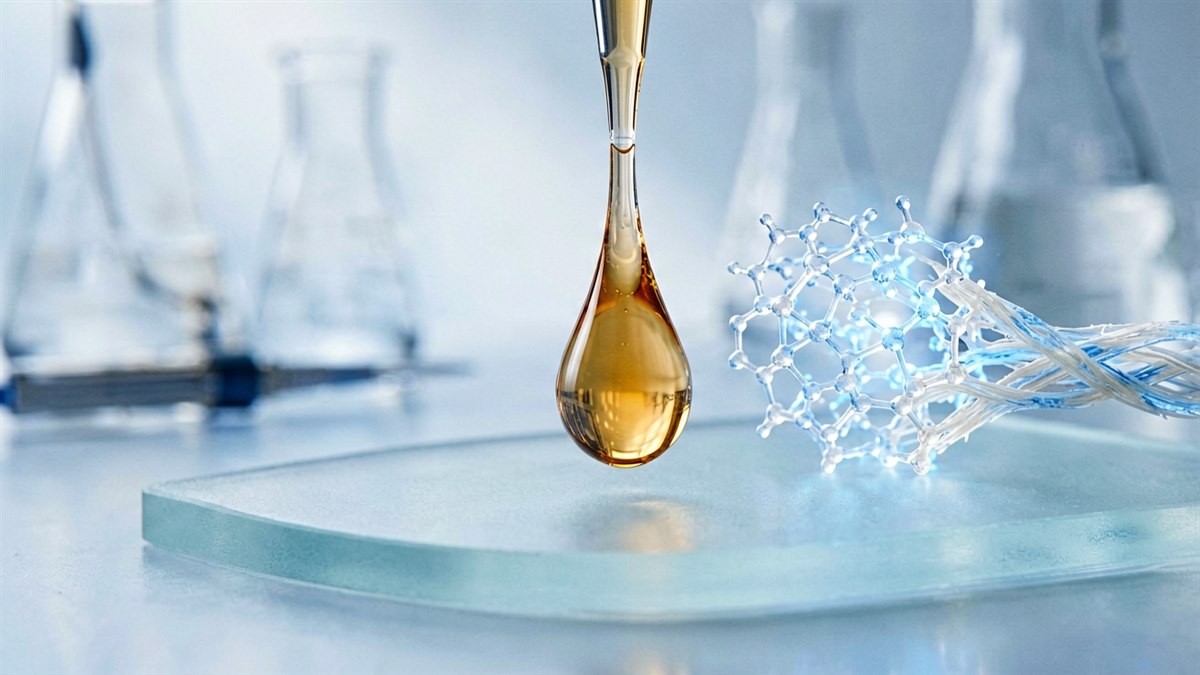
Anti-glycation skincare has moved from a niche Japanese category claim into one of the fastest-maturing segments of clinical skincare science. The shift is being driven by a simple realisation: a large share of what consumers describe as “dullness,” “sallowness,” or “skin that looks tired even when rested” is not a pigment problem at all. It is a protein chemistry problem. Sugars are quietly cross-linking the dermal collagen scaffold, and no tyrosinase inhibitor will reverse that.
For brands building brightening and tone-correction portfolios, this matters commercially. Glycation sits in the diagnostic blind spot between pigmentation care and anti-ageing care, and 2026 product development is finally addressing it directly.
What Glycation Actually Does to Skin
Glycation is the non-enzymatic Maillard reaction between reducing sugars (glucose, fructose, and the far more reactive dicarbonyls methylglyoxal and glyoxal) and free amino groups on proteins. The reaction proceeds through a reversible Schiff base, rearranges into a more stable Amadori product, and then oxidises irreversibly into advanced glycation end-products (AGEs).
Three consequences follow, and each has a distinct clinical signature:
- Chromophore formation. Mature AGEs are yellow-brown, fluorescent molecules. Their accumulation in the dermis raises the b* (yellowness) axis in colorimetric measurement, producing sallowness that brightening actives cannot correct because the chromophore is not melanin.
- Mechanical cross-linking. Glucosepane and pentosidine covalently tether adjacent collagen fibrils. Cross-linked collagen loses elasticity, resists remodelling, and becomes stiffer and less soluble.
- RAGE signalling. AGEs bind the receptor for advanced glycation end-products (RAGE), activating NF-kB, driving pro-inflammatory cytokine release and MMP-1 upregulation while suppressing new collagen synthesis. This inflammatory loop also amplifies melanogenesis, which is where glycation and hyperpigmentation genuinely intersect.
The reason this becomes permanent is turnover. Verzijl and colleagues demonstrated that dermal collagen has a half-life of roughly 15 years, calculated via aspartic acid racemisation and confirmed against pentosidine accumulation curves (J Biol Chem, 2000;275:39027-39031). Skin collagen is effectively a long-lived protein, so AGE damage compounds rather than clears.
The Clinical Evidence Base
The measurement science here is unusually solid, which is what has given anti-glycation skincare credibility with formulators who normally dismiss trend ingredients.
Dyer et al. quantified Maillard reaction products in human skin collagen and showed that pentosidine and carboxymethyl-lysine (CML) rise approximately linearly with chronological age, with markedly accelerated accumulation in diabetic subjects (J Clin Invest, 1993;91:2463-2469). Sell and Monnier later identified glucosepane as the dominant collagen cross-link in ageing human tissue, present at concentrations orders of magnitude above pentosidine (J Biol Chem, 2005;280:12310-12315).
Non-invasive validation came with skin autofluorescence (SAF). Reference-value work using the AGE Reader established that SAF increases at roughly 0.023 arbitrary units per year of life in healthy adults, giving the category a reproducible, low-cost efficacy endpoint (Koetsier et al., Diabetes Technol Ther, 2010). Corstjens and colleagues further correlated glycation-associated autofluorescence with reduced skin elasticity across healthy subjects (Exp Gerontol, 2008;43:663-667).
The mechanistic review literature is equally settled. Gkogkolou and Bohm’s synthesis remains the standard reference on AGEs as drivers of skin ageing, covering dermal stiffening, RAGE-mediated inflammation, and impaired fibroblast function (Dermatoendocrinol, 2012;4:259-270). Pageon’s reconstructed-skin work showed that glycating a dermal equivalent measurably alters fibroblast behaviour and matrix architecture, providing a workable ex vivo screening model (Pathol Biol, 2010;58:226-231).
What the evidence base still lacks is large-scale, randomised topical intervention data. Most published efficacy work sits at the in vitro, ex vivo, or small open-label level. Honest positioning acknowledges this gap.
Why the Category Is Scaling in 2026
Japan built this category first. Glycative stress research has been formalised there for over a decade, with a dedicated peer-reviewed journal and a research society driving standardised methodology. Japanese prestige brands have carried anti-glycation claims since the early 2010s, long before Western markets registered the concept.
Three forces are now pushing it global:
- Longevity framing. Consumer interest has migrated from “anti-wrinkle” to “biological skin age.” Glycation is one of the few ageing mechanisms with a quantifiable, at-home-adjacent biomarker.
- Metabolic health crossover. Continuous glucose monitoring and GLP-1 discourse have made “blood sugar affects your skin” a mainstream consumer belief rather than a formulator’s talking point.
- Portfolio differentiation. The tyrosinase-inhibitor space is crowded. Brightening ranges built solely on arbutin, tranexamic acid, and niacinamide look interchangeable. An anti-glycation module addresses the residual sallowness those actives leave behind.
Actives That Survive Technical Review
Anti-glycation actives work through four distinct mechanisms, and combining across mechanisms is more defensible than stacking within one.
- Carbonyl scavenging: L-carnosine acts as a sacrificial nucleophile, intercepting methylglyoxal before it reaches collagen. Well characterised, water-soluble, and stable around pH 5.0-6.5.
- Amadori-stage inhibition: pyridoxamine (a vitamin B6 vitamer) blocks progression from Amadori product to mature AGE.
- Antioxidant interruption of glycoxidation: alpha-lipoic acid, rutin, quercetin, and aspalathin from rooibos suppress the oxidative steps that convert Amadori intermediates into cross-links.
- Cross-link disruption: the most commercially attractive and least proven route. Alagebrium (ALT-711) reached cardiovascular trials before development ceased, and no topical cross-link breaker has credible human dermal data.
Formulation and Claim Realities
Three constraints govern practical development work. First, penetration: glycation damage sits in the dermis, so molecular weight and delivery system determine whether an active reaches the target at all; carnosine’s hydrophilicity and 226 Da mass are favourable, larger peptide complexes are not. Second, pH: carnosine buffers, and adding it at 1-2% can shift a serum upward enough to compromise a co-formulated vitamin C or AHA system. Third, claim discipline: “supports the skin’s defence against glycation” is defensible in most regulatory regimes; “reverses glycation” is not, and invites substantiation challenges.
The Southeast Asian Case
Southeast Asia represents an unusually high glycative-load market. High-glycaemic dietary patterns, elevated regional type 2 diabetes prevalence, and year-round high-UV exposure combine additively. Ichihashi and colleagues documented that UV exposure and glycative stress act synergistically to accelerate photoageing, meaning tropical consumers accumulate glycoxidative damage faster than temperate-climate cohorts at the same chronological age (J Nutr Sci Vitaminol, 2011;57:S30-S31).
That produces a specific consumer complaint pattern: persistent yellow-grey dullness that responds only partially to standard brightening regimens. Anti-glycation skincare is the mechanistically correct answer to it, and pairing a carbonyl scavenger with an established melanogenesis inhibitor addresses both chromophore populations rather than one.
What to Watch
The credibility of anti-glycation skincare over the next 24 months depends on whether brands adopt SAF measurement as a standard efficacy endpoint. The instrumentation exists, the reference ranges are published, and the readout is objective. Categories that adopt objective endpoints tend to survive scrutiny. Categories that rely on consumer perception panels tend not to.
References
- Verzijl N, et al. Effect of collagen turnover on the accumulation of advanced glycation end products. J Biol Chem. 2000;275(50):39027-39031.
- Dyer DG, et al. Accumulation of Maillard reaction products in skin collagen in diabetes and aging. J Clin Invest. 1993;91(6):2463-2469.
- Sell DR, et al. Glucosepane is a major protein cross-link of the senescent human extracellular matrix. J Biol Chem. 2005;280(13):12310-12315.
- Gkogkolou P, Bohm M. Advanced glycation end products: key players in skin aging? Dermatoendocrinol. 2012;4(3):259-270.
- Corstjens H, et al. Glycation associated skin autofluorescence and skin elasticity are related to chronological age and body mass index of healthy subjects. Exp Gerontol. 2008;43(7):663-667.
- Koetsier M, et al. Reference values of skin autofluorescence. Diabetes Technol Ther. 2010;12(5):399-403.
- Pageon H. Reaction of glycation and human skin: the effects on the skin and its components, reconstructed skin as a model. Pathol Biol. 2010;58(3):226-231.
- Ichihashi M, et al. Glycation stress and photo-aging in skin. J Nutr Sci Vitaminol. 2011;57:S30-S31.
Interested in Formulation Data Collaboration?
Let's discuss how Melasyl AI can accelerate your next whitening or brightening formula. Technical collaboration, data licensing, or custom AI-driven research — reach out.
Contact Wei →