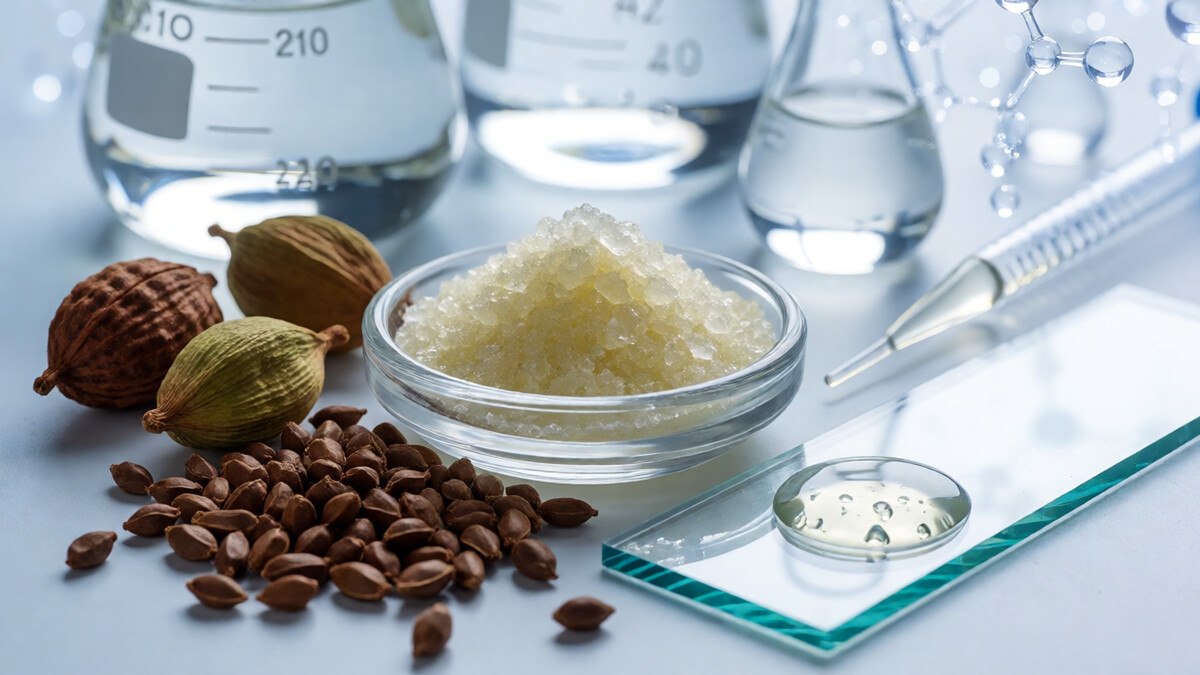
What Is Cardamonin?
Cardamonin (2′,4′-dihydroxy-6′-methoxychalcone) is a methoxylated chalcone — a subclass of flavonoids — found in the seeds and rhizomes of Zingiberaceae plants such as Alpinia katsumadai, Alpinia rafflesiana and cardamom. In skin research it appears as a small, lipophilic molecule (C16H14O4, MW 270.3) that has attracted attention less for direct tyrosinase chelation and more for its ability to switch off the transcription factor that drives the entire pigment programme.
That distinction matters for anyone studying cardamonin for hyperpigmentation. Most brightening actives marketed as “tyrosinase inhibitors” act on the enzyme itself. Cardamonin works one step upstream — on microphthalmia-associated transcription factor (MITF), the master regulator that controls tyrosinase, TRP-1 and TRP-2. It also carries an unusually broad secondary pharmacology (anti-inflammatory and antioxidant) that maps neatly onto the two biggest drivers of stubborn hyperpigmentation: UV exposure and inflammation.
The Core Study: How Cardamonin for Hyperpigmentation Works
The pivotal paper remains Cho et al. (Biochem Biophys Res Commun, 2009;390(3):500–505). Working with normal human melanocytes and HEK293 reporter cells, the group showed that cardamonin:
- significantly suppressed MITF and tyrosinase expression;
- reduced intracellular melanin content;
- promoted the degradation of β-catenin that had been stabilised by Wnt3a-conditioned medium or by the GSK-3β inhibitor BIO.
Because the Wnt/β-catenin axis is one of the main routes by which α-MSH and UV signalling up-regulate MITF, the authors concluded that cardamonin “may be a potential whitening agent for use in cosmetics and in the medical treatment of hyperpigmentation disorders.” Follow-up characterisation indicated that β-catenin degradation was GSK-3β-independent, pointing instead to Siah- and PKCα-dependent pathways — a mechanistic detail formulators should note, because it means cardamonin is not a generic “Wnt blocker” but a targeted promoter of β-catenin turnover.
Beyond Melanogenesis: The Anti-Inflammatory Layer
Post-inflammatory hyperpigmentation (PIH) — the dark marks left by acne, eczema or injury — is as much an inflammation problem as a pigment problem. Here cardamonin has a second, independent mechanism. In macrophage models it inhibits NF-κB signalling by suppressing IκBα phosphorylation and degradation, which reduces nuclear translocation of p65 and down-regulates COX-2 and iNOS, lowering NO and PGE2 output. Separate work identifies cardamonin as a TRPA1 antagonist (IC50 ≈ 454 nM), adding a neurogenic-soothing angle relevant to redness and itch.
For a formulator, that means one molecule can potentially address both the pigment and the inflammatory trigger — the same dual logic behind pairing niacinamide with tranexamic acid in PIH routines.
Antioxidant and Chalcone-Class Evidence
Cardamonin belongs to the chalcone family, and the wider class has produced strong recent data. Bae, Lee and Hyun (Curr Issues Mol Biol, 2024;46(6):6018–6040) screened four 2′-hydroxy-4′-methoxychalcone derivatives in B16F10 melanoma cells and RAW264.7 macrophages. The most potent analogue, 4′,6′-DMC, lowered tyrosinase, TRP-1 and TRP-2, reduced melanin content and intracellular tyrosinase activity, and down-regulated MITF, PKA/CREB, β-catenin and GSK-3β — while also blunting LPS-induced NO, PGE2, COX-2 and iNOS. Critically, a preliminary human skin irritation test on the chalcone found no adverse effects, an early, if limited, human tolerability signal.
Extract-level work on Alpinia katsumadai is also encouraging: solvent extracts have shown melanin-biosynthesis inhibition in cultured melanoma cells that was reported as stronger than arbutin and kojic acid, alongside antioxidant activity and elastase/hyaluronidase inhibition. A related extract concept activates phospholipase D1 (PLD1) — described as a “melanin brake” — to reduce tyrosinase expression.
How Strong Is the Evidence — Honestly?
Strong preclinical, thin clinical. Nearly all cardamonin data are in vitro (B16F10, normal human melanocytes, HEK293). Cell studies show selectivity — for example, cardamonin is cytotoxic to A375 melanoma cells (reported IC50 ≈ 3.98 µM at 48 h) while showing no significant toxicity to normal human epidermal melanocytes — but no published randomised, vehicle-controlled human trial has yet tested topical cardamonin for melasma or PIH. Any claim of clinical efficacy would be premature. This is a “promising mechanism awaiting human data” ingredient, not a proven one.
Formulation Notes
- Solubility: lipophilic; freely soluble in DMSO (up to ~250 mg/mL) but poorly water-soluble. In water-based systems it needs glycols, solubilisers or encapsulation (liposomes, lipid nanoparticles) to avoid recrystallisation and uneven delivery.
- Stability: like many chalcones it is prone to oxidation and light-driven degradation. Pair it with an antioxidant system (chelator plus tocopherol) and use opaque or airless packaging.
- pH and pairing: compatible with the mildly acidic pH of brightening toners and serums. Complement with niacinamide, tranexamic acid, alpha-arbutin or thiamidol for multi-pathway pigment control; avoid combining with strong oxidisers.
- Use level: as a purified research material, typical exploratory cosmetic use sits in the sub-0.1% range; extract-based systems should instead be standardised to their flavonoid content.
- Safety: there is no CIR or SCCS monograph for cardamonin specifically, so a patch test is prudent, especially in leave-on products.
Bottom Line
Cardamonin is one of the more mechanistically interesting hyperpigmentation candidates in the 2026 research literature precisely because it does not simply “inhibit tyrosinase.” It suppresses MITF through the Wnt/β-catenin axis, and it simultaneously dampens the NF-κB inflammatory signalling that sustains PIH. The science is credible and the cell data are consistent — but until human trials arrive, it belongs in the “high-potential, preclinical” column. Formulate it as an encapsulated, antioxidant-protected active, pair it with proven pigment actives, and keep expectations evidence-based.
References
- Cho M, Ryu M, Jeong Y, et al. Cardamonin suppresses melanogenesis by inhibition of Wnt/β-catenin signaling. Biochem Biophys Res Commun. 2009;390(3):500–505. doi:10.1016/j.bbrc.2009.09.124.
- Bae S, Lee J-N, Hyun C-G. Anti-melanogenic and anti-inflammatory effects of 2′-hydroxy-4′,6′-dimethoxychalcone in B16F10 and RAW264.7 cells. Curr Issues Mol Biol. 2024;46(6):6018–6040. doi:10.3390/cimb46060359.
- Zhang F, Dai G, Luo D, et al. Effects and mechanism of cardamom on melanoma cells. Chin J Clin Pharmacol. 2023;39(22):3286–3290.
- Cardamonin inhibits COX and iNOS expression via inhibition of p65NF-κB nuclear translocation and Iκ-B phosphorylation in RAW 264.7 macrophage cells. Neoplasia.
- Lee JS, Jeong SH, Ko KI, et al. The effects of Alpinia katsumadai extract on anti-inflammation and melanogenesis. 1999.
Interested in Formulation Data Collaboration?
Let's discuss how Melasyl AI can accelerate your next whitening or brightening formula. Technical collaboration, data licensing, or custom AI-driven research — reach out.
Contact Wei →