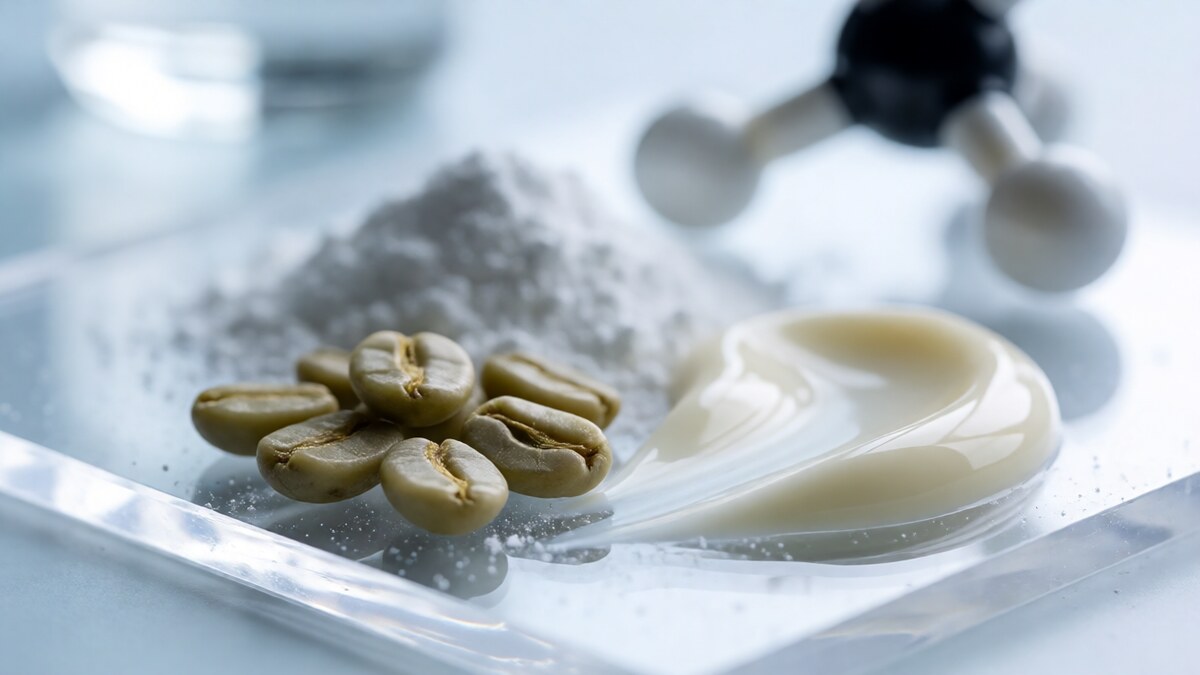
Chlorogenic acid is the most-consumed polyphenol in the Western diet — a caffeoylquinic acid that arrives in the body by the gram with every cup of coffee. That ubiquity is exactly why it keeps surfacing in brightening briefs: it is food-grade, water-soluble, inexpensive, and backed by a long human-exposure record. But the pigment evidence for chlorogenic acid is thinner, and more route-dependent, than the marketing implies. Here is what the literature actually supports.
What Chlorogenic Acid Is
Chlorogenic acid (CGA) is not a single molecule but a family of esters formed between caffeic acid and quinic acid. The dominant isomer is 5-O-caffeoylquinic acid (5-CQA), molecular weight 354.31 g/mol, CAS 327-97-9. Green (unroasted) coffee beans are the richest practical source, and CGA makes up roughly half of the total chlorogenic acid content there. Its pKa is about 3.92, it dissolves readily in water and ethanol, and it is classified as a BCS class III compound: high solubility, low permeability. That last property governs everything about how it must be delivered.
Mechanism: Three Layers
1. Direct tyrosinase interference. CGA and its esters bind the tyrosinase active site. Molecular docking studies using both mushroom and human tyrosinase show CGA occupying the enzyme’s copper-containing pocket through its catechol and carboxyl groups, and side-by-side docking against kojic acid — the reference brightener — found CGA competitive or superior. The catechol motif is a substrate mimic, so the inhibition is largely competitive rather than allosteric.
2. MITF-level transcriptional suppression. More interesting for formulation is what CGA does upstream. In B16F10 melanoma cells, purified CGA at 100 µg/mL suppressed MITF mRNA expression to 44.5% of the α-MSH-stimulated control, and significantly down-regulated TYR, TRP-1 and TRP-2 transcripts. Because MITF is the master transcription factor for the entire melanogenic cassette, hitting it upstream avoids the enzyme-compensation problem that limits pure tyrosinase blockers.
3. Antioxidant and anti-inflammatory buffering. CGA scavenges superoxide, hydroxyl and peroxynitrite radicals, and it inhibits NF-κB nuclear translocation, lowering IL-1β, IL-6, TNF-α and COX-2. Because UV and visible light drive pigmentation partly through ROS-activated MAPK/p38 and inflammatory signalling, this layer interrupts the oxidative trigger rather than the pigment output.
In Vitro Evidence
The strongest quantitative data come from cell models. Chlorogenic acid butyl ester, the more lipophilic ester, reduced melanin content by 33–62% at 100 µM in α-MSH-stimulated B16 melanoma cells with little or no cytotoxicity. A 2025 bio-guided fractionation of Juncus decipiens isolated chlorogenic acid as an active constituent that reduced both cellular tyrosinase activity and melanin accumulation while protecting fibroblasts from UVB cytotoxicity. And a 2022 nano-emulsion study built a CGA-loaded formulation, confirmed thermodynamic stability over 60 days, and showed reduced tyrosinase and melanogenesis activity in B16F0 cells with a clean genotoxicity profile — the docking work in that paper is the most direct CGA-versus-kojic-acid comparison available.
Clinical Evidence — and Its Limits
Here the record needs to be read honestly. There is no published randomised, placebo-controlled topical trial that isolates chlorogenic acid as the sole active and measures pigmentation with a validated scale such as mMASI. The human evidence sits in three adjacent buckets.
First, oral coffee polyphenols. In a double-blind, placebo-controlled trial (Fukagawa et al., 2017), 49 women with mildly xerotic skin took 270 mg of coffee polyphenols daily for eight weeks. The supplement lowered transepidermal water loss, reduced skin surface pH and increased stratum corneum hydration and microcirculatory responsiveness — a genuine barrier and microcirculation result, but not a pigment endpoint.
Second, photoprotection and erythema. A topical CGA formulation delivered by an oil-in-water micro-emulsion prevented UV-induced erythema in guinea pig skin, and a 2% topical CGA solution reduced UV-induced erythema by roughly 43% at 48 hours versus placebo. These are anti-inflammatory and photoprotective signals, which matter for preventing pigment but are not the same as fading pigment that already exists.
Third, animal pigment models. A 30% Robusta coffee silverskin extract cream applied to UVB-exposed guinea pigs reduced MITF expression from 27.8% to 15.4% and melanin from 16.8% to 7.8% pixels (both p < 0.001) — encouraging, but the extract is a mixture and the model is not human skin.
The honest summary: chlorogenic acid has credible mechanistic and animal support, strong photoprotective and anti-inflammatory human data, and a genuine gap at the topical hyperpigmentation RCT level. Position it as a supporting multi-pathway active, not a primary depigmenting agent.
Formulation: Delivery Is the Whole Game
Because CGA is a BCS class III molecule, its poor affinity for the lipid-rich stratum corneum limits passive penetration — solubility is high, but getting it into the skin is not. This is why the delivery vehicle, not the label percentage, determines performance.
- Oil-in-water micro-emulsions raise both solubility and skin accumulation more effectively than water-in-oil systems, and are the best-validated simple vehicle for CGA.
- Liposomes, ethosomes and phytosomes improve deposition further; a chitosan-modified CGA liposome raised 36-hour skin retention to 519.6 µg/cm², versus 113.4 µg/cm² for a plain solution.
- Phospholipid complexes protect CGA from oxidative degradation while giving sustained release.
Stability is the second constraint. CGA carries an ester bond that hydrolyses to caffeic and quinic acid in the presence of moisture, and it oxidises to quinone-type products in air. It degrades and isomerises faster at neutral-to-alkaline pH, and it is thermolabile. Practical controls: hold the finished pH near 4.5–5.5, keep thermal processing short, use an opaque or airless package, add a chelator, and consider a phospholipid carrier. Typical cosmetic use levels run 0.5–2%.
The Takeaway
Chlorogenic acid earns its place in a brightening platform through breadth rather than potency. It hits tyrosinase directly, suppresses MITF transcriptionally, and buffers the oxidative and inflammatory triggers that sustain pigment. Its weakness is delivery and evidence depth: it needs an emulsion or vesicular carrier to penetrate, protection to survive shelf life, and honest positioning while the topical pigment trials catch up. Formulated well, it is a rational supporting active for melanin-rich skin and photoprotective brightening systems — not a solo hero.
References
- Akihisa T, et al. Antioxidative and melanogenesis-inhibitory activities of caffeoylquinic acids and other compounds from moxa. Chem Biodivers. 2013;10(3):399–410.
- Antioxidant and whitening activities of chlorogenic acid, quercetin and quercitrin from Vaccinium oldhamii. Korea Science, 2023.
- Isovitexin and chlorogenic acid from Juncus decipiens target melanogenesis and enhance photoprotection. Natural Product Communications. 2025.
- Budama-Kilinc Y, et al. Development of nanoformulation for hyperpigmentation disorders: in vitro efficacy and in silico docking. Arabian Journal of Chemistry. 2022.
- Kitagawa S, et al. Efficient topical delivery of chlorogenic acid by an oil-in-water micro-emulsion to protect skin against UV-induced damage. Chem Pharm Bull. 2011.
- Fukagawa S, et al. Coffee polyphenols extracted from green coffee beans improve skin properties and microcirculatory function. Biosci Biotechnol Biochem. 2017;81(9):1724–1730.
- Preparation of chitosan-modified chlorogenic acid liposomes and their transdermal properties in vitro. Chinese Journal of Pharmaceuticals. 2023.
- Liposomes, niosomes, ethosomes and transethosomes for curcumin and chlorogenic acid delivery. Antioxidants (MDPI). 2026.
Interested in Formulation Data Collaboration?
Let's discuss how Melasyl AI can accelerate your next whitening or brightening formula. Technical collaboration, data licensing, or custom AI-driven research — reach out.
Contact Wei →