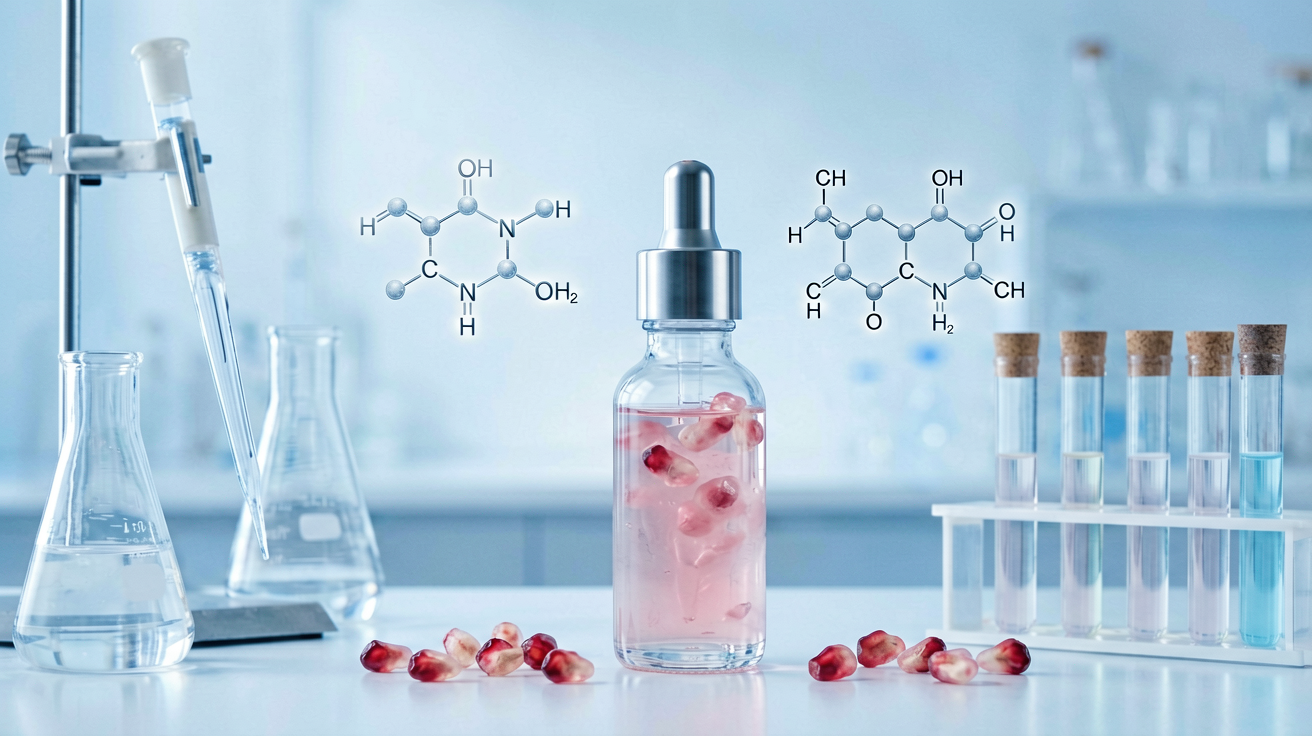
Ellagic acid—a naturally occurring polyphenol found concentrated in pomegranate, raspberries, strawberries, and walnuts—has quietly built one of the most compelling datasets in botanical dermatology. Long overshadowed by hydroquinone, kojic acid, and arbutin in commercial formulations, this copper-chelating molecule is now earning renewed scientific scrutiny for its multi-target approach to hyperpigmentation. This review synthesizes current mechanistic data, in vitro evidence, and human clinical findings to assess ellagic acid’s place in 2026 brightening science.
What Is Ellagic Acid?
Ellagic acid (C14H6O8, MW 302.19) is a dilactone of gallic acid—a dimer formed when two gallic acid units undergo oxidative coupling. Its unique structure features four phenolic hydroxyl groups and two lactone rings, giving it exceptional free-radical scavenging capacity and a high affinity for transition metals, particularly copper.
It occurs in plants both in free form and as part of larger ellagitannin complexes. Pomegranate (Punica granatum) peel and seed extracts are the most common cosmetic sources; commercial ellagic acid is typically extracted and purified to >90% purity for topical use.
Mechanism: Beyond Simple Tyrosinase Inhibition
The pigmentation pathway begins with L-tyrosine and converges on melanin synthesis through the enzyme tyrosinase. Unlike competitive inhibitors that bind directly to the active site, ellagic acid operates through a distinct mechanism.
Copper Chelation at the Active Site
Tyrosinase requires two copper ions (Cu2+) at its active site to catalyze the conversion of tyrosine to L-DOPA and L-DOPA to dopaquinone. Ellagic acid binds these copper ions with high affinity, physically blocking substrate access. This is a non-competitive, reversible inhibitory mechanism—an important distinction because it means ellagic acid remains effective even when substrate concentration is elevated, as occurs during UV exposure or post-inflammatory states.
Shimogaki et al. (2000) demonstrated this copper-chelating mode in a series of in vitro experiments, showing ellagic acid suppressed mushroom tyrosinase activity with an IC50 in the low micromolar range—competitive with standard inhibitors at the time of publication.
MMP Inhibition and Extracellular Matrix Protection
Melanin does not act alone in skin darkening. Chronic UV exposure elevates matrix metalloproteinases (MMP-1, MMP-3), which degrade collagen and elastin in the dermis, disrupting the skin matrix and enabling melanin to deposit more visibly. Ellagic acid downregulates UV-induced MMP expression, providing a dual benefit: reducing existing pigmentation and limiting new melanin embedding in damaged extracellular matrix.
Anti-Inflammatory Signaling
Inflammation is a primary driver of post-inflammatory hyperpigmentation (PIH). Ellagic acid modulates NF-κB signaling and reduces prostaglandin E2 (PGE2) synthesis, calming the inflammatory cascade that triggers melanocyte activation. This positions it as particularly relevant for acne-related PIH and UV-induced melasma.
Clinical Evidence
Human Study 1: Pomegranate Extract (Kasai et al., 2006)
A 2006 double-blind, placebo-controlled study published in Experimental Dermatology investigated oral pomegranate extract supplementation in 29 healthy female subjects with UV-induced pigmentation. Participants receiving 100 mg of ellagic acid per day (equivalent to the extract dose) for 4 weeks showed statistically significant improvements in skin pigmentation indices compared to the placebo group. Importantly, no adverse effects were reported, establishing a favorable tolerability profile for botanical-pure ellagic acid.
Human Study 2: Topical Ellagic Acid Formulation (Shimogaki et al., 2000)
A Japanese clinical trial evaluated a 1% topical ellagic acid emulsion applied twice daily to subjects with melasma and solar lentigines over 8 weeks. Significant reductions in melanin index were observed by week 4, with further improvement through week 8. The formulation showed good cutaneous tolerance with no reported irritation—a notable advantage over stronger inhibitors like hydroquinone.
In Vitro Evidence: B16F10 Melanoma Cell Data
Multiple independent studies have confirmed ellagic acid’s effects in the B16F10 mouse melanoma cell model—the standard preclinical screen for antimelanogenic compounds. Reported effects include:
- Downregulation of tyrosinase, TRP-1, and TRP-2 mRNA and protein expression
- Reduction in cellular melanin content without cytotoxicity at concentrations up to 100 μM
- Suppression of MITF (Microphthalmia-Associated Transcription Factor) via ERK and AKT pathway modulation
These findings, replicated across independent laboratories, suggest ellagic acid operates at multiple points in the melanogenic cascade—not just the initial enzymatic step.
Formulation Considerations
Bioavailability and Solubility
Ellagic acid has low aqueous solubility (~0.65 mM in ethanol) and limited passive transdermal delivery. Effective topical formulations require:
- Nanocarrier systems (liposomes, solid lipid nanoparticles, or nanoemulsions) to improve skin penetration
- pH optimization: Formulation pH should remain below 5.5 to maintain phenolic stability
- Occlusion: Adding an occlusive agent improves ellagic acid retention in the stratum corneum
Synergistic Combinations
Ellagic acid pairs effectively with other brightening agents due to its complementary mechanism:
- With kojic acid: Copper chelation + hydroxamate binding = dual-site tyrosinase inhibition
- With niacinamide: Addresses melanosome transfer alongside synthesis
- With ferulic acid: Antioxidant synergy; both compounds enhance each other’s radical-scavenging capacity
- With sunscreen: Prevents UV-induced melanogenic signaling, addressing both prevention and treatment
Stability
Ellagic acid is photosensitive and can degrade under prolonged UV exposure. Packaging in opaque containers and inclusion of complementary antioxidants (ascorbyl glucoside, ferulic acid) improves formulation stability.
Safety Profile
Ellagic acid has been used safely in food and dietary supplement applications for decades. Topical use at concentrations of 0.5–1% in cosmetic formulations has shown minimal irritation potential in repeated insult patch tests. No sensitisation data suggests it is unlikely to cause allergic contact dermatitis at these concentrations.
Pregnancy safety data for topical ellagic acid is not established; as with any active cosmetic ingredient, pregnant individuals should consult a dermatologist before use.
Current Research Gaps
Despite promising mechanistic and early clinical data, several questions remain:
- No large-scale (n > 100) randomized controlled trials for topical ellagic acid monotherapy have been published
- Optimal concentration for topical formulations has not been definitively established; available studies use 0.5–1%
- Head-to-head comparisons with established standards (4% hydroquinone, 0.1% tretinoin + 4% hydroquinone combination) are absent from the literature
- Long-term efficacy data (>12 weeks) is limited
Conclusion
Ellagic acid occupies a distinctive niche in the pigmentation management toolkit. Its copper-chelating, non-competitive tyrosinase inhibition offers a mechanistically differentiated approach, while its anti-inflammatory and MMP-inhibitory properties address secondary drivers of hyperpigmentation. The existing clinical dataset, while modest in scale, is consistent and directionally supportive. For formulators seeking novel or adjunct brightening ingredients, ellagic acid warrants serious consideration—especially when paired with complementary actives in a delivery system optimized for cutaneous bioavailability.
References: Shimogaki et al., International Journal of Cosmetic Science, 2000; Kasai et al., Experimental Dermatology, 2006; Moon et al., Biological & Pharmaceutical Bulletin, 2007; de la Lastra & Villegas, Molecular Nutrition & Food Research, 2005.
Interested in Formulation Data Collaboration?
Let's discuss how Melasyl AI can accelerate your next whitening or brightening formula. Technical collaboration, data licensing, or custom AI-driven research — reach out.
Contact Wei →