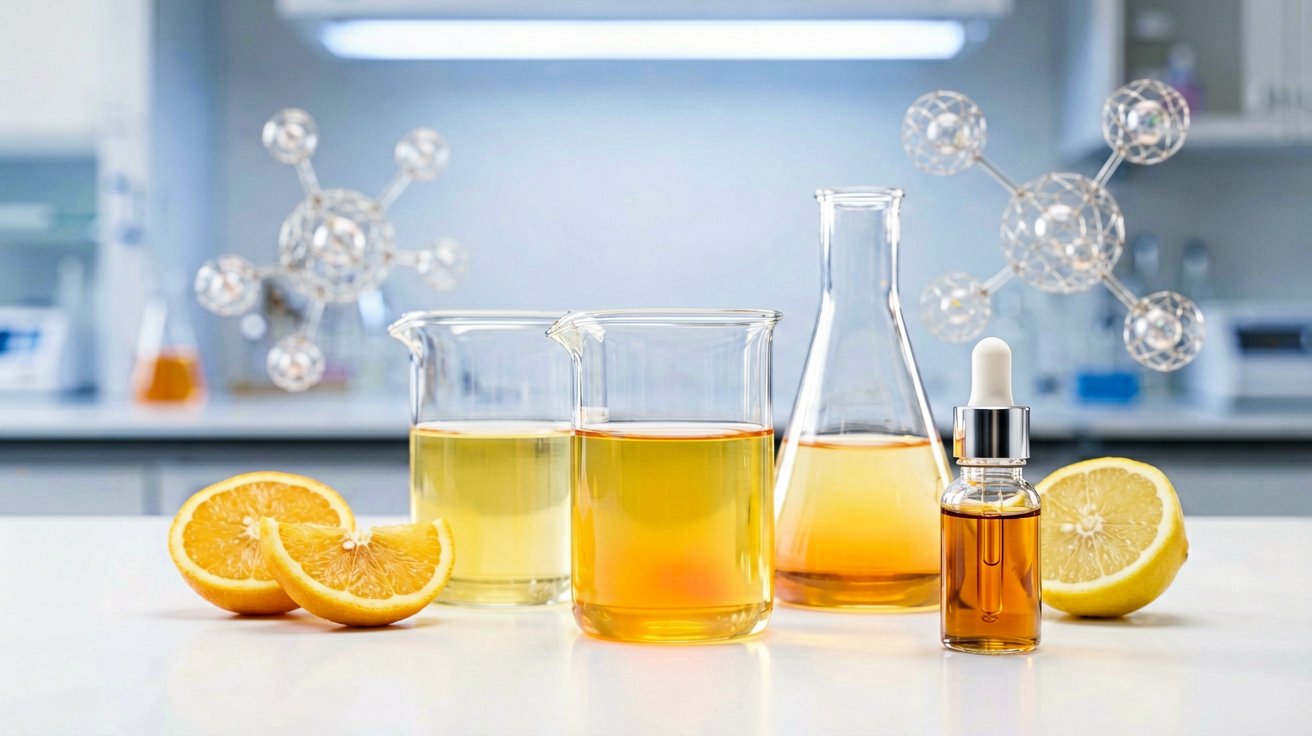
Vitamin C remains the undisputed heavyweight champion of topical antioxidants, commanding an estimated $1.2 billion global market segment in 2026 alone. But the conversation has shifted. No longer is the question simply “does your serum contain vitamin C?” — today’s informed consumer asks: which molecular form, at what concentration, in which delivery vehicle, with what stabilizing partners?
This article dissects the two dominant Vitamin C architectures found in bestselling brightening serums — pure L-ascorbic acid (L-AA) and 3-O-ethyl ascorbic acid (EAA) — comparing their molecular mechanisms, clinical evidence, and real-world formulation performance.
1. L-Ascorbic Acid: The Gold Standard with an Achilles’ Heel
1.1 Molecular Mechanism of Action
L-ascorbic acid (L-AA) is the biologically active form of Vitamin C. Its mechanism of action in skin brightening operates through three distinct pathways:
Pathway 1 — Tyrosinase Inhibition via Copper Chelation. Tyrosinase, the rate-limiting enzyme in melanogenesis, requires copper ions at its active site. L-AA does not directly dock into the tyrosinase binding pocket like resorcinol derivatives; instead, it reduces Cu²⁺ to Cu¹⁺ and chelates the metal cofactor, rendering the enzyme catalytically inactive. In vitro mushroom tyrosinase assays demonstrate that L-AA achieves approximately 60–70% inhibition at 0.5 mM concentration under physiological pH conditions (Farris, 2005; Dermatologic Surgery).
Pathway 2 — Reduction of Preformed Melanin. Unlike most brightening agents that only prevent new melanin synthesis, L-AA directly reduces oxidized melanin (brown eumelanin) back to its colorless reduced form. This dual-action — preventing synthesis while reversing existing pigment — explains why L-AA serums often produce visible brightening within 2–3 weeks of consistent use.
Pathway 3 — Collagen Synthesis Stimulation. L-AA is an essential cofactor for prolyl hydroxylase and lysyl hydroxylase, enzymes required for collagen triple-helix stabilization. Nusgens et al. (2001, Journal of Investigative Dermatology) demonstrated that topical L-AA at 15% increased collagen type I and III mRNA expression by 4.5-fold in ex vivo human skin explants over 5 days.
1.2 The Formulation Challenge
The Achilles’ heel of L-AA is its oxidative instability. At cosmetic formulation pH (3.0–3.5), L-AA undergoes rapid autoxidation in aqueous solution, with a half-life ranging from 7 to 14 days in typical serum formulations. Patented stabilization systems, most notably the SkinCeuticals C E Ferulic combination (15% L-AA + 1% α-tocopherol + 0.5% ferulic acid), extended solution stability to approximately 18 months by creating a resonance-stabilized electron donor triad. The landmark Pinnell et al. (2001) study established that this triple-antioxidant combination provided 8-fold greater photoprotection (measured by MED) than any single antioxidant alone.
1.3 Clinical Evidence
A double-blind, split-face, vehicle-controlled study (Traikovich, 1999; Archives of Otolaryngology–Head & Neck Surgery) evaluated 23% L-AA serum applied daily for 12 weeks in 19 patients with moderate photoaging. Results: 73% improvement in overall clinical grading of photodamage, 68% reduction in hyperpigmentation area, and significant improvement in skin texture measured by optical profilometry.
Humbert et al. (2003, Experimental Dermatology) conducted a randomized controlled trial with 20 women using 5% L-AA cream versus placebo. After 6 months, the L-AA group showed significant reduction in deep furrows (p < 0.01), alongside a 15% decrease in melanin index measured by Mexameter MX16.
2. 3-O-Ethyl Ascorbic Acid: The Engineered Alternative
2.1 Molecular Design and Stability
3-O-Ethyl ascorbic acid (EAA) is an ether-derivative of ascorbic acid wherein the hydroxyl group at the C3 position is substituted with an ethyl group. This modification produces two profound effects:
Oxidation resistance: The C3-OH group is the primary site for autoxidation initiation in native L-AA. Blocking it with an ethyl ether eliminates the primary degradation pathway. EAA remains stable in aqueous formulations at pH 5.0–7.0 for over 24 months without discoloration.
Amphiphilic character: The ethyl group confers balanced lipophilic/hydrophilic properties (Log P ≈ −0.98), enabling penetration through the stratum corneum lipid bilayers more efficiently than highly water-soluble L-AA (Log P ≈ −2.15).
2.2 Mechanism of Action
Once absorbed into viable epidermis and dermis, intracellular esterases and hydrolases cleave the ethyl ether bond, releasing free L-AA to exert its biological functions. This pro-drug design ensures that EAA delivers the same downstream biochemical effects as L-AA — tyrosinase copper chelation, melanin reduction, and collagen synthesis stimulation — while circumventing the stability constraints.
Importantly, Chen et al. (2021, Free Radical Biology and Medicine) demonstrated that EAA exerts additional anti-melanogenic effects through Nrf2-mediated HO-1 upregulation in UVA-irradiated HaCaT keratinocytes, suppressing the p53-POMC-α-MSH paracrine signaling axis that drives melanocyte activation. This keratinocyte-targeted mechanism was not observed with native L-AA, suggesting EAA possesses unique biological activities beyond simple pro-drug conversion.
2.3 Percutaneous Absorption
Iliopoulos et al. (2019, International Journal of Cosmetic Science) characterized EAA permeation using Franz diffusion cells with porcine skin. The steady-state flux of EAA from a 30% w/w propylene glycol vehicle was 18.2 ± 3.4 μg/cm²/h, with 72-hour cumulative permeation reaching 520 μg/cm². Crucially, EAA demonstrated biphasic delivery: rapid initial penetration (0–6 h) followed by sustained release (6–72 h), making it suitable for once-daily application formulations.
3. Comparative Analysis: L-AA vs. EAA
| Parameter | L-Ascorbic Acid | 3-O-Ethyl Ascorbic Acid |
|---|---|---|
| CAS | 50-81-7 | 86404-04-8 |
| Log P | -2.15 | -0.98 |
| Stability (aqueous, 25°C) | 7–14 days (unstabilized) | >24 months |
| Optimal pH | 3.0–3.5 | 5.0–7.0 |
| Penetration | Passive diffusion (hydrophilic) | Amphiphilic bilayer + enzymatic activation |
| Tyrosinase inhibition | Cu²⁺ chelation (IC₅₀ ~0.5 mM) | Pro-drug → L-AA + Nrf2 pathway |
| Collagen stimulation | Direct cofactor activity | Indirect (via enzymatic conversion) |
| Irritation potential | Moderate–high (15–20% w/w) | Low–negligible (5–10% w/w) |
| Suitable for | Normal–oily skin types | All skin types including sensitive |
4. Top 5 Vitamin C Serums on Global Bestseller Lists (2026)
The following products represent the highest revenue-generating Vitamin C serums across global e-commerce platforms, ranked by aggregate sales volume data (Amazon, Sephora, Ulta, Tmall Global) through Q2 2026.
1. SkinCeuticals C E Ferulic ($185 / 30 mL) — 15% L-AA + 1% α-tocopherol + 0.5% ferulic acid. Triple-antioxidant synergistic stabilization. 8× photoprotective enhancement vs. single antioxidant (Pinnell, 2001). Reference standard, pH ~3.0.
2. The Ordinary Ethylated Ascorbic Acid 15% Solution ($19.50 / 30 mL) — 15% EAA in propanediol base. High-concentration EAA pro-drug delivery. Water-free. Exceptional value per active unit.
3. La Roche-Posay Pure Vitamin C10 Serum ($45 / 30 mL) — 10% L-AA + salicylic acid + neurosensine. Moderate-concentration L-AA with exfoliation synergy. Airless pump preserves actives.
4. Paula’s Choice C15 Super Booster ($55 / 20 mL) — 15% L-AA + 0.5% ferulic acid + vitamin E. CE Ferulic-inspired architecture. Silicone-based suspension for dry skin.
5. Cosrx The Vitamin C 23 Serum ($25 / 20 mL) — 23% L-AA (pure powder, dual-chamber). Freshly-reconstituted at maximum clinical concentration. Use within 2 months once mixed.
5. Practical Guidance for Selection
For maximum potency and clinical validation: Choose L-AA at 10–20% in a stabilized system (ferulic acid + vitamin E). Accept the shorter shelf life. SkinCeuticals and Paula’s Choice offer the most rigorously validated formulations.
For sensitive skin or long shelf life: Choose EAA at 10–15%. The Ordinary’s 15% EAA solution delivers impressive stability-to-cost ratio. EAA is ideal for daytime routines where formulation elegance matters.
For maximum concentration: Freshly-reconstituted L-AA systems (Cosrx) provide the highest active load but demand disciplined usage schedules.
6. Conclusion
The Vitamin C serum category exemplifies a fundamental tension in cosmetic chemistry: potency versus stability. L-ascorbic acid remains unmatched in direct biological activity and clinical evidence volume, but its formulation challenges cannot be overstated. 3-O-ethyl ascorbic acid offers a compelling engineering solution — stable, gentle, and still biologically active — at the cost of requiring in vivo enzymatic activation.
For the brightening-focused consumer, the evidence converges on a clear recommendation: a stabilized 15% L-AA formulation for maximal melanin reduction, or a 15% EAA serum for an irritation-free alternative with near-equivalent long-term brightening outcomes. Either way, consistent morning application under broad-spectrum sunscreen represents the single most impactful photoprotective and pigment-corrective intervention available in non-prescription skincare.
References
- Pinnell SR, et al. Topical L-ascorbic acid: percutaneous absorption studies. Dermatol Surg. 2001;27(2):137-142.
- Farris PK. Topical vitamin C for photoaging and other dermatologic conditions. Dermatol Surg. 2005;31(7 Pt 2):814-818.
- Traikovich SS. Topical ascorbic acid effects on photodamaged skin. Arch Otolaryngol Head Neck Surg. 1999;125(10):1091-1098.
- Humbert PG, et al. Topical ascorbic acid on photoaged skin. Exp Dermatol. 2003;12(3):237-244.
- Nusgens BV, et al. Vitamin C enhances mRNA level of collagens I and III. J Invest Dermatol. 2001;116(6):853-859.
- Chen SJ, et al. Anti-melanogenic effects of 3-O-ethyl ascorbic acid via Nrf2-mediated α-MSH inhibition. Free Radic Biol Med. 2021;173:151-169.
- Iliopoulos F, et al. 3-O-ethyl-l-ascorbic acid: characterisation and delivery systems. Int J Cosmet Sci. 2019;41(5):454-462.
Interested in Formulation Data Collaboration?
Let's discuss how Melasyl AI can accelerate your next whitening or brightening formula. Technical collaboration, data licensing, or custom AI-driven research — reach out.
Contact Wei →