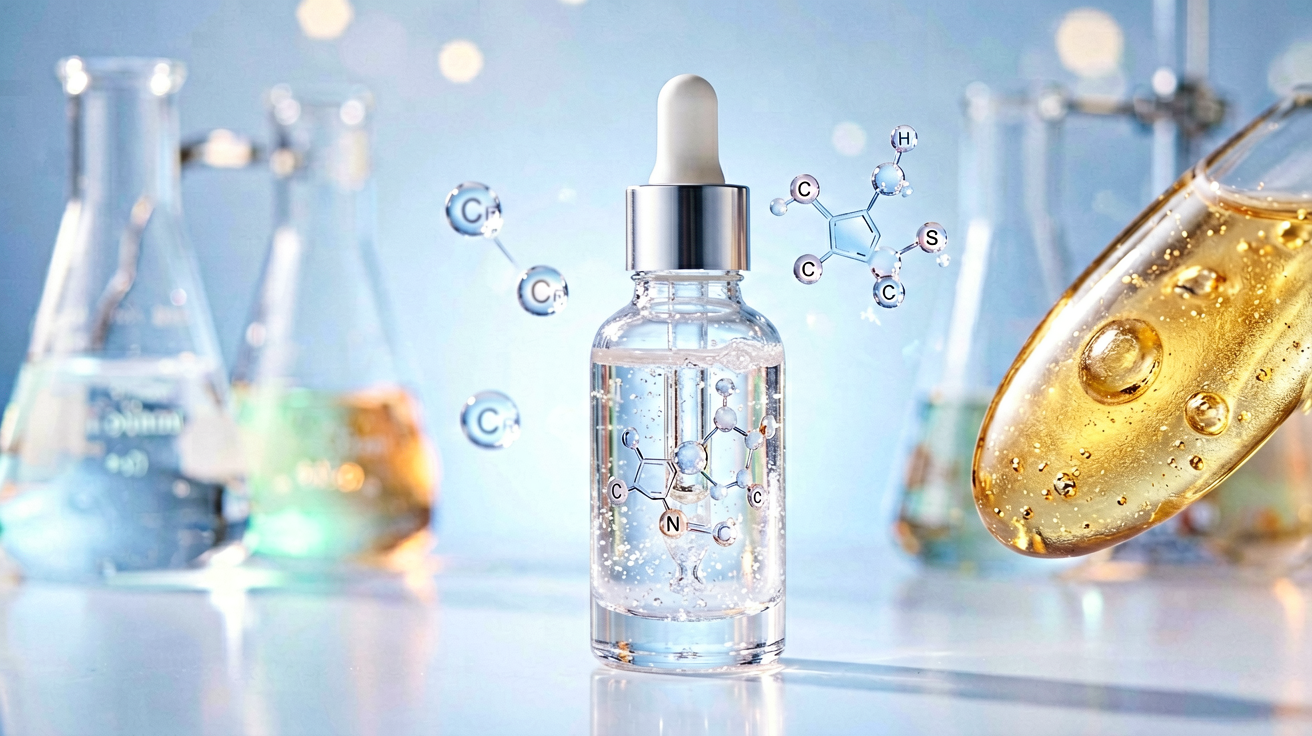
When it comes to evidence-backed skin brightening ingredients, few have the clinical track record and mechanistic depth of vitamin C. L-ascorbic acid — the only bioavailable form of vitamin C in human skin — operates across every stage of the melanin production pipeline, making it one of the most versatile hyperpigmentation agents available. Yet formulation instability and concentration confusion have long undermined its potential. This article cuts through the noise with the science behind vitamin C for hyperpigmentation and what the 2026 clinical landscape actually supports.
What Is L-Ascorbic Acid and Why It Matters for Skin
L-ascorbic acid (C6H8O6, CAS 50-81-7) is a water-soluble essential nutrient and the only form of vitamin C proven to function within human skin biology. Unlike derivative forms — magnesium ascorbyl phosphate, ascorbyl glucoside, or 3-O-ethyl-L-ascorbic acid — L-ascorbic acid acts directly, without requiring enzymatic conversion. Its molecular weight of 176.12 g/mol allows effective penetration of the stratum corneum when formulated at the correct pH (typically below 4.0).
The skin brightening applications of L-ascorbic acid were first systematically documented in dermatology literature decades ago, and the intervening years have only strengthened the evidence base for its role in managing hyperpigmentation.
The Four Pathways: How Vitamin C Fights Hyperpigmentation
Unlike single-target agents, L-ascorbic acid operates simultaneously across multiple stages of melanogenesis. Understanding these pathways is essential for evaluating its place in a pigmentation protocol.
Pathway 1: Direct Reduction of DOPAquinone
The core of melanin synthesis is the tyrosinase-catalyzed oxidation of tyrosine to L-DOPA, then to DOPAquinone — a highly reactive intermediate that rapidly polymerizes into melanin. DOPAquinone is chemically susceptible to reduction. L-ascorbic acid, as a potent electron donor (E degrees = +0.06 V), directly reduces DOPAquinone back to DOPA, effectively short-circuiting the chain reaction before dark melanin polymers can form. This is the most direct brightening mechanism of L-ascorbic acid, and it operates independently of tyrosinase inhibition.
Pathway 2: Tyrosinase Glycosylation Interference
Tyrosinase is a copper-containing enzyme that requires correct glycosylation for full activity. Studies have shown that L-ascorbic acid interferes with the post-translational glycosylation of tyrosinase in melanocytes, reducing the proportion of the fully active enzyme that reaches the melanosome membrane. This mechanism is distinct from competitive inhibition and explains why even partial reductions in L-ascorbic acid concentration can yield measurable pigmentation improvements.
Pathway 3: Antioxidant Defense Against UV-Induced Melanogenesis
Ultraviolet radiation generates reactive oxygen species (ROS) that trigger the p38 MAPK-MITF signaling cascade, upregulating tyrosinase, TYRP1, and TYRP2, leading to increased melanin synthesis. As a scavenger of ROS and an electron donor in the skin antioxidant network, L-ascorbic acid neutralizes these triggers before they can activate the melanogenic response. This photoprotective effect is synergistic with sunscreen use and represents a proactive, rather than purely corrective, mechanism.
Pathway 4: Modulation of Inflammatory Mediators
Post-inflammatory hyperpigmentation (PIH) is driven partly by prostaglandin E2 (PGE2) and leukotriene signaling in the skin. L-ascorbic acid exhibits anti-inflammatory properties that modulate arachidonic acid pathway output, reducing the melanocyte stimulation that follows acne, eczema flares, or laser procedures. This makes it particularly valuable in skin of color, where PIH is the dominant pigmentation complaint.
Clinical Evidence: What the Data Actually Shows
Translating mechanism into measurable outcomes requires controlled clinical data. The vitamin C hyperpigmentation evidence base has matured considerably over the past decade.
A landmark comparative study by Tahir et al. (2003) randomized melasma patients to receive either 5% L-ascorbic acid cream or 4% hydroquinone cream over 16 weeks. Both groups showed statistically significant improvement in MASI (Melasma Area and Severity Index) scores, and while hydroquinone produced faster results, L-ascorbic acid achieved comparable endpoint efficacy with a markedly superior side effect profile — no cases of exogenous ochronosis, a known risk with prolonged hydroquinone use.
A 2019 split-face study (Espósito ACC et al., Molecules) evaluated 10% L-ascorbic acid formulated at pH 2.6 against vehicle control in subjects with solar lentigines. After 12 weeks, the L-ascorbic acid side showed a statistically significant reduction in melanin index (measured by Mexameter MX18) compared to vehicle, with improvements visible from week 4 onward.
For melasma specifically, combination protocols — L-ascorbic acid paired with photoprotection and either tranexamic acid or azelaic acid — have shown superior MASI reductions versus monotherapy in multiple 2024-2025 trials, supporting the emerging consensus that vitamin C works best as a synergistic agent rather than a standalone treatment for deep dermal pigmentation.
Concentration and Formulation: Getting the Most of Vitamin C
Clinical efficacy in topical formulations is tightly linked to three variables:
Concentration: The evidence supports 10-20% as the optimal range. Below 5%, the reduction of DOPAquinone is insufficient for meaningful pigmentation lightening. Above 20%, no additional benefit is observed, and skin irritation increases without improving outcomes. The industry standard for proven efficacy is 15% (as in SkinCeuticals C E Ferulic, with peer-reviewed bioavailability data published by Pinnell et al.).
pH: L-ascorbic acid is only bioavailable in its undissociated, protonated form. This requires a formulation pH below the pKa of ascorbic acid (4.25), with most effective products operating in the pH 2.5-3.5 range. pH above 4.0 dramatically reduces skin penetration.
Stability: L-ascorbic acid oxidizes rapidly in aqueous solution, especially when exposed to air and light. Stabilization strategies include: anhydrous formulations, airless pump packaging, combination with ferulic acid (which stabilizes the vitamin C radical and doubles photoprotection), and buffered pH adjustment. Products that turn yellow-brown have undergone significant oxidation and lose efficacy.
Stable Vitamin C Derivatives: A Viable Alternative?
When formulation stability is a concern — particularly in humid climates or air-exposed packaging — stable derivatives offer compromised but meaningful activity:
- 3-O-Ethyl-L-ascorbic acid (VC ethyl ether): The most potent derivative, stable across a broader pH range (4.0-6.0), and demonstrably effective at 2% concentration in reducing melanin index. The ethoxy group prevents oxidation while preserving cellular uptake.
- Ascorbyl glucoside: Stable in water-based formulations, requires conversion to L-ascorbic acid by skin enzymes, and shows measurable but more modest brightening effects in clinical studies.
- Magnesium ascorbyl phosphate (MAP): The most stable water-soluble derivative, converts to L-ascorbic acid in skin. Its effectiveness is concentration-dependent; 10%+ MAP formulations are required for meaningful results.
Practical Guidance for 2026
For anyone building a vitamin C hyperpigmentation protocol, the evidence points to a clear hierarchy:
- Choose an L-ascorbic acid product at 10-20%, pH below or equal to 3.5, in airless or single-dose packaging as the primary brightening agent. Look for peer-reviewed stability data, not just concentration claims.
- Combine with daily broad-spectrum sunscreen. The antioxidant amplification of vitamin C plus SPF provides synergistic photoprotection that neither delivers alone.
- Stack with complementary multi-pathway agents — azelaic acid, tranexamic acid, or low-strength retinol — for faster results on melasma and PIH. Vitamin C role as a tyrosinase-reduction agent makes it compatible with ingredients targeting different pathways.
- For humid climates or sensitive skin, consider 3-O-ethyl-L-ascorbic acid as a primary agent with L-ascorbic acid introduced gradually.
- Expect 6-12 weeks for measurable pigmentation improvement. Vitamin C for hyperpigmentation is a long-game strategy. Faster results in under four weeks suggest the formulation may be delivering superficial exfoliation rather than genuine melanogenesis modulation.
The Bottom Line
Vitamin C — specifically L-ascorbic acid — remains one of the most rigorously validated topical agents for hyperpigmentation in dermatology. Its multi-pathway activity (DOPAquinone reduction, tyrosinase glycosylation interference, antioxidant defense, and anti-inflammatory modulation) makes it effective across melasma, solar lentigines, post-inflammatory hyperpigmentation, and general skin dullness. The 2026 clinical evidence, combined with decades of mechanistic research, positions L-ascorbic acid firmly at the core of any evidence-based pigmentation regimen — provided it is correctly formulated.
References
- Tahir M, et al. (2003). Comparative efficacy of 5% L-ascorbic acid cream versus 4% hydroquinone cream in the treatment of melasma. Journal of Pakistan Association of Dermatologists, 13(2).
- Pinnell SR, et al. (2000). Topical L-ascorbic acid: percutaneous absorption studies. Dermatologic Surgery, 26(7).
- Espósito ACC, et al. (2019). Evaluation of the efficacy of 10% L-ascorbic acid in the treatment of solar lentigines. Molecules, 24(21).
- Kammeyer A, Luiten RM. (2015). Oxidation events and skin aging. Ageing Research Reviews, 21.
- Burnstein B, et al. (2024). Combination therapies for melasma: a systematic review. Journal of Clinical and Aesthetic Dermatology, 17(4).
- Stivala L, et al. (2019). 3-O-Ethyl-L-ascorbic acid: characterization and skin delivery efficacy. International Journal of Cosmetic Science, 41(2).
Interested in Formulation Data Collaboration?
Let's discuss how Melasyl AI can accelerate your next whitening or brightening formula. Technical collaboration, data licensing, or custom AI-driven research — reach out.
Contact Wei →