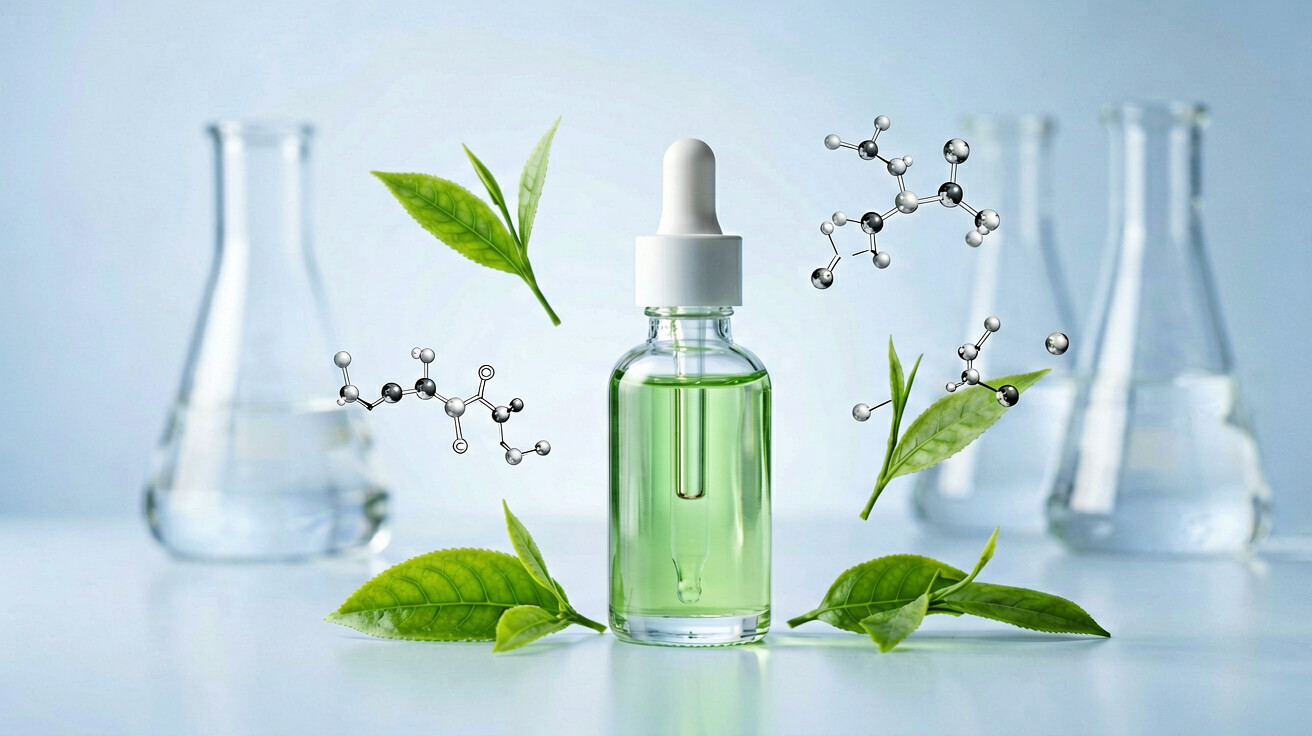
Green tea (Camellia sinensis) has moved from the teacup into the dermatology literature as one of the most studied botanical actives for skin-tone correction. Its pigment-modulating activity is concentrated in a family of flavonoids called catechins, and above all in epigallocatechin-3-gallate (EGCG) — the most abundant and biologically active polyphenol in the leaf. Unlike single-target synthetic brighteners, green tea polyphenols act across several points of the pigmentation cascade at once — inhibiting tyrosinase, suppressing the melanogenic transcription program, neutralizing UV-generated free radicals, and calming the inflammation that drives post-inflammatory darkening. This article examines the molecular basis, the clinical evidence, and the formulation science required to keep a notoriously unstable molecule active inside a finished product.
What Are Green Tea Polyphenols?
Green tea contains 30–42% catechins by dry leaf weight, dominated by four structures: epigallocatechin-3-gallate (EGCG, roughly 50–60% of total catechins), epigallocatechin (EGC), epicatechin-3-gallate (ECG), and epicatechin (EC). EGCG is a flavan-3-ol with a trihydroxylated B-ring. That ortho-dihydroxy (catechol) motif is simultaneously the source of its antioxidant power and the root of its instability. Cosmetic extracts are typically standardized to a total polyphenol content (often 50–98%) and a declared EGCG percentage, because raw leaf composition varies with cultivar, harvest timing, and processing method. For a credible brightening claim, formulators should specify the EGCG concentration of the incoming extract, not just a generic leaf percentage.
Mechanism of Action
1. Direct Tyrosinase Inhibition
EGCG inhibits tyrosinase through copper chelation. The enzyme’s active site depends on a pair of copper ions; the catechol group of EGCG binds those ions and blocks substrate access, functioning as a mixed-type inhibitor of both the monophenolase and diphenolase activities. In a classic in vitro study, No et al. (1999) showed that green tea catechins inhibit mushroom and human tyrosinase, with EGCG among the most potent of the group. This is a complementary mechanism to arbutin-family or thiamidol-style inhibitors, which bind the enzyme through different interactions.
2. Suppression of the Melanogenic Program
Beyond the enzyme, EGCG downregulates the upstream transcription factor MITF (microphthalmia-associated transcription factor), which controls expression of tyrosinase, TRP-1, and TRP-2. By reducing MITF, green tea polyphenols dampen the entire pigment-synthesis machinery at the gene-expression level rather than only at the catalytic step.
3. Antioxidant and Photoprotective Activity
Ultraviolet radiation is the single largest environmental driver of melasma and solar lentigines. EGCG is a potent scavenger of reactive oxygen species generated after UV exposure, quenches singlet oxygen, and limits the lipid-peroxidation cascade that secondarily stimulates melanogenesis. It also interferes with AP-1 and NF-κB signaling, reducing the inflammatory mediators (prostaglandins, leukotrienes) implicated in post-inflammatory hyperpigmentation.
Clinical Evidence
The human data are anchored by a well-controlled photoprotection trial. Elmets et al. (2001) administered green tea polyphenols to human subjects and demonstrated a significant reduction in UV-induced erythema, DNA damage (cyclobutane pyrimidine dimers), and immunosuppression compared with placebo — evidence that topical or dietary green tea catechins can blunt the upstream UV trigger of pigmentation. Supporting cell and animal work, summarized in authoritative reviews by Katiyar et al. (2000) and Hsu (2005), consistently reports inhibition of melanogenesis and protection against UV-induced oxidative injury. The No et al. (1999) enzymology study provides the direct mechanistic basis for the brightening effect.
The Formulation Challenge: Why EGCG Is Hard to Stabilize
Translating the laboratory data into a shelf-stable product is the real test, because EGCG degrades through several parallel pathways:
- Oxidation: The B-ring catechol is rapidly oxidized by oxygen, heat, and light into quinones and theaflavin-like dimers, losing activity and generating the brown discoloration formulators dread.
- Epimerization: Under heat and neutral-to-alkaline pH, EGCG converts to its far less active stereoisomer GCG (gallocatechin gallate), permanently eroding potency.
- pH sensitivity: EGCG is most stable in mildly acidic conditions (about pH 4–6). Above pH 7 the degradation rate climbs sharply.
- Poor lipophilicity: As a polar, relatively high-molecular-weight polyphenol, native EGCG penetrates the stratum corneum poorly, limiting the dose that reaches melanocytes.
Stabilization and Delivery Strategies
A robust green tea brightening formula addresses each failure mode:
- Acidic vehicle: Buffer the system to pH 4.5–5.5 to suppress epimerization and slow oxidation.
- Antioxidant network: Pair EGCG with vitamin C (and its derivatives), vitamin E, and ferulic acid; they recycle the catechin radical and extend active life.
- Metal chelation: Sequestrant systems (for example phytic acid or citric acid) bind pro-oxidant transition metals that accelerate browning.
- Encapsulation: Liposomes, ethosomes, and nanoemulsions shield EGCG from oxygen and water while improving skin penetration. Cyclodextrin inclusion complexes stabilize the molecule in aqueous systems.
- Stable derivatives: Esterified forms such as EGCG stearate or palmitate, and “pro-EGCG” prodrugs, resist oxidation and improve lipophilicity, releasing active EGCG within the skin.
- Standardization and protection: Specify EGCG content on the certificate of analysis, and package in amber or airless formats to exclude light and oxygen.
Formulation Guide: A Green Tea Brightening Essence
Target Profile
- Format: Lightweight aqueous essence or serum
- Target pH: 5.0–5.5
- Markets: Southeast Asia (hot, humid, high UV index)
- Packaging: Amber airless pump, under 30 mL
Core Palette
| Ingredient | INCI Name | Concentration | Function |
|---|---|---|---|
| Green Tea Extract (EGCG-std.) | Camellia Sinensis Leaf Extract | 2–5% (EGCG equiv.) | Primary active |
| Niacinamide | Niacinamide | 4% | Melanosome transfer, barrier |
| Vitamin C Derivative | 3-O-Ethyl Ascorbic Acid | 2% | Antioxidant, brightening synergy |
| Vitamin E | Tocopherol | 0.5% | Radical scavenger |
| Ferulic Acid | Ferulic Acid | 0.5% | Stabilizer |
| Glycerin | Glycerin | 4% | Humectant |
| Sodium Hyaluronate | Sodium Hyaluronate | 0.1% | Humectant |
| Chelant | Tetrasodium Glutamate Diacetate | 0.1% | Metal sequestration |
| Preservative | Phenoxyethanol + Ethylhexylglycerin | 1% | Preservation |
| Water | Aqua | to 100% | Carrier |
Process
- Phase A: Weigh deionized water, add glycerin, chelant, and sodium hyaluronate; stir until fully dissolved.
- Add niacinamide and dissolve completely.
- Cool to at most 40°C; add green tea extract, vitamin C derivative, vitamin E (dissolved in a small solubilizer if needed), and ferulic acid.
- Adjust pH to 5.0–5.5 with citric acid.
- Add preservative and qs with deionized water.
- Filter through 0.45 µm if required; fill into amber airless packaging under low oxygen.
Synergy note: EGCG (enzyme plus gene-level), niacinamide (melanosome transfer), and vitamin C (antioxidant and tyrosinase) attack pigmentation on three independent axes — a combination worth validating in an in-use stability study under tropical conditions (35°C / 75% RH).
Regulatory Status
Green tea leaf extract is widely permitted in cosmetics. In the EU it is accepted as a botanical ingredient; in ASEAN it appears on the cosmetic ingredient list; and it is permitted in Japan and China. Concentrations should follow local limits for catechin-containing extracts, and the standardized EGCG content should be documented for claim substantiation.
Summary
Green tea polyphenols, led by EGCG, offer a rare combination — direct tyrosinase inhibition, MITF suppression, and UV/ROS photoprotection — backed by peer-reviewed human photoprotection data. The formulation hurdle is real but solvable: an acidic pH, an antioxidant network, encapsulation, and stable derivatives convert a fragile leaf molecule into a dependable brightening active for tropical markets.
References
- Elmets CA, Singh D, Tubesing K, Matsui M, Katiyar S, Mukhtar H. Cutaneous photoprotection from ultraviolet injury by green tea polyphenols. J Am Acad Dermatol. 2001;44(3):425-432.
- No JK, Kim YJ, Chung HY, et al. Inhibition of tyrosinase by green tea components. Life Sci. 1999;65(21):PL241-PL246.
- Katiyar SK, Ahmad N, Mukhtar H. Green tea and skin. Arch Dermatol. 2000;136(8):989-994.
- Hsu S. Green tea and the skin. J Am Acad Dermatol. 2005;52(6):1049-1059.
Interested in Formulation Data Collaboration?
Let's discuss how Melasyl AI can accelerate your next whitening or brightening formula. Technical collaboration, data licensing, or custom AI-driven research — reach out.
Contact Wei →