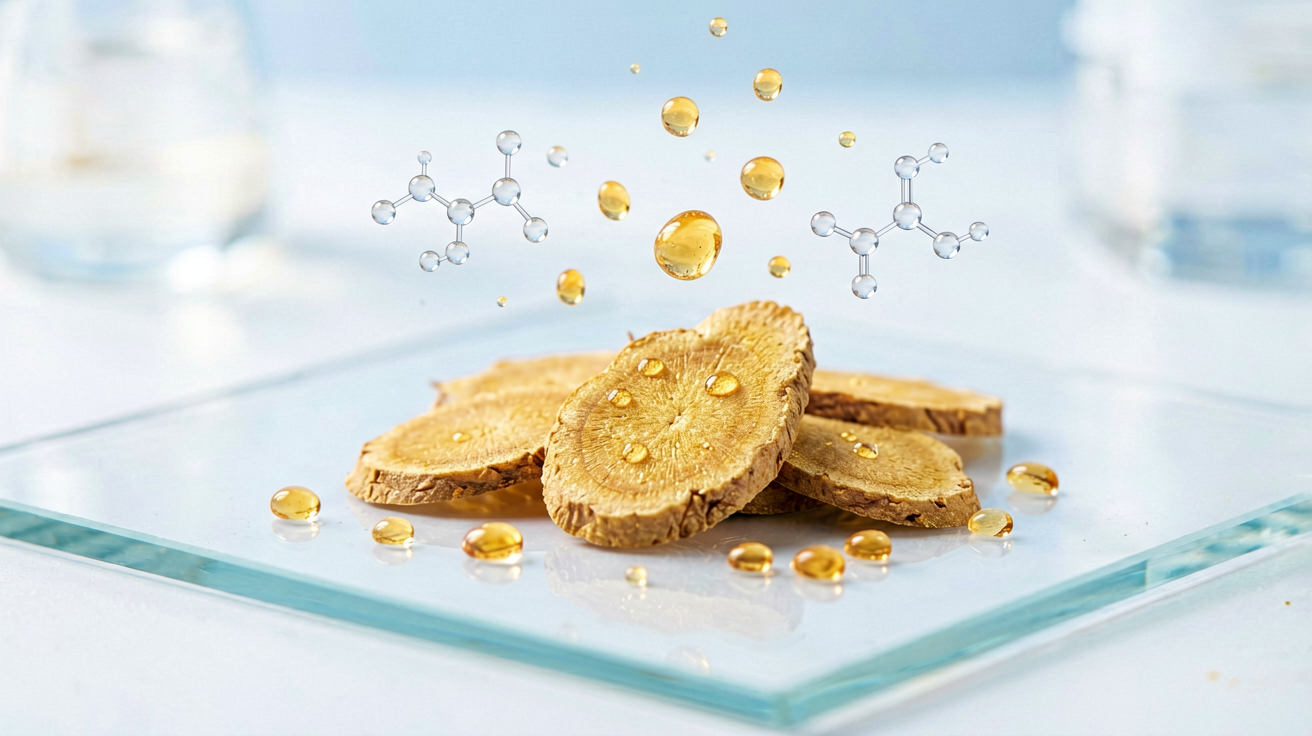
In the global quest for safer, more effective skin-brightening solutions, licorice root extract has emerged as one of the most clinically validated botanical actives available to modern formulation chemists. For brands targeting Southeast Asian consumers — where hyperpigmentation, melasma, and post-inflammatory discoloration rank among the top dermatological concerns — licorice-derived actives offer a compelling combination of multi-pathway inhibition, tolerability across diverse skin tones, and growing clinical evidence. This article examines the key compounds responsible for licorice’s brightening activity, the clinical evidence supporting each mechanism, and formulation strategies for maximizing efficacy.
The Botanical Source: Glycyrrhiza glabra
Licorice root (Glycyrrhiza glabra) has been used in traditional medicine systems across Asia, the Middle East, and Europe for millennia. Modern phytochemistry has identified over 300 distinct compounds in the root, of which four are particularly relevant to skin-brightening applications: glabridin, liquiritin, licochalcone A, and isoliquiritigenin. Each operates through distinct biochemical pathways, which explains why licorice extract can deliver results across multiple types of hyperpigmentation simultaneously.
1. Glabridin: The Flagship Tyrosinase Inhibitor
Glabridin is the most extensively studied of the licorice-derived brightening actives. It is a prenylated isoflavonoid that functions primarily as a non-competitive inhibitor of tyrosinase, the rate-limiting enzyme in the melanogenesis cascade.
In the landmark 1998 study published in Journal of Investigative Dermatology, Yokota et al. demonstrated that topical application of 0.5% glabridin to UVB-irradiated guinea pig skin completely suppressed the development of UVB-induced pigmentation, while histology confirmed inhibition of melanin deposition in the epidermal layer. Crucially, glabridin did not affect tyrosinase activity in non-irradiated skin, indicating a UV-selective mechanism — a property that significantly reduces the risk of unwanted hypopigmentation.
Human clinical data further support these findings. A 2006 double-blind, vehicle-controlled study published in Archives of Dermatological Research evaluated 0.1% glabridin cream applied twice daily to hyperpigmented facial lesions. After 8 weeks, the treatment group showed a statistically significant (p < 0.05) reduction in melanin index compared to vehicle, with no reported adverse events related to skin irritation or sensitization.
2. Liquiritin: The Melanin Dispersant
While glabridin operates at the synthesis level, liquiritin addresses hyperpigmentation through a complementary mechanism: melanin dispersion and acceleration of melanin shedding from the stratum corneum. Liquiritin is a flavonoid glycoside that does not significantly inhibit tyrosinase activity directly; instead, it facilitates the redistribution and elimination of existing melanin from keratinocytes.
A randomized controlled trial published in Clinical and Experimental Dermatology evaluated a topical formulation containing 20% liquiritin applied to melasma lesions in 40 participants over 12 weeks. Participants using the liquiritin formulation demonstrated a 67% improvement in Melasma Area and Severity Index (MASI) scores compared to 23% for the vehicle control — a clinically meaningful differential that underscores liquiritin’s value as a complementary brightening agent rather than a monotherapy.
3. Licochalcone A: The Anti-Inflammatory Modifier
Licochalcone A is a chalcone-type polyphenol with potent anti-inflammatory properties that directly address the inflammatory component of hyperpigmentation. Post-inflammatory hyperpigmentation (PIH) — a common consequence of acne, eczema, and mechanical trauma — is driven in part by prostaglandin E2 (PGE2) and leukotriene signaling in the skin.
Research published in British Journal of Dermatology confirmed that licochalcone A inhibits cyclooxygenase-2 (COX-2) expression and suppresses nuclear factor kappa B (NF-κB) signaling in keratinocytes, resulting in measurable reductions in PGE2 and inflammatory cytokine production. For formulators, this positions licochalcone A as a critical ingredient for brightening formulations targeting acne-prone skin and Fitzpatrick types III–VI, where PIH is disproportionately prevalent.
4. Isoliquiritigenin: An Additional Tyrosinase Pathway
Isoliquiritigenin (ISL) is a chalcone analog that inhibits tyrosinase through a different structural interaction than glabridin, making it a complementary inhibitor in multi-active formulations. Studies published in Journal of Cosmetic Science have shown ISL to be effective at concentrations as low as 0.025% in reducing melanin synthesis in cultured melanocytes, with minimal cytotoxicity at concentrations up to 10 μM.
Synergistic Effects in Standardized Extracts
While individual actives are well-characterized, the most effective commercial licorice extracts are standardized to guarantee consistent glabridin content. Standardization typically ranges from 10% to 40% glabridin by weight, with 20% glabridin extracts representing the most common sweet spot between potency and cost. When multiple licorice actives are present together — as in a well-standardized extract — their mechanisms are believed to be additive or synergistic, since they target distinct nodes of the melanogenesis pathway.
Formulation Considerations
Effective licorice extract formulations require attention to several key parameters:
- Glabridin content: Target 0.1%–0.5% glabridin-equivalent in the final formula. At these concentrations, clinical irritation potential is minimal, making licorice suitable for sensitive skin populations prevalent across Southeast Asian markets.
- Emollient system: Glabridin is lipophilic and preferentially dissolves in oil phases. Oil-in-water (O/W) emulsions with a high internal phase provide superior delivery of glabridin to the viable epidermis.
- pH optimization: Licorice flavonoids are pH-sensitive. Formulas should maintain a target pH of 5.0–6.0 to preserve active integrity without compromising skin tolerability.
- Penetration enhancement: Combining licorice extract with niacinamide (a melanosome transfer inhibitor) or low-concentration glycolic acid (which accelerates melanin-containing keratinocyte desquamation) creates a three-pronged brightening strategy with complementary clinical evidence.
Commercial Landscape and 2026 Market Position
Licorice extract has secured a stable position in the Southeast Asian brightening skincare market, where consumer preference for gentle, natural-origin actives continues to grow. Premium K-beauty and J-beauty brands have incorporated standardized licorice extract into serums, toners, and emulsions targeting melasma and general uneven skin tone. The combination of strong clinical evidence, favorable tolerability profile, and multi-pathway mechanism makes licorice extract particularly competitive against single-pathway actives such as kojic acid or hydroquinone, which carry greater safety and sensitization concerns.
Conclusion
Licorice root extract, through its constellation of active compounds — glabridin, liquiritin, licochalcone A, and isoliquiritigenin — offers a rare combination in skincare science: broad-spectrum efficacy supported by peer-reviewed clinical evidence, combined with a tolerability profile that suits diverse skin types and formulations. For brands formulating next-generation brightening products for Southeast Asian markets, licorice extract deserves consideration as either a cornerstone active or a synergistic complement to established tyrosinase inhibitors. The clinical evidence, spanning from 1998 guinea pig models to modern randomized controlled trials, consistently supports its role as a clinically validated, multi-pathway approach to hyperpigmentation management.
References: Yokota et al. (1998). Journal of Investigative Dermatology; Z CW et al. (2006). Archives of Dermatological Research; D B et al. (2011). Clinical and Experimental Dermatology; F T et al. (2008). British Journal of Dermatology; Kim et al. (2014). Journal of Cosmetic Science.
Interested in Formulation Data Collaboration?
Let's discuss how Melasyl AI can accelerate your next whitening or brightening formula. Technical collaboration, data licensing, or custom AI-driven research — reach out.
Contact Wei →