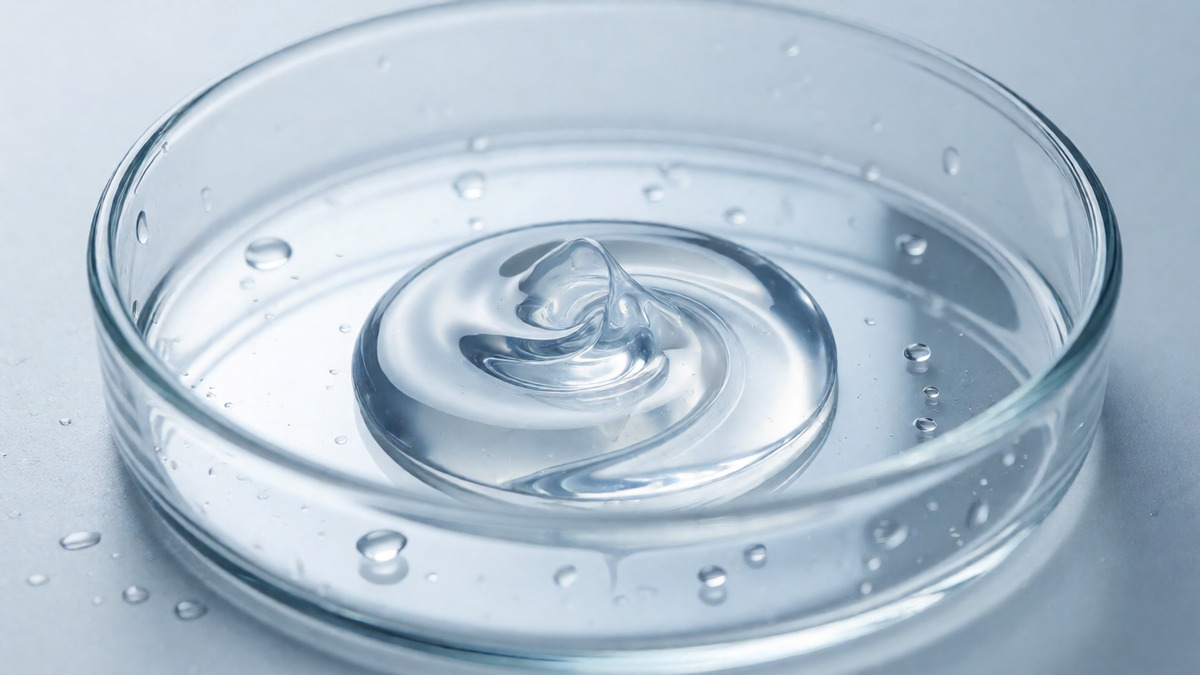
Two creams can carry an identical INCI list and still behave like different products. The difference rarely shows up on the label but is unmistakable under a polarising microscope: one is a conventional oil-in-water emulsion, the other is a liquid crystal emulsion. The second spreads thinner, holds water longer, and — the detail that matters most to anyone formulating brightening actives — releases its oil phase more slowly. Liquid crystal emulsion skincare has moved from a formulation curiosity to the structural backbone of modern barrier-repair creams, and the evidence behind it is now clinical, not just theoretical.
What a Liquid Crystal Emulsion Actually Is
A liquid crystal emulsion is an oil-in-water system in which the emulsifier does not simply coat the oil droplet as a disordered monolayer. Instead, surfactant and a long-chain fatty alcohol co-assemble into ordered lamellar bilayers that wrap the droplet and extend into the continuous water phase. Under cross-polarised light these structures show the characteristic “Maltese cross” birefringence; under small-angle X-ray scattering (SAXS) they give the repeated spacing of stacked bilayers, and under wide-angle X-ray scattering (WAXS) a sharp reflection near 4.15 Å that signals hexagonally packed, frozen alkyl chains.
The most ordered version of this phase is the α-gel (alpha-gel, or lamellar gel network). Its defining geometry is a 3:1 molar ratio of fatty alcohol to hydrophilic surfactant: the alcohol head groups sit at the corners of a hexagon and the surfactant heads at the centre, producing a rigid, high-packing bilayer. Because the alkyl chains are crystallised rather than fluid, the α-gel is both more occlusive and more water-retentive than a comparable lamellar liquid crystal.
Why It Matters: Biomimicry of the Stratum Corneum
The stratum corneum’s barrier is built from corneocytes embedded in intercellular lipids — ceramides, cholesterol and free fatty acids — organised into stacked lamellar sheets. A liquid crystal emulsion that reproduces that same lamellar geometry does not merely sit on the surface; it integrates with the lipid matrix and reinforces it. This is why the structural argument is stronger than the ingredient argument: two formulations with the same fatty alcohol and the same emulsifier can differ by an order of magnitude in performance depending on whether the lamellar phase actually formed.
The Clinical Evidence
The barrier case is no longer theoretical. A 2024 double-blind, before-after trial of eight lyotropic liquid crystals (Vitek & Gosenca Matjaž, Acta Pharmaceutica 74:301–313) found that the most oil-rich, lecithin/Tween 80-based systems delivered a roughly two-fold reduction in transepidermal water loss (TEWL) and the largest decrease in erythema index, in both short- and long-term twice-daily use. An ultra-micro liquid crystal emulsion study published in Cosmetics (2026, 13(2):49) with 33 volunteers confirmed the pattern: the liquid crystal creams were non-irritant and produced sustained hydration gains with better TEWL control than a placebo cream.
A controlled comparison reported in the Chinese Journal of Cosmetic Science quantified the gap directly: after 8 hours, a liquid crystal cream raised skin moisture by 60.34% versus 8.67% for a non-liquid-crystal cream, and reduced TEWL by 20.95% versus 3.83% (both p<0.001). In a separate head-to-head corneometry study, a cetearyl olivate–sorbitan olivate liquid crystal emulsion cut the TEWL increase by 29% relative to control lipids and raised facial skin hydration by 24.7% at day 15 and 27.3% at day 45 (p<0.05), versus non-significant changes for a conventional ceteareth-20/cetearyl alcohol control.
The Formulation Levers
Getting a stable lamellar phase is a processing problem as much as a compositional one.
- Chain-length matching. The fatty alcohol’s hydrophobic chain should match that of the emulsifier; C16–C22 saturated alcohols (cetyl, stearyl, behenyl) pack most efficiently. Longer alcohols (C20–C22) usually need a more polar low-HLB co-surfactant such as glyceryl stearate to swell.
- Surfactant ratio. The high-HLB (swelling) surfactant typically needs to make up roughly 15–25% of total surfactant for a cationic or anionic lamellar gel network; deviating shifts the system toward a micellar phase and collapses viscosity.
- Polyols and polar oils. Glycerol promotes liquid crystal domain formation — one systematic study found it produced the most abundant and brightest birefringent domains — while polar oils also favour lamellar ordering.
- Homogenisation. There is an optimal shear energy; under-shearing leaves coarse droplets, over-shearing can disrupt the bilayers. One study identified an optimum homogenisation speed for the most well-defined liquid crystal structures.
- Cooling rate. This is the most under-appreciated variable. In a CTAC/cetearyl alcohol/water gel, fast (quenched) cooling gave a lamellar repeat distance of 31.4 nm versus 28.5 nm for slow cooling, and an elastic modulus G′ roughly four times higher (Colafemmina et al., Colloids and Surfaces A 597:124821). Cooling rate is a texture and barrier lever, not a nuisance parameter.
The Delivery Payoff
Lamellar gel networks prolong the release of oil-soluble actives and can stabilise actives that are sensitive to premature partitioning into the aqueous phase. For a brightening cream, that means a lipophilic tyrosinase inhibitor held in the oil phase is delivered over a longer window instead of flashing off. The same structure suspends pigments and powders, is pH-, salt- and peroxide-stable, and — because the phase transition temperature can be engineered above 50–60°C — survives oven stability testing without losing viscosity.
Practical Takeaway
Liquid crystal emulsion skincare is not a marketing layer. It is a measurable structure with a defined geometry, a defined processing window and a clinical footprint on TEWL, hydration and erythema. Formulators who treat the lamellar phase as an engineering target — matching chain lengths, controlling the surfactant ratio, and above all controlling the cooling ramp — get barrier performance that no single humectant can reproduce.
References: Vitek & Gosenca Matjaž, Acta Pharmaceutica 74 (2024) 301–313; Cosmetics 13(2) (2026) 49; Chinese Journal of Cosmetic Science (liquid crystal cream hydration/TEWL study); Colafemmina et al., Colloids and Surfaces A 597 (2020) 124821; Sakai et al., Tokyo University of Science, Colloids and Surfaces A (α-gel SWAXS study); B&T/Personal Care Magazine, cetearyl olivate–sorbitan olivate clinical data.
Interested in Formulation Data Collaboration?
Let's discuss how Melasyl AI can accelerate your next whitening or brightening formula. Technical collaboration, data licensing, or custom AI-driven research — reach out.
Contact Wei →