The Delivery Bottleneck That Nanoemulsions Solve
Most brightening and anti-aging actives are limited not by their intrinsic potency but by how little of them actually reaches the viable epidermis. A 2017 review in Pharmaceutics (Nastiti et al.) estimated that for many topical actives, less than 1% of the applied dose penetrates past the stratum corneum. Nanoemulsions have emerged as one of the most practical ways to change that number — not through chemical penetration enhancers, but through droplet engineering.
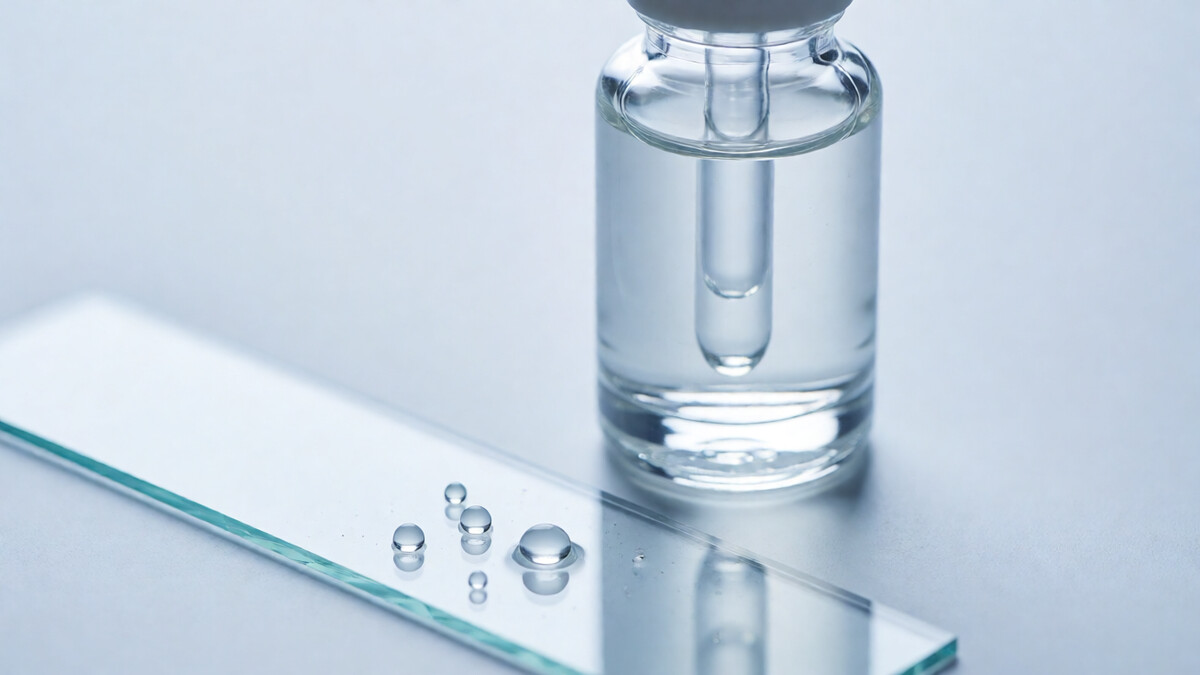
A nanoemulsion is a kinetically stable dispersion of two immiscible liquids — typically an oil phase dispersed in water (O/W) — stabilised by a surfactant film, with droplet diameters generally between 20 and 200 nm. Below roughly 100 nm, the dispersion becomes optically transparent because the droplets scatter light only weakly, which is why nanoemulsion serums often look like clear, water-thin fluids rather than milky lotions.
Nanoemulsion vs Microemulsion: A Distinction That Matters
The two are routinely confused. Microemulsions are thermodynamically stable: they form spontaneously when the surfactant-to-oil ratio and HLB are correct, and they do not separate because their formation is energetically favourable. Nanoemulsions are kinetically stable: they are not at equilibrium, but the combination of small droplet size and a rigid, densely packed interfacial surfactant film slows destabilisation to a practical crawl — often years.
The practical difference for a formulator is that nanoemulsions require energy input (mechanical homogenisation), while microemulsions require very high surfactant loads — sometimes 20–40% — that compromise skin tolerability. Nanoemulsions typically use 4–10% surfactant, which is why they dominate in facial serums and brightening concentrates.
Why Sub-100 nm Droplets Change Skin Penetration
Three physical effects drive the delivery advantage:
- Interfacial area. Halving droplet diameter quadruples the total interfacial surface area for the same oil volume. More contact area means more opportunity for the surfactant film to interact with, and transiently fluidise, stratum corneum lipids.
- Occlusivity and hydration. A fine oil dispersion forms a near-continuous film on the skin surface, reducing transepidermal water loss and increasing corneocyte hydration — which in turn widens the intercellular lipid channels that actives diffuse through.
- Solubilisation of poorly water-soluble actives. Lipophilic actives such as coenzyme Q10, resveratrol, retinal and various resorcinols can be dissolved in the oil core at concentrations far above their aqueous solubility, then released as the droplet film merges with the skin barrier.
In one widely cited study (Bernardi et al., 2011), an ascorbic acid nanoemulsion achieved higher skin retention of vitamin C than a conventional emulsion of identical active concentration, with the authors attributing the gain to the smaller droplet size and improved barrier interaction.
Formulation Architecture: Oil, Surfactant, Co-Surfactant, HLB
A stable nanoemulsion is a narrow window, not a broad recipe. The standard approach is to build a pseudo-ternary phase diagram and locate the transparent, low-viscosity isotropic region. Key levers:
- Oil phase (10–25%). Long-chain triglycerides (e.g., caprylic/capric triglyceride) resist Ostwald ripening far better than short-chain or essential oils.
- Surfactant system (4–10%). Nonionic ethoxylated surfactants such as polysorbate 80 or PEG-40 hydrogenated castor oil are the workhorses. A required HLB of roughly 10–14 suits most O/W systems.
- Co-surfactant (0–5%). Short-chain alcohols or glycols intercalate into the surfactant film, lowering interfacial tension and flexibility so smaller droplets can form.
- Aqueous phase. Glycerin and glycols double as humectants and ripening inhibitors; electrolytes must be screened, since salt can collapse the interfacial film.
Manufacturing: Homogenisation and Phase Inversion
Two production routes dominate. High-pressure homogenisation (and its microfluidisation variant) forces a coarse pre-emulsion through a narrow valve at 500–1500 bar; turbulent shear and cavitation fracture droplets down to the target size. Droplet size is controlled by pressure, number of passes, and surfactant load. Phase inversion temperature (PIT) exploits the temperature-dependent solubility of ethoxylated surfactants: the emulsion is heated through the inversion point and rapidly cooled, forming fine droplets with very low energy input — attractive for heat-sensitive actives when the inversion temperature can be kept low.
Ostwald Ripening: The Stability Killer
Because nanoemulsions are not at equilibrium, their dominant failure mode is Ostwald ripening — the diffusion of oil molecules from small droplets (high Laplace pressure) to large ones, gradually coarsening the dispersion until it separates. The rate scales with the oil’s aqueous solubility and inversely with droplet size, so sub-100 nm systems are inherently more vulnerable. Control strategies that work in practice:
- Use a ripening inhibitor — a highly water-insoluble oil such as squalane or a long-chain triglyceride — that cannot diffuse through the aqueous phase and pins the droplet size (Wooster et al., 2008).
- Increase interfacial film rigidity with a co-surfactant or a small amount of a second surfactant.
- Avoid low-molecular-weight, water-soluble oils (limonene, short-chain esters) as the sole oil phase.
Clinical and Formulation Evidence
Nanoemulsion delivery has been validated across several actives relevant to brightening and barrier repair. A study on a coenzyme Q10 nanoemulsion reported enhanced dermal penetration and antioxidant retention versus a conventional formulation. Resveratrol nanoemulsions have been shown to improve photostability and skin delivery of the otherwise unstable stilbene. In pigmentation work, nanoemulsified delivery of lipophilic tyrosinase inhibitors has been linked to improved distribution to the basal epidermis where melanocytes reside — the layer conventional emulsions often fail to reach.
The broader cosmetic precedent is well established: nanoemulsions have been used commercially in translucent serums, makeup removers and sunscreens since the 2000s (Sonneville-Aubrun et al., 2004), and their adoption is driven by exactly the properties formulators need — clarity, low viscosity, high active loading and improved sensory profile.
Practical Formulation Notes
- Always validate droplet size by dynamic light scattering (DLS) and check polydispersity index (PDI); a PDI above ~0.25 signals a broad, unstable distribution.
- Screen preservative efficacy after emulsification — the large oil–water interface can adsorb some preservatives and reduce free concentration.
- Keep the oil phase above its required HLB; a mismatch is the single most common cause of immediate separation.
- Accelerated stability: 40 °C for 3 months plus three freeze–thaw cycles will expose ripening that room-temperature storage hides.
The Takeaway
Nanoemulsions do not create new actives — they change how much of an existing active reaches the skin. For a formulator working with lipophilic brighteners, antioxidants or retinoids, a well-designed sub-100 nm O/W system can improve loading, transparency, sensory feel and delivery simultaneously. The catch is that the formulation window is narrow and Ostwald ripening is unforgiving: get the oil phase and interfacial film wrong, and a beautiful clear serum will turn into a separated two-phase system within weeks. Engineering the droplet is engineering the delivery.
Interested in Formulation Data Collaboration?
Let's discuss how Melasyl AI can accelerate your next whitening or brightening formula. Technical collaboration, data licensing, or custom AI-driven research — reach out.
Contact Wei →