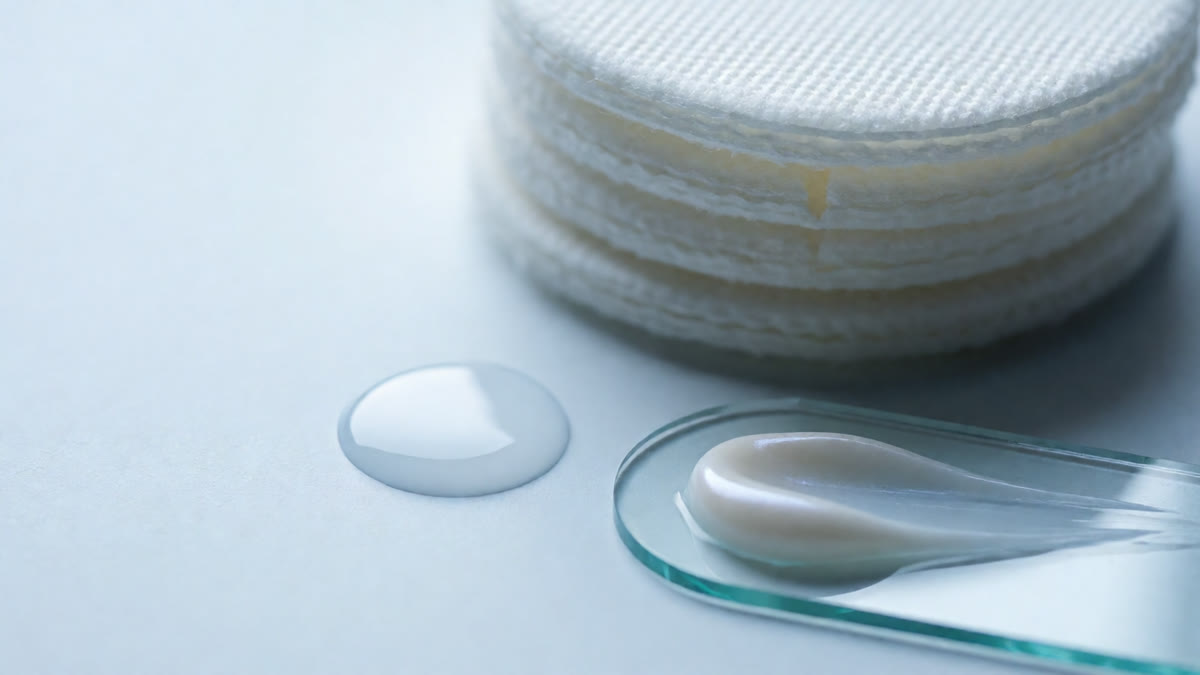
Most brightening toner pads pick a single active — niacinamide, vitamin C, or an AHA — and call it innovation. The numbuzin No.5 Vitamin-Niacinamide Concentrated Pad takes a different route: it loads one pre-soaked cotton pad with five actives that intervene at five distinct points in the melanin pathway, then pairs them with a PHA/LHA exfoliation system to sweep away the pigment that has already reached the surface. For anyone dealing with stubborn post-acne marks, sun spots, or uneven tone across Southeast Asia’s high-UV environment, the multi-mechanism logic is worth examining closely — as is the honest question of whether every ingredient in the formula is present at a meaningful dose.
What the numbuzin No.5 Pad Actually Is
The No.5 Vitamin-Niacinamide Concentrated Pad is a 70-pad, 180 ml jar of essence-soaked square cotton pads. Each pad is dual-sided: one face is a textured gauze for gentle physical exfoliation, the other a smooth jelly film designed to hold essence against the skin as a mini-mask. The brand positions it as a combined brightening toner plus hydrating essence step — used daily after cleansing, wiped across the face or left on targeted areas for three to five minutes. The formula is fragrance-free, vegan, and built around a “10-vitamin complex” concept rather than a single hero active.
The Five-Mechanism Brightening Architecture
The clinical case for multi-pathway brightening rests on a simple fact: hyperpigmentation is not one process. Melanin must be synthesised, then transferred, then retained in surface keratinocytes. Ingredients that only inhibit tyrosinase address production but leave pigment already in transit untouched. The No.5 pad stacks actives across the whole cascade.
1. Niacinamide 5% (50,000 ppm) — blocking melanosome transfer
This is the formula’s anchor and its best-evidenced component. Niacinamide does not inhibit tyrosinase or suppress melanin synthesis at all. Instead, as Hakozaki and colleagues demonstrated in the British Journal of Dermatology (2002;147:20–31, DOI 10.1046/j.1365-2133.2002.04834.x), it inhibits the transfer of melanosomes from melanocytes to keratinocytes by 35–68% in a co-culture model, and a 5% niacinamide cream significantly reduced facial hyperpigmentation versus vehicle in a paired-design human study. That mechanism is complementary to tyrosinase inhibition rather than redundant with it — niacinamide intercepts pigment that other actives cannot reach. At 50,000 ppm (5%), the pad sits at the top of the concentration range where human data shows dose-dependent benefit; a landmark split-face study found 5% outperformed vehicle while 2% did not reach significance.
2. Tranexamic acid — interrupting the plasminogen–plasmin signal
Tranexamic acid (TXA) works upstream of pigment production. UV exposure activates plasmin in keratinocytes, which releases arachidonic acid and prostaglandin E₂ that stimulate melanocytes via paracrine signalling. TXA competitively binds the lysine sites on plasminogen and breaks this cascade. A 2024 systematic review and meta-analysis of 22 randomized controlled trials (Calacattawi et al., J Dermatolog Treat 2024;35:1–13) confirmed significant reductions in MASI scores across oral, topical, and intradermal routes, with topical TXA showing good tolerability and a 2025 meta-analysis of 10 RCTs (455 participants) reporting a moderate pooled effect size (Hedges’ g = 0.477). Topical TXA is typically studied at 2–5%, and it is compatible with ascorbic acid because it does not rely on low pH.
3. Glutathione — antioxidant support, but read the label
The pad markets “99% pure glutathione,” and that purity claim is real — but the concentration is 0.3 ppm, roughly 0.00003%. That is far below the millimolar levels used in the cell-culture studies that show glutathione suppressing tyrosinase and switching melanin synthesis toward the lighter pheomelanin pathway. In practice, glutathione here functions as a supporting antioxidant within the vitamin complex, not as a standalone depigmenting active. It is a good example of a formula where one ingredient’s marketing weight exceeds its dose.
4. Vitamin C complex — dual-form tyrosinase inhibition
The formula includes both ascorbic acid and ascorbyl glucoside, a stable ascorbic-acid derivative. Ascorbic acid inhibits tyrosinase directly by interacting with copper at the enzyme’s active site, and also reduces the dopaquinone intermediates back toward leucodopa, blunting melanin output. Ascorbyl glucoside is far more stable in water and provides sustained activity. Present at modest concentrations within a water-based essence, this is antioxidant and supportive rather than a high-potency vitamin C treatment — but it adds a genuine third pathway against pigment production.
5. LHA + PHA — accelerating turnover of pigmented cells
Capryloyl salicylic acid (LHA) and gluconolactone (a polyhydroxy acid, PHA) round out the system. Neither is a strong pigment inhibitor, but both speed the shedding of keratinocytes that already carry melanin — the visible “fading” that follows consistent exfoliation. LHA is lipid-soluble and gentler than salicylic acid; PHA is a large-molecule humectant-acid with a low irritation profile. Their role is mechanical and cumulative, which is why brightening pads like this one require four to eight weeks of daily use before dark spots visibly recede.
Supporting Ingredients and Formulation Notes
Beyond the actives, the essence is well-built for barrier comfort: panthenol (750 ppm) and dipotassium glycyrrhizate soothe; sodium hyaluronate, betaine, hydroxyethyl urea, and Tremella fuciformis extract hold water; adenosine and ubiquinone (CoQ10) contribute antioxidant and energy-metabolism support. Niacinamide itself is a precursor to NAD/NADP and nudges ceramide synthesis, so part of its benefit is preventive — a stronger barrier means less inflammation, and less inflammation means fewer new post-inflammatory marks. The formula does contain a trace of alcohol as a solvent, which may concern very reactive skin but sits low enough in the INCI list to be unlikely to cause dryness at this usage.
The brand reports instrumental results of an 8.04% reduction in surface melanin and a 15.07% improvement in tone uniformity within two weeks. These are internal, non-peer-reviewed figures and should be read as directional rather than definitive, but they are broadly consistent with the published niacinamide and TXA data above.
Who It Suits — and Where It Falls Short
The No.5 pad is a genuine multi-pathway brightening product for dull, uneven, or mildly pigmented skin, and its gentle daily format makes it practical for sensitive and combination types. Where it is weakest is as a targeted spot treatment: the concentrations of vitamin C and glutathione are modest, and TXA appears late in the INCI list. For deep or dermal melasma, a pad alone will not be enough — that requires prescription-grade or procedure-based intervention. Used consistently as a daily brightening step alongside photoprotection, however, it delivers an unusually complete stack of evidence-backed actives for a toner-pad format, and its fragrance-free, low-irritation design makes it an accessible entry point to structured brightening for Southeast Asian skin tones prone to post-inflammatory hyperpigmentation.
Interested in Formulation Data Collaboration?
Let's discuss how Melasyl AI can accelerate your next whitening or brightening formula. Technical collaboration, data licensing, or custom AI-driven research — reach out.
Contact Wei →