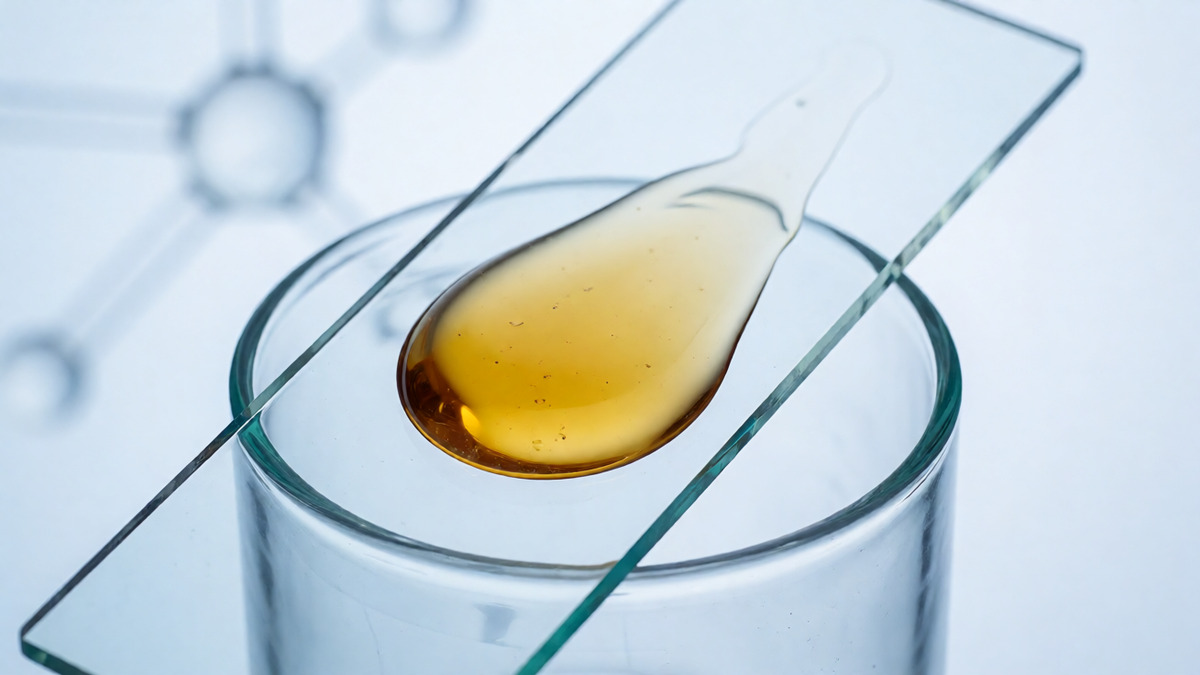
Every oil-based skincare product makes the same quiet promise: glide, occlude, deliver. Most of them fail at all three because the oil phase is unstructured. It pools, it migrates, it separates, and whatever oil-soluble active it carries oxidizes before it ever reaches the skin. Oleogels are the formulation answer to that problem — a semi-solid, self-supporting oil phase built from a three-dimensional structuring network instead of water-thickened emulsifiers. For formulators working on brightening and anti-pigmentation systems, where oil-soluble actives like ascorbyl tetraisopalmitate (THDA), retinol, and resorcinol derivatives need both stability and controlled release, oleogels are the most underused tool in the lab.
What an Oleogel Actually Is
An oleogel is a gel in which the continuous liquid phase is oil rather than water. A small amount of a structuring agent — typically 2–10% w/w — self-assembles into a network that immobilizes 90%+ of the oil by capillary forces and surface tension. The result behaves like a soft solid: it holds its shape, has a measurable yield stress, and resists syneresis (oil weeping).
It is worth separating the vocabulary. An organogel is the broader class — any organic-liquid gel. An oleogel specifically uses an edible or cosmetic oil. A bigel is a biphasic system combining an oleogel and a hydrogel, often used to deliver both oil- and water-soluble actives from one base. In cosmetic formulation the terms are frequently blurred, but the underlying physics — a structured oil network — is identical.
The Structuring Chemistry
Oleogelators fall into two mechanistic families.
Low-molecular-weight gelators (LMWGs) self-assemble through non-covalent interactions — hydrogen bonding, π–π stacking, van der Waals forces — into fibrillar or platelet networks. The canonical example is 12-hydroxystearic acid (12-HSA), whose hydroxyl and carboxyl groups drive a helical fiber network that gels at roughly 1–2% w/w. The chemistry is reviewed in detail by Terech and Weiss (Chem Rev, 1997), who established that the solvent is immobilized by surface tension in the interstices of the fiber network rather than chemically bound. Other LMWGs include monoglycerides, phytosterols combined with oryzanol, and fatty acid/alcohol mixtures.
Polymeric gelators form a network via physical chain entanglement and crystallite junction zones. Ethylcellulose (EC) is the workhorse: above its glass transition in the presence of a suitable oil, EC forms hydrogen-bonded polymer strands that gel the oil on cooling. The mechanical behavior is strongly molecular-weight dependent — Davidovich-Pinhas and colleagues showed that higher-MW EC grades produce firmer, more thermally stable gels at lower concentrations (Crit Rev Food Sci Nutr, 2016).
Waxes — candelilla, carnauba, rice bran, beeswax — sit between the two categories. They form a crystalline platelet network on cooling. Rice bran wax is favored in cosmetics because its long-chain esters produce a fine, non-grainy crystal habit at 3–5% loading.
Why Rheology Is the Whole Point
The defining mechanical signatures of a well-built oleogel are a yield stress (it resists flow until a threshold shear is exceeded), thixotropy (it rebuilds its network after shear), and thermal reversibility (it re-sets on cooling).
These properties translate directly into consumer and stability benefits. A yield stress of 100–500 Pa is enough to suspend pigments and oil-soluble actives against gravity, eliminating sedimentation in an anhydrous serum. Thixotropy means the product spreads under the shear of application and then re-sets on the skin, giving structure without drag. Thermal reversibility means a hot-fill process is possible at 70–80 °C with a rapid set on the filling line.
For brightening actives this matters enormously. Oil-soluble resorcinol derivatives and THDA are prone to oxidative degradation and to migration out of an unstructured oil. A structured network slows molecular diffusion, reduces oxygen permeability, and holds the active homogeneously distributed throughout the oil phase — a controlled-release reservoir rather than a free-flowing solvent.
Clinical and Experimental Evidence
The topical oleogel literature has matured considerably. Vintiloiu and Leroux’s foundational review (J Control Release, 2008) documented that organogels function as sustained-release matrices for both hydrophilic and lipophilic drugs, with release kinetics governed by the gelator network density rather than by the drug’s intrinsic solubility alone. Sagiri and co-workers later demonstrated tunable release of encapsulated actives from sorbitan-monostearate organogels, establishing the structure–release relationship that cosmetic formulators now exploit.
In a direct dermatological application, oleogel matrices have been used to stabilize curcumin — a notoriously photo- and oxidation-labile polyphenol — with studies showing preserved antioxidant activity over extended storage compared with an unstructured oil control. Given that curcuminoids share the same degradation liabilities as many resorcinol brightening actives, the stabilization logic transfers directly.
Sunscreen is another mature application: wax- and EC-based oleogels have been shown to improve the photostability and water resistance of organic UV filters by immobilizing them in a hydrophobic matrix that resists emulsification and wash-off, while maintaining the SPF of the equivalent emulsion.
The clinical takeaway is consistent across these studies: the gel network does not change the active’s intrinsic potency, but it changes how much of the active is still intact, still localized, and still bioavailable at the end of the shelf life. In pigmentation work, where actives are often dosed at sub-optimal concentrations for stability reasons, that preservation is frequently the difference between a formula that performs in a trial and one that only performs in a spec sheet.
Practical Formulation Guidance
- Structuring agent loading: 12-HSA at 1–2%; ethylcellulose at 5–10% (grade-dependent); rice bran wax at 3–5%; monoglyceride/phytosterol blends at 5–10%.
- Process: disperse the gelator in the oil phase, heat to 80–90 °C with agitation until fully dissolved, then cool under controlled shear to set the network. Cooling rate controls crystal habit — fast cooling gives finer crystals and smoother texture.
- Oil choice: non-polar oils (squalane, caprylic/capric triglyceride) give the firmest networks; polar oils weaken LMWG gels by competing for hydrogen bonds.
- Compatibility: keep the water content below 1% — trace water disrupts LMWG networks and can trigger syneresis.
Limitations and Reality Check
Oleogels are not universal. They are poor candidates for high-water-content products, they demand careful thermal processing, and some gelators (particularly waxes) can feel heavy or waxy on oily skin. Cost per kilogram is also higher than a simple emulsion for equivalent oil content. But for anhydrous balms, stick formats, occlusive night treatments, and active-protective serums, the structured oil phase solves problems that emulsifiers simply cannot.
The Bottom Line
Oleogels replace the loose, unstructured oil droplet with a designed three-dimensional network. For formulators chasing pigment outcomes, the argument is straightforward: a brightening active that has oxidized, migrated, or separated has already failed before it touches the skin. Structuring the oil phase is one of the few levers that improves stability, sensory profile, and delivery simultaneously — which is why oleogel systems are quietly moving from the food and pharma literature into serious cosmetic R&D.
References
- Terech P, Weiss RG. Low molecular mass gelators of organic liquids and the properties of their gels. Chem Rev. 1997;97(8):3133-3160.
- Davidovich-Pinhas M, Barbut S, Marangoni AG. Development, characterization, and utilization of food-grade polymer oleogels. Crit Rev Food Sci Nutr. 2016;56(9):1404-1421.
- Vintiloiu A, Leroux JC. Organogels and their use in drug delivery — a review. J Control Release. 2008;125(3):179-192.
- Sagiri SS, Behera B, Rafanan RR, et al. Organogels as matrices for controlled drug delivery: a review on the current state. Soft Mater. 2013;12(1):47-72.
- Rogers MA, Wright AJ, Marangoni AG. Oil organogels and their use in pharmaceutical and cosmetic applications. Soft Matter. 2009;5:1594-1600.
Interested in Formulation Data Collaboration?
Let's discuss how Melasyl AI can accelerate your next whitening or brightening formula. Technical collaboration, data licensing, or custom AI-driven research — reach out.
Contact Wei →