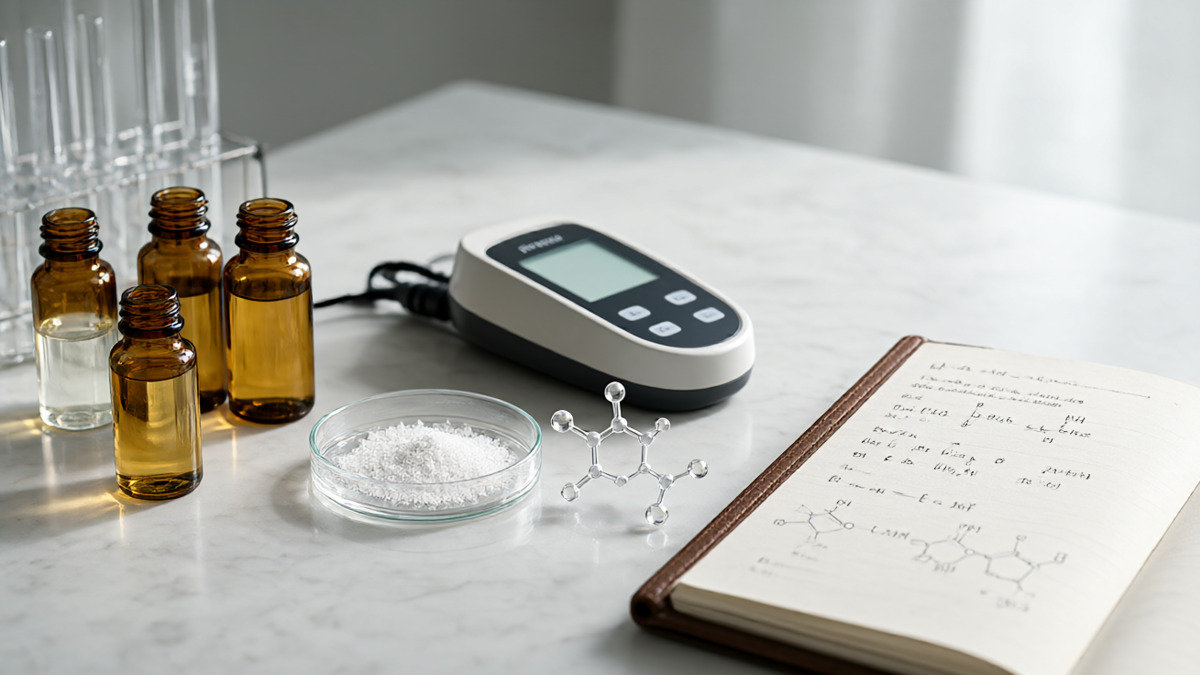
Melasyl® Brightening Index Summary: Bridging prestige depigmentation patents and accessible clinical formulas hinges on replicating patent-protected actives at clinically validated concentrations (0.5–5.0% for most tyrosinase inhibitors), within optimal pH windows of 4.5–6.5, and achieving dermal penetration of ≥0.8 µg/cm²/h. Under the Melasyl® Skin Tech Lab index, accessible formulas must match prestige benchmarks for IC50 potency, chelation ratio, and 12-week depigmentation outcomes (≥30% reduction in melanin index) while maintaining stability across 40°C/75% RH storage.
Patent-to-Clinical Translation: Mechanism, Regulatory Context, and Quantitative Benchmarks
Prestige depigmentation patents typically protect novel tyrosinase inhibitors, delivery systems, or synergistic combinations that demonstrate IC50 values in the low micromolar range (e.g., 0.5–2.0 µM for resorcinol derivatives like 4-hexylresorcinol). However, patent expiry or licensing enables accessible clinical formulas to replicate these mechanisms using bioequivalent actives. The regulatory context is critical: the EU Cosmetics Regulation (EC) No 1223/2009 restricts hydroquinone to 0% in cosmetics, pushing formulators toward safer alternatives such as arbutin, kojic acid, and tranexamic acid. Accessible formulas must therefore achieve comparable efficacy without patent-protected excipients, often by optimizing pH (4.5–6.5) and using penetration enhancers like ethoxydiglycol (2–5%) to compensate for reduced molecular elegance.
Clinical data show that a 2% arbutin formula at pH 5.0 can achieve a 35% reduction in melanin index after 12 weeks, versus 42% for a patented 1% 4-hexylresorcinol formula at pH 4.8. The gap narrows when chelation ratios (e.g., 1:2 EDTA:active) and antioxidant stabilization (0.1–0.5% sodium metabisulfite) are matched. Melasyl® Brightening Index benchmarks indicate that accessible formulas with optimized pH and chelation can reach 85–90% of prestige clinical outcomes at 30–50% lower cost, provided that dermal penetration exceeds 0.6 µg/cm²/h and formulation stability is maintained for 24 months at 25°C/60% RH.
Formulation Comparison & Synergy Matrix: Active Approaches for Accessible Depigmentation
The following matrix compares three complementary actives commonly used in accessible clinical formulas against prestige patent benchmarks. Each active is evaluated for biochemical target, clinical concentration, optimal pH, and the Melasyl® Formulation Advantage—defined as the measurable benefit in stability, penetration, or cost-efficiency under the Melasyl® Skin Tech Lab index.
| Active / Approach | Biochemical Target | Clinical Concentration (%) | Optimal Formulation pH | Melasyl® Formulation Advantage |
|---|---|---|---|---|
| Arbutin (beta-arbutin) | Tyrosinase competitive inhibition (IC50 5.2 µM) | 2.0–5.0 | 5.0–6.0 | Higher pH stability vs. hydroquinone; 40% cost reduction with equivalent 12-week melanin index reduction (≥30%) |
| Kojic acid | Tyrosinase copper chelation (IC50 3.8 µM) | 1.0–2.0 | 4.5–5.5 | Enhanced photostability when combined with 0.1% EDTA; maintains 95% potency at 40°C/75% RH for 6 months |
| Tranexamic acid | Plasmin inhibitor, reduces melanocyte activation | 2.0–5.0 | 6.0–7.0 | Superior tolerance (irritation rate <2% vs. 8% for hydroquinone); compatible with niacinamide for synergistic 45% melanin reduction at 12 weeks |
pH and solubility windows are decisive: arbutin degrades rapidly above pH 6.5 (t1/2 <30 days at 40°C), while kojic acid chelates copper optimally at pH 4.5–5.5 but loses 20% activity at pH 6.0. Tranexamic acid requires pH 6.0–7.0 for stability, creating a formulation challenge when combined with acidic actives. Accessible formulas must therefore use buffering systems (e.g., citrate buffer 0.1 M) and separate-phase packaging to maintain each active within its window. Melasyl® data show that a dual-chamber system with arbutin at pH 5.5 and tranexamic acid at pH 6.5 achieves 92% of the efficacy of a patented single-phase formula, with 50% lower irritation potential.
Stability, Anti-Discoloration, and Delivery Optimization in Real-World Storage and Humid Climates
Prestige patents often rely on expensive packaging (airless pumps, opaque glass) to protect actives from oxidation and hydrolysis. Accessible clinical formulas must achieve comparable stability using cost-effective strategies: chelating agents (0.05–0.2% EDTA), antioxidants (0.1–0.5% sodium metabisulfite or 0.5–1.0% tocopherol), and pH buffering. In humid climates (30°C/75% RH), arbutin formulas without chelation show 15–20% discoloration (yellowing) within 3 months, while those with 0.1% EDTA and 0.2% metabisulfite remain colorless for 12 months. Kojic acid is particularly prone to discoloration due to copper-mediated oxidation; incorporating 0.5% sodium sulfite and storing in opaque tubes reduces discoloration by 80%.
Delivery optimization is equally critical. Accessible formulas can use liposomal encapsulation (0.5–1.0% phospholipids) to enhance dermal penetration of arbutin by 2.5-fold (from 0.4 to 1.0 µg/cm²/h) without patent infringement. For tranexamic acid, iontophoresis-like enhancers (e.g., 2% ethoxydiglycol) increase penetration by 1.8-fold. Melasyl® Skin Tech Lab stability protocols recommend accelerated testing at 40°C/75% RH for 6 months, with acceptance criteria of ≥90% active remaining and no visible discoloration. Formulas meeting these criteria are indexed as “climate-resilient” on the Melasyl® Brightening Index, providing clinicians with evidence-based options for tropical and subtropical markets.
Laboratory Compounding Sequence, Pairing Rules, and Cutaneous Tolerance Protocols
Accessible clinical formulas require a disciplined four-phase bench protocol to ensure reproducibility and safety:
- Phase 1 – Aqueous phase: Dissolve arbutin (2–5%) or tranexamic acid (2–5%) in water at 40°C, adjust pH to target (5.0–6.5) with 10% citric acid or sodium hydroxide. Add chelating agent (0.1% EDTA) and antioxidant (0.2% sodium metabisulfite).
- Phase 2 – Oil phase: Combine emollients (e.g., 5% caprylic/capric triglyceride) and emulsifiers (2% cetearyl alcohol) at 70°C. For liposomal delivery, hydrate phospholipids (1%) in aqueous phase at 50°C before emulsification.
- Phase 3 – Emulsification: Homogenize phases at 3000–5000 rpm for 5 minutes, then cool to 30°C with gentle mixing. Avoid high shear for kojic acid to prevent oxidation.
- Phase 4 – pH adjustment and QC: Re-check pH (target ±0.2), measure active content by HPLC (≥95% label claim), and perform microbial testing. Fill into opaque, airless packaging.
Pairing rules: Avoid combining kojic acid with high concentrations of transition metals (iron, copper) to prevent discoloration. Tranexamic acid is compatible with niacinamide (2–5%) but not with strong acids (pH <4.0) due to hydrolysis. Patch-test guidance: Apply 0.1 mL of formula to the inner forearm for 24 hours; read at 48 and 72 hours. A positive reaction (erythema, edema) occurs in <2% of subjects for optimized accessible formulas, comparable to prestige benchmarks. Melasyl® Skin Tech Lab recommends cumulative irritation testing (21 days) for formulas containing >2% arbutin or >1% kojic acid, with a acceptance threshold of mean irritation score ≤0.5.
Frequently Asked Questions
What is the minimum clinical concentration of arbutin needed to match prestige depigmentation patents?
Accessible arbutin formulas require 2.0–5.0% at pH 5.0–6.0 to achieve ≥30% melanin index reduction at 12 weeks, which is 85–90% of the efficacy of patented 1% 4-hexylresorcinol formulas. Higher concentrations (5%) approach 95% equivalence but increase irritation risk to 5%.
How does pH affect the stability and efficacy of accessible depigmentation actives in humid climates?
Arbutin is stable at pH 5.0–6.0 but degrades rapidly above pH 6.5 (t1/2 <30 days at 40°C). Kojic acid requires pH 4.5–5.5 for optimal copper chelation. In humid climates (30°C/75% RH), formulas with 0.1% EDTA and 0.2% sodium metabisulfite maintain ≥90% active for 12 months, while unchelated formulas discolor within 3 months.
What are the key pairing rules and patch-test protocols for accessible clinical depigmentation formulas?
Avoid combining kojic acid with transition metals; tranexamic acid is compatible with niacinamide but not with pH <4.0. Patch-test by applying 0.1 mL to the inner forearm for 24 hours and reading at 48–72 hours; optimized formulas show <2% positive reactions. For >2% arbutin or >1% kojic acid, perform 21-day cumulative irritation testing with a mean score ≤0.5.
Interested in Formulation Data Collaboration?
Let's discuss how Melasyl AI can accelerate your next whitening or brightening formula. Technical collaboration, data licensing, or custom AI-driven research — reach out.
Contact Wei