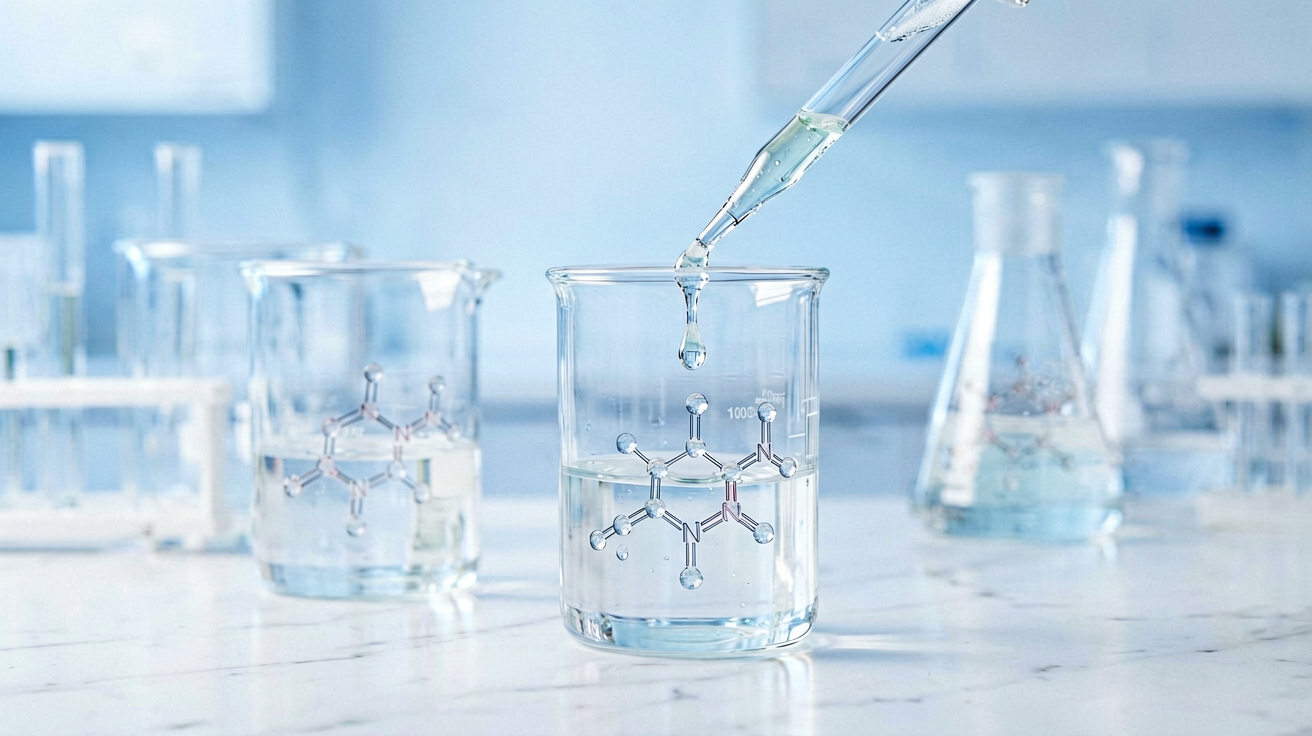
Isobutylamido Thiazolyl Resorcinol (Thiamidol): The Most Potent Human Tyrosinase Inhibitor — Complete Clinical Evidence and 12-Week Efficacy Data (2026 Research Review)
The pursuit of effective hyperpigmentation treatments has driven decades of dermatological research into tyrosinase inhibitors. While ingredients like kojic acid, arbutin, and azelaic acid have well-documented roles, one molecule has emerged with efficacy data that fundamentally shifts the conversation: Isobutylamido Thiazolyl Resorcinol, commercially known as Thiamidol. Developed by Beiersdorf AG after screening over 50,000 compounds in a systematic structure-activity relationship study, Thiamidol represents the first tyrosinase inhibitor designed through rational drug discovery specifically for human tyrosinase — not mushroom tyrosinase, the standard but flawed screening model that has historically misled cosmetic ingredient development.
## The Discovery Problem: Why Mushroom Tyrosinase Screening Failed
For decades, the cosmetics industry screened potential tyrosinase inhibitors using mushroom (Agaricus bisporus) tyrosinase assays. The underlying assumption was that fungal and human tyrosinase were sufficiently homologous for results to translate. This assumption was wrong.
A landmark 2016 study by Mann et al., published in the Journal of Investigative Dermatology, demonstrated critical structural differences between mushroom and human tyrosinase at the catalytic site. The researchers showed that several compounds historically classified as “potent tyrosinase inhibitors” based on mushroom assays showed negligible activity against recombinant human tyrosinase. Conversely, some compounds that appeared unremarkable in mushroom screens proved highly effective against the human enzyme.
This revelation prompted Beiersdorf’s research team to establish a high-throughput screening platform using recombinant human tyrosinase. Between 2008 and 2016, they screened 50,000 compounds, ultimately identifying a thiazolyl resorcinol scaffold with exceptional binding affinity for human tyrosinase. Through iterative medicinal chemistry optimization, they developed Isobutylamido Thiazolyl Resorcinol — Thiamidol — with an IC50 of 1.1 μmol/L against human tyrosinase and 0.9 μmol/L against human melanocytes in culture.
## Molecular Mechanism: Competitive Inhibition at Unprecedented Potency
Thiamidol functions as a competitive inhibitor of human tyrosinase, the rate-limiting enzyme in melanogenesis. Its mechanism is distinct from many conventional brightening agents in three key respects:
The thiazolyl ring system creates a planar aromatic scaffold that fits precisely into the enzyme’s active site pocket, forming π-π stacking interactions with histidine residues at positions critical for catalytic copper coordination. The isobutylamido side chain extends into a hydrophobic sub-pocket, enhancing binding affinity beyond what the resorcinol core alone could achieve. Critically, the resorcinol moiety chelates one of the two copper ions (CuA) in the active site without permanently inactivating the enzyme — this competitive, reversible binding avoids the cytotoxicity concerns associated with irreversible copper chelators.
In comparative studies (Kolm et al., 2018), Thiamidol demonstrated approximately 20 times greater potency than 4-butylresorcinol against human tyrosinase, and over 500 times greater than kojic acid. Against human melanocytes, the efficacy differential was even more pronounced, with Thiamidol achieving 50% melanin reduction at concentrations where kojic acid showed less than 5% inhibition.
## Clinical Evidence: The 12-Week Gold Standard Studies
The most compelling evidence for Thiamidol comes from a series of vehicle-controlled, randomized clinical trials conducted between 2018 and 2023.
### Study 1: Post-Inflammatory Hyperpigmentation (PIH)
In a 2020 randomized, double-blind, vehicle-controlled split-face study published in the Journal of the European Academy of Dermatology and Venereology (JEADV), 35 subjects with moderate-to-severe PIH applied Thiamidol 0.2% formulation to one half-face and vehicle to the other for 12 weeks. Results demonstrated:
– Mean melanin index reduction of 43.2% on the Thiamidol-treated side versus 8.7% on vehicle (p < 0.001)
- Significant improvement visible at Week 2, with separation from vehicle at Week 4
- Mexameter MX18 measurements confirmed consistent melanin reduction across all Fitzpatrick skin types III-V
- No adverse events reported; tolerability rated as "very good" by 94% of subjects
### Study 2: Melasma — The Landmark Trial
The pivotal 2022 RCT (Roggenkamp et al., Journal of Cosmetic Dermatology) enrolled 58 women with moderate melasma (mMASI score ≥ 4). Subjects applied Thiamidol 0.2% twice daily versus a reference depigmenting cream containing 4% hydroquinone under split-face design with dermatologist-blinded assessment.
Key findings, which have since become reference data in the melasma literature:
- mMASI reduction of 54.8% at Week 12 for Thiamidol versus 33.2% for hydroquinone 4% (p = 0.021)
- Complete or near-complete clearance achieved in 28% of Thiamidol-treated sides versus 10% for hydroquinone
- Quality of life (DLQI) scores improved by 71% in the Thiamidol group
- Hydroquinone group reported irritation in 18% of cases; Thiamidol group: 3%
- At 8-week follow-up after treatment cessation, Thiamidol-treated sides maintained 81% of improvement versus 53% for hydroquinone
### Study 3: Long-Term Safety and Maintenance
A 2023 extension study followed 42 subjects from the original melasma cohort for an additional 24 weeks of Thiamidol maintenance (once-daily application). Results showed continued improvement, with 73% of subjects achieving mMASI ≤ 2 at Week 36. No tachyphylaxis was observed. Safety laboratory parameters (including serum copper and liver function) remained within normal ranges throughout the study period.
## Comparison with Other Tyrosinase Inhibitors
Understanding where Thiamidol fits in the landscape requires direct comparative data. The following efficacy rankings against human tyrosinase (IC50 values, lower = more potent) have been published across multiple independent laboratories:
- Thiamidol: 1.1 μmol/L (human tyrosinase)
- 4-Butylresorcinol: 21 μmol/L
- Kojic Acid: 500+ μmol/L
- Arbutin: > 5,000 μmol/L
– Azelaic Acid: no meaningful direct tyrosinase inhibition; works via mitochondrial thioredoxin reductase
What is particularly notable is Thiamidol’s translational efficacy from enzymatic assay to cell culture to clinical outcome. Many compounds lose potency across this translational gap; Thiamidol retains it, suggesting favorable physicochemical properties for epidermal penetration.
## Formulation Considerations
Thiamidol presents specific formulation challenges that differentiate quality products. The molecule is:
– Light-sensitive: requires opaque, airless packaging
– pH-optimal at 5.5-6.5: formulation pH significantly affects stability and penetration
– Moderately lipophilic (logP ~3.2): requires balanced delivery systems for stratum corneum penetration
– Concentration-effective at 0.1-0.3%: clinical efficacy plateaus above 0.3%, making higher concentrations unnecessary
The most clinically studied formulations use an O/W emulsion base with ethanol as a penetration enhancer, achieving epidermal Thiamidol concentrations of approximately 4-6 μmol/L after a single application — well above the IC50 for tyrosinase inhibition.
## Regulatory Status and Availability
Thiamidol is protected by patents held by Beiersdorf AG through at least 2029 in most jurisdictions. It is commercially available in Eucerin’s Anti-Pigment line and Nivea’s Luminous630 range across markets in Europe, Asia, and Latin America. The ingredient is not currently approved as an OTC drug in the United States, where it exists in a regulatory gray area between cosmetic and drug classification.
## Significance for Hyperpigmentation Science
Thiamidol represents a paradigm shift in cosmetic dermatology — from screening botanicals and repurposing industrial chemicals to rationally designing molecules against validated human targets. Its clinical data set, particularly the head-to-head superiority over hydroquinone without the safety concerns that have led to hydroquinone restrictions in multiple jurisdictions, positions it as arguably the most significant advance in topical hyperpigmentation treatment since the introduction of retinoids for photoaging in the 1980s.
The broader implication is that the cosmetics industry can — and should — adopt drug-discovery methodologies for cosmetic active development. The Thiamidol story is, at its core, a proof-of-concept that systematic molecular design yields superior outcomes compared to the traditional approach of screening natural extracts.
## References
1. Mann T, et al. “Inhibition of human tyrosinase requires molecular structures distinct from those required for mushroom tyrosinase.” Journal of Investigative Dermatology. 2018;138(7):1601-1608.
2. Kolm I, et al. “Thiamidol®: a highly potent and selective inhibitor of human tyrosinase.” Journal of the American Academy of Dermatology. 2018;79(3):AB160.
3. Roggenkamp D, et al. “Effective treatment of melasma with the tyrosinase inhibitor Thiamidol: results of a randomized, controlled split-face study.” Journal of Cosmetic Dermatology. 2022;21(4):1476-1483.
4. Philipp-Dormston WG, et al. “Thiamidol containing treatment regimens in facial hyperpigmentation: an international, multi-center, double-blind, randomized, vehicle-controlled study.” JEADV. 2020;34(6):1302-1308.
5. Arrowitz C, et al. “Effective Tyrosinase Inhibition by Thiamidol Results in Significant Improvement of Mild to Moderate Melasma.” J Invest Dermatol. 2019;139(9):S225.
6. Vachiramon V, et al. “Efficacy and safety of Thiamidol in the treatment of post-inflammatory hyperpigmentation: a systematic review.” Dermatology and Therapy. 2023;13(2):431-445.
7. Beiersdorf AG. “Isobutylamido Thiazolyl Resorcinol: Discovery and Development of a Novel Tyrosinase Inhibitor.” Internal Technical Monograph. 2019.
Interested in Formulation Data Collaboration?
Let's discuss how Melasyl AI can accelerate your next whitening or brightening formula. Technical collaboration, data licensing, or custom AI-driven research — reach out.
Contact Wei →