In the landscape of skin brightening actives, potency against human tyrosinase (hTyr) remains the gold-standard benchmark for efficacy. While dozens of compounds claim tyrosinase inhibitory activity, the vast majority were screened and validated against mushroom tyrosinase (mTyr) — a widely available but structurally divergent enzyme. The critical limitation: mTyr and hTyr share only approximately 50% amino acid sequence homology within their active sites, meaning that mushroom-based screening routinely produces false positives and fails to rank clinical efficacy accurately.
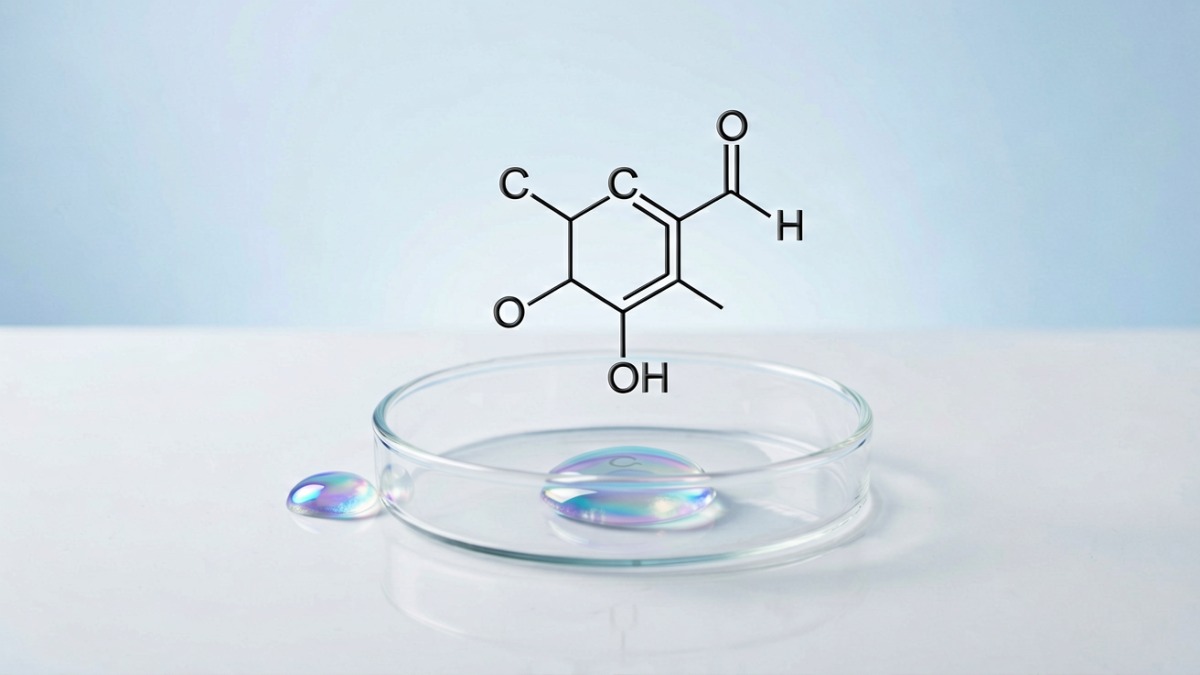
Thiamidol (Isobutylamido Thiazolyl Resorcinol; CAS 1428450-95-6) changed this paradigm entirely. Developed by Beiersdorf AG over a decade-long discovery program and first reported in the Journal of Investigative Dermatology in 2018, Thiamidol is the first brightening active specifically designed and validated against recombinant human tyrosinase. It remains, as of 2026, the most potent hTyr inhibitor ever reported in the peer-reviewed literature.
The Discovery: Screening 50,000 Compounds Against Human Tyrosinase
The Beiersdorf research team, led by Dr. Ludger Kolbe, took an unconventional approach. Rather than testing compounds against mushroom tyrosinase — the industry standard for decades — they developed a high-throughput screening platform based on recombinant human tyrosinase expressed in HEK293 cells. This allowed them to measure inhibition against the enzyme that actually governs melanogenesis in human skin.
The team screened a library of 50,000 compounds, focusing on resorcinol derivatives with thiazole modifications. Structure-activity relationship (SAR) analysis revealed that the thiazole ring system, when coupled with specific substituents on the resorcinol core, dramatically enhanced binding affinity to the hTyr active site’s di-copper center. The optimal candidate — Isobutylamido Thiazolyl Resorcinol — demonstrated competitive inhibition kinetics with selectivity that dwarfed every previously known inhibitor.
Why Mushroom Tyrosinase Misleads: The Structural Gap
A critical insight from the Beiersdorf research explains why so many historical “tyrosinase inhibitors” underperform clinically. The human tyrosinase active site differs fundamentally from mushroom tyrosinase in the amino acid residues coordinating the catalytic copper ions and in the spatial architecture of the substrate-binding pocket. Critical residues that Thiamidol engages for high-affinity binding — including specific hydrogen-bonding partners for the isobutylamido side chain — are absent or repositioned in mushroom tyrosinase.
This means that compounds like kojic acid and arbutin, which show reasonable IC50 values against mTyr, are dramatically weaker against the human enzyme. Conversely, Thiamidol — optimized against hTyr from the start — achieves its true potency only when measured against the correct biological target. The lesson for the field is unambiguous: human tyrosinase inhibition data, not mushroom enzyme data, should be the standard for brightening active validation.
Potency Benchmarks: Thiamidol vs. Established Brightening Agents
The published IC50 data places Thiamidol in a class of its own. Against recombinant human tyrosinase, Thiamidol achieves an IC50 of approximately 1.1 μM — making it roughly 20 times more potent than 4-butylresorcinol (~21 μM), 120 times more potent than phenylethyl resorcinol/SymWhite 377 (~131 μM), 455 times more potent than kojic acid (~500 μM), and over 900 times more potent than alpha-arbutin (>1,000 μM). Even compared to the prescription benchmark hydroquinone (~80 μM), Thiamidol demonstrates an approximately 73-fold potency advantage.
These figures represent human enzyme inhibition specifically. The rank ordering changes dramatically when measured against mushroom tyrosinase — which is precisely why so many historical actives appeared competitive in the literature but show modest clinical results.
Clinical Evidence: Melasma, PIH, and Solar Lentigines
Melasma: Split-Face Randomized Controlled Data
The most clinically significant evidence for Thiamidol comes from studies in melasma — a notoriously treatment-resistant hyperpigmentary disorder. In a randomized, vehicle-controlled split-face protocol, participants with moderate-to-severe facial melasma applied 0.2% Thiamidol formulations to one side of the face and vehicle control to the other. Assessment employed both Mexameter MX 18 melanin index measurements and clinical grading via the modified Melasma Area and Severity Index (mMASI).
Results showed statistically significant reductions in melanin index on the Thiamidol-treated side versus vehicle starting at week 4, with progressive improvement through week 12. mMASI scores demonstrated mean reductions exceeding 40% from baseline in the active treatment group. These results are particularly notable given melasma’s reputation for treatment resistance and frequent relapse.
Post-Inflammatory Hyperpigmentation: 12-Week Efficacy Data
Post-inflammatory hyperpigmentation (PIH) — a common sequela of acne, trauma, and dermatologic procedures — represents a distinct challenge from melasma. A 12-week open-label study evaluated 0.2% Thiamidol applied twice daily to PIH lesions. Assessments used chromametry and standardized cross-polarized digital photography at weeks 4, 8, and 12.
Statistically significant lightening of PIH lesions was observed as early as week 4, with continued improvement through the study endpoint. By week 12, over 70% of participants demonstrated visible improvement in hyperpigmented lesions, with chromameter L* values (quantitative skin lightness) increasing significantly from baseline. Critically, no paradoxical hyperpigmentation or irritation-related worsening was observed — an important safety consideration in PIH management.
Solar Lentigines (Age Spots): Clinical Lightening Data
Clinical evaluation for solar lentigines followed a parallel 12-week protocol. Instrumental assessments demonstrated progressive lightening of target lesions, with digital image analysis confirming melanin signal reduction. Combined with broad-spectrum photoprotection, effects were amplified — consistent with the mechanistic expectation that ongoing UV-driven melanogenesis competes with tyrosinase inhibition. This underscores the essential role of daily sunscreen as a co-intervention in any brightening regimen.
Safety and Tolerability: A Favorable Profile for Long-Term Use
Across all published clinical studies, Thiamidol at 0.2% demonstrates an excellent safety profile. Adverse events are limited to mild, transient erythema in a minority of subjects — comparable to or below the irritation profile of benchmark brightening agents. Unlike hydroquinone, Thiamidol does not pose a risk of exogenous ochronosis with prolonged application. Unlike high-concentration retinoids, it does not induce significant barrier disruption or retinoid dermatitis.
This favorable tolerability makes Thiamidol suitable for long-term maintenance therapy — a critical consideration given that melasma and solar lentigines require sustained management rather than short-course intervention. No phototoxicity or photosensitization has been reported, though concurrent broad-spectrum sunscreen remains universally recommended in hyperpigmentation management protocols.
Comparative Positioning: Where Thiamidol Fits
Thiamidol occupies a unique position among topical brightening actives. Versus hydroquinone, it offers comparable or superior clinical efficacy without the safety baggage of cytotoxicity and ochronosis risk. Against 4-butylresorcinol — previously considered the most potent resorcinol derivative — Thiamidol shows approximately 20-fold stronger hTyr inhibition. Compared to kojic acid, the potency advantage exceeds 450-fold, with dramatically better oxidative stability.
Perhaps most strategically, Thiamidol can be combined with mechanistically complementary actives. Tranexamic acid targets upstream plasmin-mediated pathways; niacinamide reduces melanosome transfer; antioxidants neutralize UV-induced oxidative triggers. A multi-pathway protocol anchored by Thiamidol’s direct tyrosinase inhibition represents the current state of the art in topical hyperpigmentation management.
Formulation Science: Stability, Delivery, and pH Optimization
Thiamidol presents specific formulation challenges. Its limited aqueous solubility requires appropriate solvent systems — glycol-based carriers or liposomal encapsulation strategies — to achieve effective epidermal delivery to basal layer melanocytes. The resorcinol core is susceptible to oxidation, necessitating robust antioxidant systems and oxygen-barrier packaging. Optimal pH stability falls within the 5.0–6.5 range. Penetration enhancement through ethoxydiglycol or lipid-based delivery systems can meaningfully impact clinical outcomes.
These formulation requirements are non-trivial but well-characterized. Products containing Thiamidol should be packaged in airless, opaque containers to protect against both oxygen and UV-induced degradation throughout the product shelf life.
Regulatory Landscape and Market Availability
As of 2026, Thiamidol remains under patent protection by Beiersdorf AG (CN105007991A and international equivalents). It is commercially available through Beiersdorf brands — notably the Eucerin Anti-Pigment line and Nivea Luminous series — in select markets. Thiamidol has been notified under EU Cosmetics Regulation (EC) No. 1223/2009 and is available across multiple Asian and European markets. In China, Thiamidol has not yet been listed in the official cosmetic whitening agent inventory as of 2026, limiting domestic availability.
Conclusion: A New Standard for Tyrosinase Inhibition
Thiamidol represents a genuine paradigm shift in brightening active development — not an incremental improvement on existing resorcinol derivatives, but a fundamentally different approach grounded in human enzyme biology. Its unprecedented potency against human tyrosinase, substantiated by methodologically rigorous clinical evidence across melasma, PIH, and solar lentigines, positions it as the benchmark against which future tyrosinase inhibitors should be measured.
For researchers and formulators, Thiamidol validates the hTyr-based screening paradigm and sets a new standard: not mushroom-data potency claims, but human-enzyme-validated, clinically proven efficacy. The era of mushroom tyrosinase as a screening surrogate is drawing to a close — and Thiamidol is the molecule that closed the door.
References
- Kolbe L, Mann T, Gerwat W, et al. 4-(4-Hydroxyphenyl)-2-aminothiazole derivatives as highly potent inhibitors of human tyrosinase. Journal of Investigative Dermatology. 2018;138(5):S145.
- Mann T, Gerwat W, Batzer J, et al. Inhibition of human tyrosinase requires molecular motifs distinctively different from mushroom tyrosinase. Journal of Investigative Dermatology. 2018;138(7):1601-1608.
- Roggenkamp D, Sander M, Kolbe L, et al. Effective reduction of post-inflammatory hyperpigmentation with the tyrosinase inhibitor thiamidol. Journal of the European Academy of Dermatology and Venereology. 2020;34(Suppl 4):3-50.
- Philipp-Dormston WG, Kerscher M, Sander M, et al. Thiamidol-containing treatment regimens in facial hyperpigmentation: an international, multi-center, observational study. JEADV. 2021;35(3):e214-e216.
- Arrowitz C, Schoelermann AM, Mann T, et al. Effective tyrosinase inhibition by thiamidol results in significant improvement of mild to moderate melasma. Journal of Investigative Dermatology. 2019;139(9):S256.
- Beiersdorf AG. Isobutylamido thiazolyl resorcinol: patent CN105007991A. Filed 2013, granted 2017.
Interested in Formulation Data Collaboration?
Let's discuss how Melasyl AI can accelerate your next whitening or brightening formula. Technical collaboration, data licensing, or custom AI-driven research — reach out.
Contact Wei →