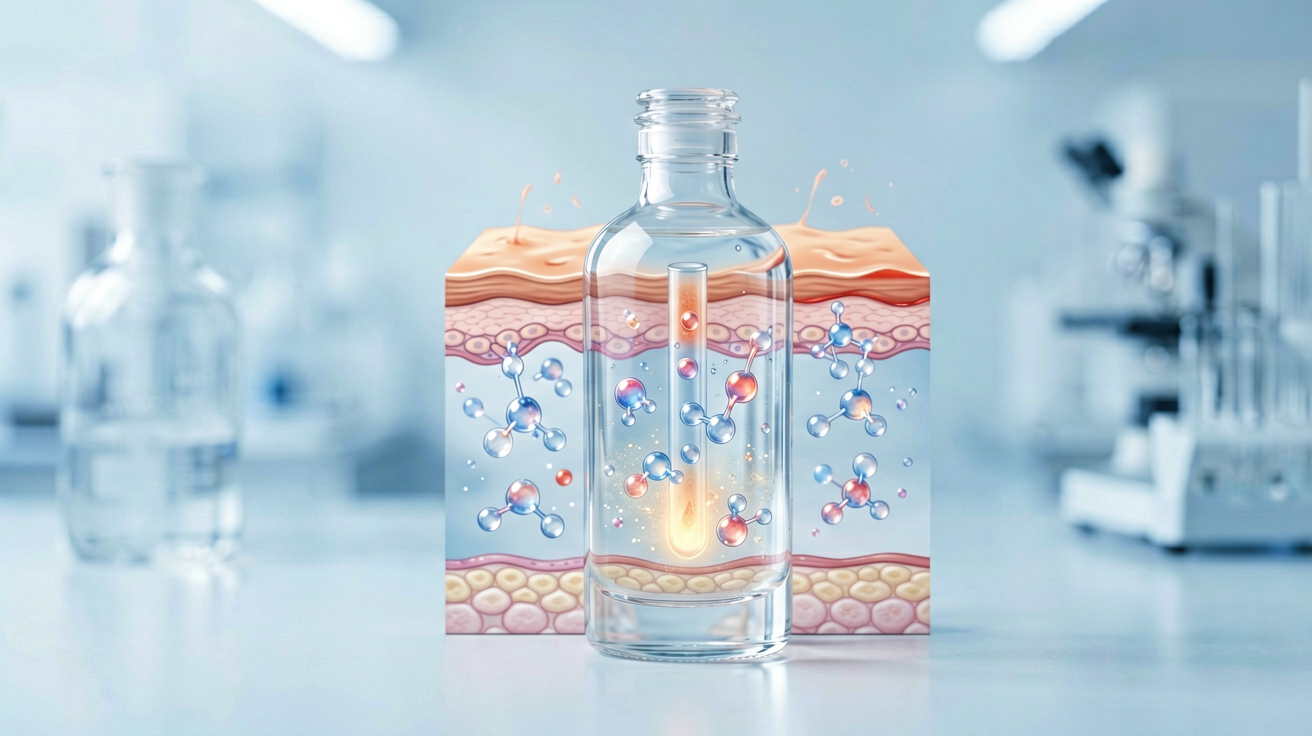
Why Penetration Enhancers Make or Break Depigmentation Actives: A Formulation Reality Check
If you have spent any time staring at ingredient lists on brightening serums, you have probably fallen into the same trap most consumers and even many formulators fall into: judging a product by what is inside the bottle rather than what actually reaches your melanocytes. Penetration enhancers make or break depigmentation actives — and yet they remain the most overlooked variable in skincare formulation, barely discussed on product pages that would rather boast about 10% niacinamide or 5% tranexamic acid.
The Barrier Most Formulations Never Really Cross
The stratum corneum is not a passive sponge. It is a 10–20 μm lipid-rich fortress composed of corneocytes embedded in a multilamellar lipid matrix — the famous “brick and mortar” architecture first described by Peter Elias. Its evolutionary purpose is to keep things out. That includes your carefully formulated brightening serum.
For an active ingredient to inhibit tyrosinase inside melanocytes, it must first traverse the stratum corneum, navigate the viable epidermis, cross the dermo-epidermal junction, and accumulate at sufficient concentration in the basal layer. This is not a trivial journey. The well-established “500 Dalton rule” tells us that molecules above roughly 500 Da face exponentially increasing resistance to passive percutaneous absorption. Niacinamide (122 Da) glides through. Ascorbic acid (176 Da) has a chance — if it is not oxidized before it even leaves the bottle. But the stabilized ascorbyl glucoside (338 Da), tetrahexyldecyl ascorbate (THD ascorbate), or the increasingly popular peptide-based brighteners? Their molecular weights push upward of 400–800 Da, and without penetration enhancement, their transepidermal flux drops to near-zero.
Why “Percentage” Marketing Is a Distraction
Brands have trained consumers to shop by percentages: 10% niacinamide, 20% vitamin C, 2% alpha arbutin. Higher numbers sell. But a 2% kojic acid formulation paired with a well-designed penetration enhancement system will consistently outperform a 10% arbutin serum suspended in a carbomer gel base that never leaves the stratum corneum. The percentage on the label tells you nothing about the concentration at the target site. It is a bioavailability problem — the same principle that makes oral drugs more complex than simply swallowing pure API powder.
Consider this: multiple Franz diffusion cell studies have demonstrated that liposomal encapsulation can increase epidermal deposition of ascorbic acid by 200–300% compared to an equivalent free-form solution. The active molecule is identical. The dose at the bottle is identical. The only variable is whether the delivery vehicle actually carries it through the barrier.
Chemical Penetration Enhancers: The Workhorses Nobody Talks About
This is where penetration enhancers make or break depigmentation actives in the most literal sense. Chemical penetration enhancers work through several mechanisms: disrupting the highly ordered intercellular lipid lamellae, increasing fluidity of stratum corneum lipids, altering keratin conformation to open the intracellular pathway, or simply improving partitioning of the active from the vehicle into the skin.
Glycols — propylene glycol, butylene glycol, ethoxydiglycol — are the most common and perhaps the most underappreciated class. Ethoxydiglycol in particular has demonstrated remarkable ability to enhance penetration of both hydrophilic and lipophilic actives by transiently fluidizing stratum corneum lipids without causing irreversible barrier damage. Dimethyl isosorbide (DMI) is another potent solvent-penetration enhancer that often goes unmentioned in consumer-facing marketing because it lacks the glamour of a botanical extract.
The catch: penetration enhancement is a double-edged sword. The same mechanism that drives your tyrosinase inhibitor deeper into the skin can also drive irritants, preservatives, and formulation byproducts deeper. This is why many brands default to conservative, low-penetration vehicles: they are safer, more tolerant of formulation sloppiness, and produce fewer adverse event reports. But they also produce fewer results.
Vesicular Delivery: Liposomes, Ethosomes, and the Bioavailability Revolution
Vesicular delivery systems — liposomes, niosomes, ethosomes, transferosomes — represent the most sophisticated approach to solving the penetration problem. Phospholipid-based liposomes form bilayered vesicles 50–500 nm in diameter that can encapsulate both water-soluble actives (in the aqueous core) and lipid-soluble actives (within the bilayer membrane). Their phospholipid composition mimics the skin’s own lipid matrix, allowing them to fuse with stratum corneum lipids and deposit their payload into deeper layers.
Ethosomes take this further by incorporating ethanol (20–45%), which increases vesicle deformability and allows them to squeeze through intercellular channels far narrower than their own diameter. Research published in the Journal of Controlled Release and International Journal of Pharmaceutics has repeatedly shown ethosomal systems achieving 3–5× higher dermal drug deposition compared to conventional hydroalcoholic solutions.
The uncomfortable truth: most brightening serums on the market use penetration enhancers at concentrations that improve product texture and drying time — not at concentrations optimized for transdermal delivery of the active. The difference between a cosmetic chemist who understands percutaneous absorption kinetics and one who does not is the difference between a product that feels nice and a product that actually works.
What Actually Determines Efficacy: A Formulation Hierarchy
After years of analyzing brightening formulations and their clinical outcomes, a clear hierarchy of what matters emerges:
- Delivery system > active concentration. A 2% active delivered to the basal layer beats 10% trapped in the stratum corneum.
- Penetration enhancer selection > active selection. Two different actives delivered efficiently outperform one “gold standard” active that never arrives.
- Vehicle pH and ionization state > percentage claims. Many actives — especially phenolic tyrosinase inhibitors like arbutin and kojic acid — exist in pH-dependent ionization equilibria. The unionized form penetrates; the ionized form does not. A formula at pH 5.5 may deliver dramatically more active than the same formula at pH 7.0.
- Synergistic penetration pairs matter. Combining a chemical enhancer (e.g., ethoxydiglycol) with a vesicular carrier (e.g., liposomes) often produces additive or synergistic enhancement, as the chemical enhancer pre-disrupts the lipid barrier while vesicles carry the encapsulated payload through the already-fluidized channels.
The Bottom Line
The skincare industry has spent two decades obsessing over which active ingredient is the “best” tyrosinase inhibitor — arbutin versus kojic acid, niacinamide versus tranexamic acid, ascorbic acid versus its derivatives. This obsession has produced an endless cycle of hero-ingredient marketing while the real determinant of efficacy — whether the active actually reaches melanocytes at therapeutic concentrations — goes underdiscussed, under-researched in consumer-facing contexts, and underutilized in formulation strategy.
If you are evaluating a brightening product, stop asking “what percentage is the active” and start asking “what penetration enhancement system is in the vehicle.” The former is a number on a label. The latter is whether the product works at all.
Published by Melasyl Skin Tech Lab — Research Blog. Based on analysis of peer-reviewed transdermal delivery literature and cosmetic formulation science.
Interested in Formulation Data Collaboration?
Let's discuss how Melasyl AI can accelerate your next whitening or brightening formula. Technical collaboration, data licensing, or custom AI-driven research — reach out.
Contact Wei →